
Listen to article – This audio is generated by AI
SEO for manufacturing companies is the process of improving a manufacturer’s visibility in search engines to attract qualified buyers and generate more valuable inquiries and RFQs.
The key phrase here? Manufacturing SEO.
When we talk about SEO for industrial companies, we’re talking about a completely different approach from traditional B2C SEO. Manufacturing buyers often use highly technical and specialized search terms, navigate longer sales cycles, and rely on low-volume searches that carry high commercial intent.
You don’t want a generic strategy; you want one that caters to the specific needs of the manufacturing industry. Keep reading to learn more about the unique search behaviors and digital needs of this industry and how to build a strategy that drives RFQs.
What Is Manufacturing SEO?
Manufacturing SEO is a specialized approach to search engine optimization that connects manufacturers with industrial buyers searching online for products, capabilities, materials, and suppliers. It focuses on making relevant technical and commercial information easy to find throughout the buyer’s research and decision-making process.
Manufacturing SEO vs. Traditional SEO
Rather than just telling you that manufacturing SEO differs from traditional SEO, let’s take a closer look at what sets them apart:
| Area | Manufacturing SEO | Traditional SEO |
| Target audience | Engineers, procurement teams, distributors, and industrial decision-makers | General consumers or broader business audiences |
| Search behavior | Highly technical, specific, and often low-volume searches | Often broader, higher-volume searches |
| Keyword focus | Products, capabilities, materials, specifications, applications, certifications, and suppliers | Products, services, informational topics, and common customer needs |
| Buying cycle | Typically longer and may involve multiple stakeholders | Often shorter with fewer decision-makers |
| Content needs | Technical guides, specifications, comparisons, case studies, and quality information | Educational articles, product content, guides, and promotional content |
Why SEO for Manufacturing Companies Requires a Different Strategy
Building on the previous section, let’s take this a step further by exploring the specific requirements of SEO for the manufacturing industry.
The Buying Journey Is Longer Than One Google Search
B2B sales cycles are typically more complex than B2C sales cycles. In B2C, a customer may perform one search, click on a link, and make an immediate purchase.
For B2B, purchases tend to involve higher costs, greater complexity, and more research before a decision is made. For instance, a prospect might discover a manufacturer through an educational article but return later through a capability page, case study, branded search, or product page before submitting an RFQ.
In other words, the path from search to sale is rarely immediate. And with B2B buying committees averaging 17 stakeholders, manufacturers may need to reach professionals with different priorities at different stages of the buying journey. This makes matching search intent with the right content and page type critical.
Industrial Searches Are Often Technical and Specific
In manufacturing SEO, higher search volume doesn’t always mean higher value. Industrial buyers often use increasingly specific searches as they narrow down their requirements.
For example:
CNC machining → 5-axis CNC machining → aluminum 5-axis CNC machining → aerospace 5-axis CNC machining → AS9100 CNC machining supplier
While broader terms may attract more searches, specific terms can signal stronger commercial intent. That’s why manufacturers should look beyond search volume and target keywords that reflect the processes, materials, specifications, and requirements of potential buyers.
Different Stakeholders Search Differently
As mentioned, B2B buying committees include an average of 17 stakeholders. However, that doesn’t mean everyone searches the same way. Each stakeholder has different priorities, which can influence the terms they use and the information they look for.
While this varies by company, here’s an example of what that might look like:
| Stakeholder | What they may care about | Example search behavior |
| Engineer | Materials, tolerances, technical feasibility | “tight tolerance aluminum CNC machining” |
| Procurement team | Suppliers, certifications, pricing, lead times | “ISO-certified CNC machining supplier” |
| Operations | Capacity, reliability, scalability | “high-volume CNC machining company” |
| Business leader | Risk, capabilities, strategic fit | “aerospace contract manufacturing company” |
Understanding these differences helps manufacturers target multiple search intents rather than optimizing for a single type of buyer.
How Do You Build a Manufacturing SEO Strategy That Drives RFQs?
If you’re interested in learning about SEO strategies for manufacturers, this is the section you’re looking for. Below, you’ll find a detailed explanation of each step in the manufacturing SEO-to-RFQ framework.
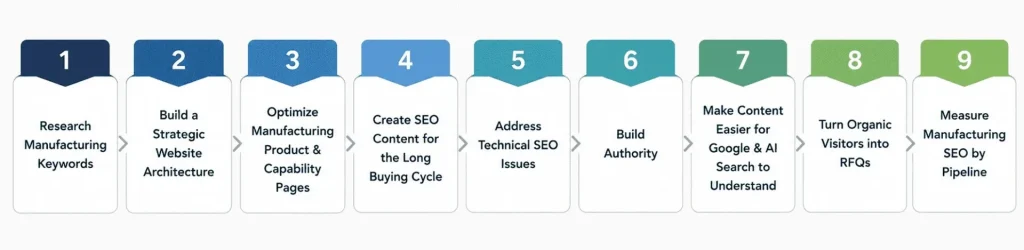
1. Research Manufacturing Keywords Around How Buyers Actually Search
Scratch surface-level keywords and focus on specific, high-intent search terms. The risk of choosing keywords based on high search volume alone is that you may get lost in the competition or target terms that don’t reflect what your actual buyers are searching for.
For instance, there’s a big difference between “plastic manufacturing” and “ISO 13485 medical plastic manufacturer.” The first is broad and could reflect many different search intents, while the second reveals much more about the buyer’s specific requirements.
SEO for industrial manufacturing should instead focus on building keyword groups around:
- Product names and product categories
- Manufacturing processes and capabilities
- Materials
- Part types and technical specifications
- Applications and problems solved
- Industries served
- Location and service-area terms when relevant
- Questions asked by engineers, procurement teams, distributors, and buyers
- High-intent terms related to suppliers, quotes, pricing, lead times, custom orders, and RFQs
Use the following examples to better understand how this may look:
| Keyword type | Example search pattern | Intent | Best page type |
| Product | custom stainless steel components | Commercial | Product/category page |
| Capability | precision CNC machining services | Commercial | Capability page |
| Application | components for medical devices | Commercial/informational | Application page |
| Industry | contract manufacturing for aerospace | Commercial | Industry page |
| Question | how to choose a contract manufacturer | Informational | Blog/resource |
| Specification | ISO-certified plastic manufacturer | High intent | Capability or trust page |
Use Real Buyer Language as Keyword Research
Your customers and competitors can also be valuable sources of keyword ideas. Review sales conversations, RFQs, customer questions, site-search data, Search Console queries, product documentation, competitor SERPs, and discussions with engineers or product specialists to see how buyers describe their needs.
This is important because the terminology your team uses internally may not always match the language buyers type into search engines. Using real buyer language can help you uncover relevant keywords that traditional keyword research might miss.
2. Build a Website Architecture Around Products, Capabilities, and Applications
You don’t want just a few great blog posts; you need well-crafted product, capability, application, and industry pages supported by relevant resources. And the information across these pages shouldn’t just be high quality; it should also be accurate and consistent.
With 69% of B2B buyers reporting inconsistencies between information on company websites and information provided by sellers, it’s clear that disconnected messaging can create confusion and affect trust.
Instead, every type of page should have a clear role in your manufacturing SEO strategy, as shown below.
| Page type | Role in manufacturing SEO |
| Product and product-category pages | Target searches for specific products and product groups |
| Capability and service pages | Showcase the manufacturing processes and services you provide |
| Application and use-case pages | Connect your offerings to specific problems and applications |
| Industry pages | Demonstrate relevance within specific sectors |
| Materials pages | Address searches related to the materials you work with |
| Location pages | Capture geographically relevant searches when appropriate |
| Case studies | Provide evidence of capabilities and results |
| Technical resources | Answer detailed questions and support buyer research |
| Comparison and selection content | Help buyers evaluate products, materials, or processes |
| FAQs and educational articles | Answer common questions and capture informational searches |
3. OptimizeManufacturing Product and Capability Pages for Search and Buyers
It isn’t enough to simply have the right pages. To truly master SEO for manufacturing companies, SEO landing pages should be optimized for both search engines and the buyers evaluating your capabilities.
Focus on:
- Unique descriptions: Avoid duplicating manufacturer, supplier, or generic copy across pages.
- Crawlable specifications: Present important technical specifications in HTML rather than hiding them only in PDFs, images, or other formats search engines may struggle to interpret.
- Clear page structure: Use descriptive titles, headings, and copy that clearly communicate what the page offers.
- Useful supporting content: Include relevant images, diagrams, tables, downloadable resources, and FAQs.
- Strategic internal links: Connect related products, capabilities, applications, industries, and technical resources.
- Clear conversion paths: Make RFQ forms and contact options easy for qualified buyers to find.
- Buyer-focused terminology: Maintain technical accuracy while incorporating the language your potential buyers actually use in search.
4. Create SEO Content for the Long Manufacturing Buying Cycle
As mentioned, B2B buying cycles are often longer and more complex than typical consumer purchases. As such, SEO content for manufacturers should meet buyers wherever they are in their research journey.
This means creating content for different stages, including problem awareness, process and material research, supplier evaluation, technical comparison, risk reduction, and the final RFQ or sales conversation.
Common manufacturing content includes process explainers, material comparisons, tolerance and specification guides, design-for-manufacturability content, supplier-selection guides, industry-specific use cases, case studies, certification and quality-control explanations, and technical FAQs.
Here’s what that might look like in practice:
Problem awareness → Process explainers and educational guides
Technical research → Material, tolerance, and specification guides
Supplier evaluation → Supplier-selection guides and capability pages
Technical comparison → Material, process, and solution comparisons
Risk reduction → Case studies, certification, and quality-control content
Decision → Product, capability, contact, and RFQ pages
The Valuable SEO Content You May Already Have
As companies start putting together their strategy, they may wonder, “How are we supposed to create all this content, and when?”
Before creating completely new assets, we recommend looking at what you already have. Manufacturing companies often have valuable technical information that can be repurposed into search-friendly content.
That PDF with your product specifications? Use the information to strengthen your product pages.
That report showcasing impressive results? Turn it into a case study.
Those internal resources explaining manufacturing processes? Transform them into an instructional how-to guide.
All this to say, you may already have valuable SEO content hiding in your PDFs, reports, product documentation, sales materials, and internal resources. Start there before creating everything from scratch.
5. Address Technical SEO Issues That Can Hide Manufacturing Content
Even high-quality content won’t deliver its full value if search engines can’t properly crawl, understand, or index it.
This is especially important for manufacturing websites, which may have large product catalogs, technical specifications, filtering systems, and downloadable resources that create additional complexity.
Common SEO mistakes that can affect SEO for manufacturing companies include:
- Unclear or overly deep site architecture
- Duplicate or thin product pages
- JavaScript-dependent specifications
- Uncrawlable tables or product information
- Duplicate information across PDFs and HTML pages
- Poor internal linking
- Faceted navigation and filter URLs
- Discontinued product pages
- International or multilingual SEO issues
- Slow, image-heavy pages
- Incorrect canonicalization
- Indexing problems affecting product and capability pages
The goal isn’t simply to fix technical errors. It’s to make sure your most valuable product, capability, and technical information is accessible to both search engines and potential buyers.
6. Build Authority with Evidence Industrial Buyers Actually Care About
Your potential clients don’t just want generic marketing claims. They need real indicators of expertise and credibility that give them confidence in your company. Depending on your business, relevant trust signals may include:
- Certifications
- Materials and processes supported
- Equipment and production capabilities
- Quality-control procedures
- Technical expertise
- Industries served
- Facility or production information
- Case studies and measurable outcomes
- Author or reviewer expertise
One way to strengthen these signals is to make your expertise visible in your content. When publishing technical resources, have engineers, technical specialists, product experts, or other subject matter experts review the information for accuracy.
At Scopic Studios, we apply the same principle to our own content. For example, when we publish an article about SEO, our SEO specialists review the content before publication and are listed as expert reviewers. At the top of this article, you’ll see “Reviewed by Sonja Somborac.” Clicking on her name lets readers learn more about her professional background and expertise.
Build External Authority Through Relevant Backlinks
Backlinks from relevant, reputable websites can also strengthen your manufacturing SEO strategy. Look for opportunities to earn links from industry associations, trade publications, suppliers and partners, manufacturing directories, and local or regional organizations.
You can also create original technical resources, research, or industry data that other websites may naturally reference and link to.
Fun fact: B2B SEO statistics show that 70% of top performers highlight specialized industry knowledge as central to their success.
7. Make Manufacturing Content Easier for Google and AI Search to Understand
In the past, the primary focus was getting your content to rank in traditional search results.
Now? AI-driven search experiences are also interpreting content to determine which sources and information to surface in AI-generated answers.
Fortunately, many strategies that support traditional SEO can also make your content easier for AI systems to understand and reference. Here are some tips to consider:
- Answer important questions directly before expanding
- Use descriptive headings
- Clearly identify products, processes, materials, industries, and applications
- Use comparison/mapping tables where useful
- Add appropriate structured data/schema
- Include original examples and expert insight
- Cite reliable external sources for factual/statistical claims
- Keep important information in accessible HTML
- Create clear relationships between product, capability, application, industry, and resource pages
- Keep technical information accurate and current
Need help adapting your content for AI-driven search? With our GEO services, you can strengthen how your brand and expertise are represented across AI search platforms while complementing your broader SEO strategy.
8. Turn Organic Visitors into RFQs
Ranking is important, but the true test of SEO for manufacturers is whether that visibility brings qualified visitors to your website and moves them toward a desired action.
For this to happen, we recommend creating clear conversion paths. Here’s what that might look like:
Technical article → Capability page → Case study → RFQ
Material page → Relevant products → Technical specifications → RFQ
Industry page → Applicable capabilities → Proof/case study → Contact
Remember, SEO doesn’t end when a visitor lands on your page. Your website should be structured in a way that encourages the next step.
This includes contextual CTAs, easy-to-find RFQ buttons, clear contact options, links from informational to commercial content, relevant proof near conversion points, and RFQ forms that gather useful information without creating unnecessary friction.
This is also where SEO and lead generation services can work together, helping turn organic visibility into qualified sales opportunities.
9. Measure Manufacturing SEO by Pipeline, Not Traffic Alone
Ranking #1 for a high-volume keyword isn’t necessarily a win if the visitors aren’t potential buyers. A successful manufacturing SEO strategy should measure performance against business outcomes, not just rankings, clicks, and traffic.
Depending on your goals and tracking capabilities, useful KPIs may include:
- Qualified organic inquiries
- RFQ submissions
- Sales calls and conversations
- Product and capability page engagement
- Assisted conversions
- Target-account visits, where measurable
- Organic leads by product, capability, or industry
- Qualified pipeline influenced by organic search
- Non-branded commercial keyword visibility
- Conversions assisted by technical resources
Manufacturing SEO Strategy: Putting It All Together
While every manufacturer has different products, buyers, and goals, effective strategies often follow a similar path:
Industrial buyer intent → keyword cluster → correct page type → supporting content → internal links → RFQ path → measurement
In practice, that means understanding what your buyers search for, grouping those searches by intent, and creating the right commercial pages to meet their needs. From there, support those pages with valuable technical content, connect related information through internal links, and provide a logical path toward an RFQ.
And don’t forget to measure whether that visibility is contributing to meaningful business opportunities. This helps you understand what’s working, identify areas for improvement, and adjust your strategy accordingly.
If you don’t have the resources to manage these steps internally, working with a manufacturing SEO company can help you develop and execute a strategy around your specific goals.
Final Thoughts
We now know that SEO for manufacturing companies requires a different approach from B2C SEO. Rather than simply attracting more traffic, the goal is to be discoverable by the right people, including engineers, procurement teams, and other decision-makers searching for products, capabilities, specifications, and suppliers.
At Scopic Studios, we create custom SEO strategies tailored to your industry, audience, and business goals. With our SEO services, we help businesses strengthen their search visibility, reach qualified prospects, and turn organic traffic into meaningful business opportunities.
FAQs About SEO for Manufacturing Companies
Why is SEO important for manufacturers?
SEO helps manufacturers become visible when potential buyers are researching products, capabilities, and suppliers online. It also helps companies capture qualified demand beyond traditional channels like referrals, distributors, trade shows, and outbound sales.
How is manufacturing SEO different from traditional SEO?
Manufacturing SEO focuses on technical searches, niche but high-value keywords, and longer buying cycles involving multiple stakeholders. Rather than driving quick purchases, it often aims to attract qualified buyers and move them toward an inquiry or RFQ.
What are the best keywords for manufacturing companies?
The best keywords are those that reflect how your target buyers actually search. This often includes specific terms around products, manufacturing processes, materials, applications, industries, technical requirements, and high-intent searches related to suppliers, pricing, or quotes.
Should manufacturers focus on product pages or blog content for SEO?
Both play an important role. Product and capability pages typically form the foundation of manufacturing SEO, while blog content supports them by answering questions and reaching buyers earlier in their research.
About SEO for Manufacturing Companies Guide
This guide was authored by Baily Ramsey, and reviewed by Sonja Somborac, SEO Specialist at Scopic Studios.
Scopic Studios delivers exceptional and engaging content rooted in our expertise across marketing and creative services. Our team of talented writers and digital experts excel in transforming intricate concepts into captivating narratives tailored for diverse industries. We’re passionate about crafting content that not only resonates but also drives value across all digital platforms.