
Listen to article – This audio is generated by AI
It’s simple. Consumers turn to ChatGPT for answers. It was only a matter of time before businesses started looking for ways to reach the same audience.
And with ads coming to ChatGPT, our team knew we had to be among the early adopters to take advantage of this new advertising opportunity. So we put it to the test.
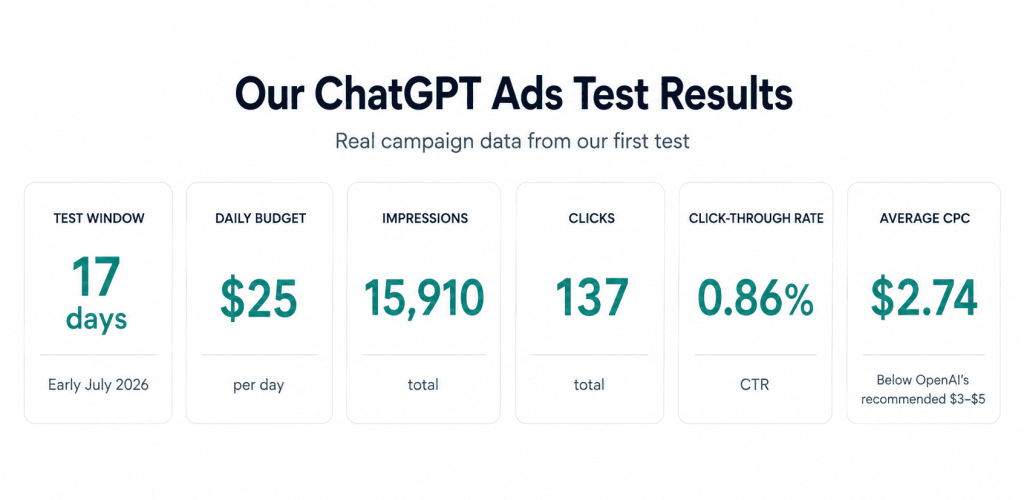
We ran a 17-day ChatGPT Ads campaign for one of our own products with a $25 daily budget. The results? We found that clicks were relatively affordable, the CTR was respectable for an emerging platform, and targeting required a different mindset than Google Ads.
Overall, the test generated promising traffic data, but it was too limited to establish long-term ROI.
And guess what? We’re not gatekeeping any of our findings.
Below, we break down exactly what our test showed, what we would do differently in our next campaign, and other important insights that could help your company prepare for ChatGPT Ads.
ChatGPT Ads in 2026: What Our Test Revealed
We’re not here to share made-up numbers or speculate what the results “should” look like. We’re discussing a real campaign for one of our own products, run for roughly two and a half weeks on a modest daily budget.
Overall, we were happy with the campaign’s cost efficiency, as our average CPC of $2.74 came in below OpenAI’s recommended bid range of $3 to $5. Our click-through rate was 0.86%, which is in line with the early benchmarks reported by third parties.
While the early results were promising, any company using this advertising platform for the first time will tell you that it’s a learning process. If they don’t, they may be overselling their expertise before they truly understand the platform.
That’s why we’re not afraid to share what we learned. Let’s take a look:
- Account structure is stricter than it is on Google. There is no MCC-style account, so each brand needs its own advertiser account with a unique name and logo. The name displayed in the ad comes from the account settings rather than the campaign. This means that if you advertise a product under a parent company’s account, the parent brand will appear in the ad.
- Verification can stop your campaign before you spend a dollar. Business verification is handled by a third party, and our verification initially failed because the website associated with the ad account did not match our legal business name. We were able to resolve the issue after submitting a support ticket, but you should expect some friction and prepare proof of domain ownership in advance if your landing page domain differs from your registered entity.
- Traffic is invisible in GA4 unless you track it intentionally. Without UTM parameters, ChatGPT ad traffic may be categorized as direct traffic in GA4, making it impossible to separate from other sources. Tag every ad URL from day one, or you could lose the ability to analyze on-site behavior, which is the part of the customer journey that the ad platform cannot show you.
- Budget floors make small tests expensive. The $25 daily minimum, combined with a $3 to $5 recommended bid, means that a genuine test costs real money. Smaller brands cannot test the waters cheaply, which affects which businesses this channel is realistically suited for… at least for now.
The Biggest Takeaway
Efficient traffic is not the same as proven traffic. The test showed that we can buy quality attention at a reasonable price. It did not show us what that attention is worth at the bottom of the funnel.
ChatGPT Ads Are Evolving Fast. Here’s Why That Matters
The question is quickly shifting from “can you advertise on ChatGPT?” to “how quickly can we get our ads up and running?”
And for good reason. This is a fast-moving platform, with things changing by the day, or at least that’s what it seems. What began with OpenAI testing ads inside ChatGPT in February 2026 quickly expanded to include a self-serve Ads Manager beta in May 2026, along with agency buying options.
Consider this: The platform launched with only Reach and Clicks objectives and no conversion optimization. This means you could pay for reach or clicks but could not optimize for leads. Within months, OpenAI added conversion tracking through its pixel and Conversions API, followed by conversion-optimized campaigns. Advertisers can now optimize for specific actions.
Other recent changes include larger ad formats, cost-per-action bidding, and broader availability.
All this is to say that this is an emerging channel worth watching. Not next year, now. This means it’s more important than ever to know how to run ads on ChatGPT.
As businesses pay closer attention to brand mentions in AI search, ads in ChatGPT offer a more direct way to appear in relevant conversations. They give advertisers access to a large, high-intent audience while giving early movers time to learn before the space gets crowded.
It should come as no surprise, then, that adoption is growing across SaaS, digital tools, marketing, and other service categories as access expands. Before launching your first campaign, however, it’s important to understand that ChatGPT Ads don’t work like traditional paid search.
How ChatGPT Ads Differ from Google Ads
If you’re used to Google Ads, ChatGPT Ads targeting requires a bit of a mindset shift. The platform works differently, which means marketers and companies need to rethink how they reach users, develop creative, and measure results.
In our test, the average CPC of $2.74 compared well with what advertisers typically pay for competitive marketing and agency keywords on Google. However, that doesn’t mean every campaign will see the same results. Costs will vary depending on your industry, strategy, and goals.
So, what else sets the two platforms apart? Here’s a quick comparison:
| Area | ChatGPT Ads | Google Ads |
| Targeting | Context hints and conversational intent | Keywords, audiences, and automated signals |
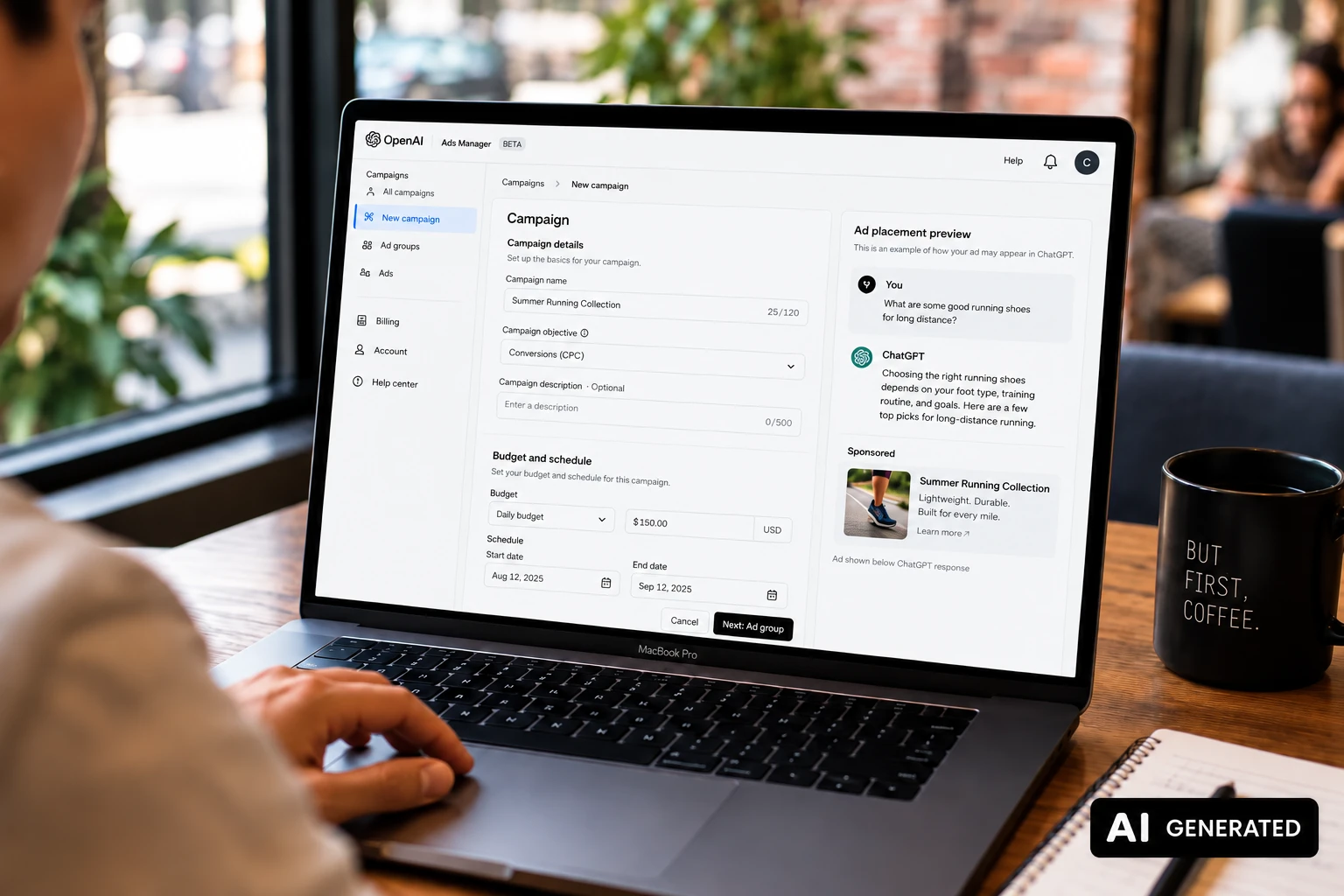
| Placement | Sponsored card below relevant answers | Search results and other Google channels |
| Audience | Eligible Free and Go users in select markets | Broad global audience |
| Creative | Short, benefit-focused copy | Multiple formats and asset combinations |
| Accounts | Separate account for each brand | Multiple accounts under one manager |
| Delivery | Quickly favors stronger creatives | Optimizes based on campaign type and goal |
| Reporting | Can lag by a few hours | Core metrics typically refresh hourly |
To better understand the differences, check out our blog on ChatGPT vs Google Ads.
Practical Tips for Running Ads in ChatGPT
As you’re learning how to run ads in ChatGPT, a few practical tips from our experience can help you get started:
Tip #1: Write context hints as if you were describing a conversation with your ideal customer rather than creating a keyword list.
Tip #2: Keep your creative short and lead with a concrete benefit.
Tip #3: Set up conversion tracking from day one using the pixel and Google Tag Manager. Even if you begin with a Clicks campaign, your data will be ready when you move to conversion optimization.
Tip #4: Add UTM parameters to every ad URL so you can identify ChatGPT traffic in GA4.
Tip #5: Start with a clear test budget and a fixed time frame. Then, account for the reporting lag before analyzing your results.
Tip #6: Run an AI visibility audit to see where your brand and competitors appear in AI-generated answers. Use those insights to identify relevant conversations and opportunities where ChatGPT Ads could support your organic visibility.
What We Would Do Differently Next Time:
As mentioned, this is a learning process. Our first test helped us refine our approach to ChatGPT optimization and identify ways to improve visibility over time.
Here’s what we learned:
- Start with the Conversions objective. For example, if your goal is to generate leads, select your lead-submission event as the conversion you want ChatGPT Ads to optimize for. Make sure conversion tracking is set up before creating the campaign, because you cannot change the selected objective or conversion event later.
- Test fewer ads with more distinct messaging. Instead of creating multiple ads that say essentially the same thing, test completely different value propositions to identify which messaging resonates most with ChatGPT users.
- Match each ad with a closely aligned landing page. Ensure your landing page delivers on the promise of the ad by reinforcing the same message, offer, or value proposition. Consistent messaging creates a smoother user experience and can improve conversion rates.
- Run the campaign long enough to collect meaningful conversion data. We recommend testing for at least 30 days with a budget that can generate enough conversions to evaluate performance confidently. Our 17-day test provided useful directional insights, but it wasn’t long enough to determine long-term ROI or fully optimize the campaign.
Final Thoughts
ChatGPT Ads are now a real advertising channel, even if the platform is still evolving. So, if you’re wondering, “Are ChatGPT Ads worth it?” the short answer is that they show promise for reaching a high-intent audience.
However, while our test showed that we could attract relevant traffic at a reasonable cost, it did not prove bottom-funnel ROI. Conversion optimization was not available during our test, but it is available now, making conversions the next key metric to test.
Results will vary from one company to another, but one thing is clear: this platform is moving fast. Getting started early gives you more time to learn, adapt, and build an advantage as it grows.
At Scopic Studios, we understand the importance of staying visible across different platforms. In addition to exploring ChatGPT Ads, we provide PPC and GEO services that help businesses connect with their audience across search and AI-powered experiences.
About Ads in ChatGPT Guide
This guide was authored by Baily Ramsey, and reviewed by Sonja Somborac, SEO Specialist at Scopic Studios.
Scopic Studios delivers exceptional and engaging content rooted in our expertise across marketing and creative services. Our team of talented writers and digital experts excel in transforming intricate concepts into captivating narratives tailored for diverse industries. We’re passionate about crafting content that not only resonates but also drives value across all digital platforms.