
This guide covers what customer lifecycle marketing means, the stages from onboarding to expansion, how marketing supports adoption, retention, and upsell at each one, where email, automation, content, and customer signals fit in, the gaps that most commonly break the lifecycle, and how to think about lifecycle marketing as an ongoing discipline rather than a series of one-off campaigns.
Quick answer: Customer lifecycle marketing means matching marketing activity to four stages after the sale, onboarding, activation and adoption, retention, and expansion, and triggering messages from real customer behavior instead of a fixed calendar. Most programs underperform not because of a missing channel, but because nobody owns the stages between the sale and the upsell.
What Is Customer Lifecycle Marketing (And What It Isn’t)
Customer lifecycle marketing is the practice of tailoring marketing activity to where a customer actually is in their relationship with your business, from the moment they onboard through the point where they might expand their spend, rather than treating every customer the same way regardless of tenure or usage.
Three terms get used almost interchangeably, and they shouldn’t be:
- Customer lifecycle marketing is the strategic discipline. It spans every channel and covers the full relationship.
- Lifecycle email marketing is one channel’s execution of that discipline, not the discipline itself. You can run great lifecycle emails inside a weak overall program, or a strong lifecycle program with very little email at all.
- Customer journey mapping is a research and visualization method, useful for understanding a customer’s path and pain points, but it’s an input into lifecycle marketing rather than a substitute for it.
5 to 25x. That’s how much more it costs to acquire a new customer than to keep one you already have, according to research popularized by Bain & Company and cited by Harvard Business Review. A 5% improvement in retention alone can lift profits by 25% to 95%.
That’s the entire business case for customer lifecycle marketing in one statistic. A business that markets seriously to the customers it already has isn’t just protecting revenue; it’s running one of the highest-return activities available to it.
Most lifecycle content stops at the sale, treating onboarding as an operations problem and everything after as customer success’s job. This guide treats onboarding, adoption, retention, and expansion as equally important, connected stages, because that’s closer to how customer relationships actually work.
The Customer Lifecycle Marketing Stages, From Onboarding to Expansion
A customer lifecycle technically begins earlier than this, with awareness and acquisition. This guide picks up at the point a prospect becomes a customer, since that’s where most marketing content, including a lot of what’s already out there, leaves off.
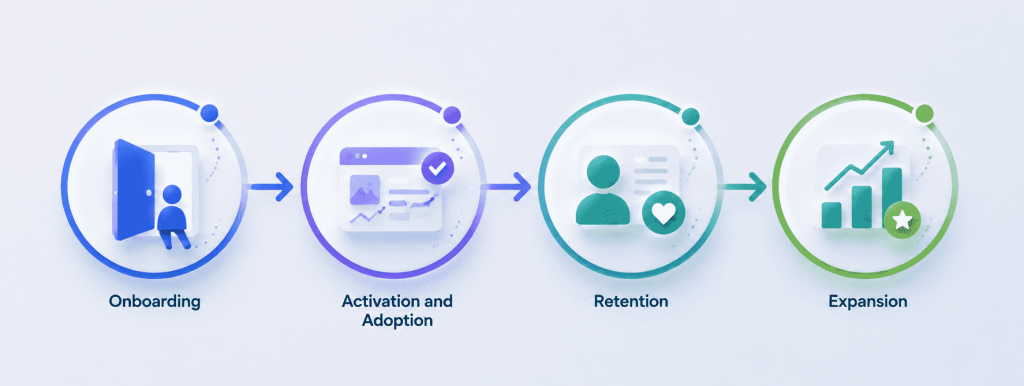
From there, the customer lifecycle marketing funnel breaks down into four core stages:
| Stage | What’s Happening | Marketing’s Goal |
| Onboarding | The period immediately after signup or the deal closing | A confident first experience and a clean handoff from sales |
| Activation and Adoption | The customer reaches a first real value moment and starts using the product or service regularly | Reinforce that value and build habitual use |
| Retention | The relationship is now stable and recurring | Sustained relevance and early detection of disengagement |
| Expansion | The customer is a strong candidate for upsell, cross-sell, or account growth | Surface the right moment and support the upsell conversation |
Here’s the part most frameworks leave out: these stages aren’t a one-way street. A customer can slide backward from retention toward disengagement just as easily as they can move forward toward expansion. That’s exactly why marketing’s job doesn’t end once a customer reaches “retained.” If you want to map your own lifecycle stage by stage in more visual detail, our roundup of customer journey mapping tools covers the leading platforms for that kind of work.
What Marketing Actually Does at Each Lifecycle Stage
Naming the stages is one thing. Knowing what marketing is actually responsible for at each one is what makes the framework useful.
Supporting Onboarding
The job: reinforce the decision, not just confirm the signup.
A short welcome sequence, clear next steps, and a fast route to the first meaningful action, not a single automated “thanks for signing up” email and then silence. This is also where a lot of programs quietly underperform. Research from Wyzowl has consistently found that more than 90% of customers feel companies could do a better job with onboarding, and weak onboarding is regularly cited as one of the top reasons new customers churn before they ever become long-term ones.
Driving Activation and Adoption
The job: turn a first login into a habit.
Marketing’s job shifts to use-case education: surfacing underused features or services relevant to what the customer has actually done so far. This works best when it’s triggered by behavior, a customer who’s used one feature but not a related one, say, rather than sent on a fixed calendar regardless of what the customer has actually done.
A simple example: if a customer has logged in and completed setup but hasn’t touched a core feature after two weeks, that’s a far more useful trigger for an educational email than “send everyone a feature tips email every Tuesday.” The first message is relevant to that specific customer’s stall point. The second is relevant to nobody in particular, and gets treated that way.
Sustaining Retention
The job: notice the quiet ones before they leave.
Ongoing relevance and early-warning detection: noticing drops in engagement or usage before they become cancellations, and delivering content or offers that remind a quiet customer why they signed up in the first place. This is also where a lot of programs go quiet entirely, on the assumption that a retained customer doesn’t need marketing anymore. For a deeper dive on keeping existing customers engaged over time, see our guide to repeat engagement marketing.
Driving Expansion
The job: make the upsell feel like the next logical step, not a pitch.
Surfacing expansion-relevant moments, a usage milestone, a plan limit, a new use case, and supporting sales or customer success with the messaging and content that make an upsell conversation feel natural rather than cold. For the specific tactics that turn this stage into revenue, from loyalty programs to data-driven upsell targeting, see our guide to post-sales marketing strategies for customer expansion.
How Email, Automation, Content, and Customer Signals Work Together
Each channel plays a specific role in marketing customer lifecycle programs. Confusing those roles, or collapsing all of them into one channel, is where most programs go wrong.
The Role of Email
Owns: direct, one-to-one communication.
Email remains the most direct, owned channel for lifecycle communication: welcome sequences, usage nudges, renewal and expansion prompts. It doesn’t depend on an algorithm, and the business already owns the list. That said, customer lifecycle email marketing is one execution channel within the broader discipline, not the whole thing. If email is your primary lifecycle channel and you need outside help executing it well, our roundup of B2B lifecycle email marketing agencies compares the leading specialists.
The Role of Automation
Owns: firing the right message at the right moment, without a human watching every account.
If you’re wondering how to automate customer lifecycle marketing at any scale beyond a handful of accounts, the answer is triggers, not calendars. Automation should fire from real behavior, a usage milestone, an inactivity streak, a plan limit, instead of a fixed send schedule that ignores what the customer has actually done. Once you understand that role, our guide to marketing automation tools can help you evaluate platforms.
The Role of Content
Owns: answering questions the customer hasn’t asked marketing yet.
Help documentation, use-case guides, onboarding walkthroughs, customer stories. Content does the ongoing education and confidence-building work that a single email can’t. It’s what a customer finds when they go looking for help between scheduled touchpoints, and its job is to be there when the customer needs it, not just when marketing decides to send something.
The Role of Customer Signals
Owns: telling the other three channels when to fire.
The inputs that should be triggering everything above:
- Usage data
- Support ticket volume
- Satisfaction scores (NPS or CSAT)
- Login or engagement frequency
You don’t need an enterprise customer data platform to start here; even a simple “flag accounts with declining usage” rule is customer-signal-driven lifecycle marketing. For readers who want to go deeper on the tooling behind these behavioral triggers, our guide to customer journey analytics tools is a good next stop.
6 Lifecycle Marketing Gaps That Quietly Kill Retention and Revenue
Most lifecycle programs don’t fail because a team picked the wrong channel. They fail because of a handful of recurring, avoidable gaps.
1. Onboarding treated as a single welcome email, instead of a stage with its own goals, content, and success criteria.
2. No clear owner for post-sale marketing. Communication quietly stops the moment a deal closes, and sales or customer success is left to handle everything alone.
3. Campaigns run on a fixed calendar instead of being triggered by real usage or behavioral signals, so messages arrive at the wrong moment, or not at all.
4. Retention and expansion treated as sales or customer-success responsibilities, with no marketing support, even though marketing often already has the content and channels needed to make both easier.
5. Lifecycle marketing collapsed into “email marketing,” so other channels go quiet after the sale even when they were active before it.
6. No feedback loop from support tickets, churn reasons, or satisfaction scores back into campaign messaging, so the same avoidable churn reasons keep recurring, unaddressed.
Notice what’s missing from that list: a wrong tool, or a wrong channel. Every one of these six is an ownership or process gap. Nobody defined the stage, nobody triggered the message from real behavior, or nobody closed the loop between what customers were telling the business and what marketing was actually sending them.
Expansion revenue now makes up 40% to 50% of new annual recurring revenue at many high-performing SaaS companies, according to analysis reported by SaaS Mag. A lifecycle program with no marketing support for retention or expansion isn’t just a customer experience gap. It’s leaving a substantial, quantifiable growth lever untouched.
If your team is still measuring lifecycle activity in opens and clicks rather than pipeline impact, our guide on how to tie marketing to pipeline and revenue is a useful next step.
Customer Lifecycle Marketing Strategy: Beyond One-Off Campaigns
A genuinely effective customer lifecycle marketing strategy starts with a mindset shift: lifecycle marketing isn’t a campaign type, it’s an operating model. A single well-timed onboarding sequence is a campaign. A system that automatically adjusts messaging based on what a customer has actually done is lifecycle marketing.
| Campaign Thinking | Lifecycle Thinking |
| Calendar-driven | Signal-triggered |
| One team’s initiative | Shared ownership across marketing, sales, and success |
| Measured by opens and clicks | Measured by stage progression and retention |
| Built once | Continuously adjusted as customer behavior changes |
Which One Are You? A 60-Second Maturity Check
- Ad hoc: Lifecycle communication happens inconsistently, mostly reactive, with no defined stages.
- Reactive: Basic automated sequences exist (a welcome email, a renewal reminder), but they don’t adjust based on behavior.
- Coordinated: Stages are defined, channels have clear roles, and marketing, sales, and customer success share visibility into where each customer stands.
- Predictive: Campaigns are triggered by real usage and engagement signals, and the team can spot at-risk or expansion-ready accounts before they self-identify.
No tool purchase is required to move from ad hoc to reactive, or from reactive to coordinated. That’s mostly a matter of defining stages and assigning ownership, the two things most teams skip.
What This Looks Like in Practice
Two customer lifecycle marketing examples that show the framework in action, not named case studies, just what good execution actually looks like:
The 30-day check-in. A subscription-based service business replaces its single generic monthly newsletter with an inactivity-triggered check-in email that fires at 30 days of low usage. That one change catches disengagement before renewal time instead of after, when it’s too late to do much about it.
The milestone-based welcome. A B2B service provider ties its onboarding sequence to project milestones rather than calendar days, so a customer who moves faster or slower than average still gets the right message at the right point in their actual progress, not a generic “week two” email that may or may not match reality.
Building a Lifecycle That Doesn’t Stop at the Sale
The businesses that get the most out of customer lifecycle marketing are the ones that treat onboarding, retention, and expansion as seriously as they treat acquisition, with clear ownership and signal-triggered communication rather than a single post-sale email series and a hope that it’s enough.
Building that kind of program takes coordinated execution across email, automation, content, and data. Scopic Studios’ certified team (Google, HubSpot, Semrush) supports clients across the full range of email marketing and automation services when a team needs extra hands to put this framework into practice.