Digital marketing for nonprofits doesn’t have to mean doing everything. It means using the same channels every organization has access to and tying each one back to what actually matters: awareness, donations, volunteers, and community trust.
Quick answer: A nonprofit’s digital marketing strategy should pick one or two channels tied to a specific goal (awareness, donations, volunteers, or community), claim the free Google Ad Grant early, and expand only once those channels are working. Doing five channels halfheartedly performs worse than doing two consistently well.
Why Digital Marketing for Nonprofits Works Differently
A business markets to one kind of person: a potential customer. A nonprofit markets to several different people at once, and each one needs something different from you.
- Donors want to see impact and trust that their money is used well.
- Volunteers want a low-friction way to get involved, not a three-page application before they even understand the role.
- Beneficiaries need to know how to access what you offer.
- The wider community, people who may never give or volunteer, still matters. They share your posts, show up to events, and vouch for your cause in conversation.
These groups aren’t fixed categories, either. A volunteer often becomes a donor once they’ve seen your work up close. A longtime donor sometimes becomes your most effective advocate just by talking about your cause with friends. Treat these audiences as a path people move along, not four separate marketing plans running in parallel.
That also means success in digital marketing for nonprofits isn’t one number. A campaign can build awareness while raising no money at all, and that’s fine, as long as you knew that was the goal going in.
3 Myths About Digital Marketing for Nonprofits
A short, honest reality check before you plan anything:
| Myth | Reality |
| You need to be active on every platform | One or two channels, run consistently, beat five run halfheartedly. |
| Digital marketing for nonprofits requires a real budget | The Google Ad Grant alone is worth up to $120,000 a year in free search advertising, before you spend a cent. |
| More content and more posts always mean better results. | Relevance to your specific donors and volunteers beats volume, every time. |
Nonprofit-Only Advantages
Nonprofits also have access to resources a for-profit business simply doesn’t:
- Google Ad Grants: up to $10,000 a month in free Google Search advertising for eligible 501(c)(3) organizations (more in Section 3.4).
- Canva for Nonprofits: free access to Canva’s premium design tools.
- Mailchimp and Constant Contact: discounted nonprofit plans.
- Google Workspace for Nonprofits: free or discounted productivity tools.
- TechSoup: discounted software across dozens of major vendors.
These are worth knowing early, since they change the budget math for almost everything in this guide.
Many of the prioritization principles below also apply well beyond the nonprofit sector. Our guide to digital marketing strategies for small businesses covers similar ground for resource-constrained teams, since a tight budget and a small staff create the same tradeoffs no matter what the organization is raising money for.
Setting Nonprofit-Specific Digital Marketing Goals
Before choosing channels, decide what you’re actually trying to achieve. A solid digital marketing strategy for nonprofit teams starts with goals that are specific, measurable, achievable, relevant, and time-bound (SMART), tied to one of the four outcomes above rather than a vague sense of “more visibility.”
Here’s what that looks like for each outcome:
- Awareness: Grow email newsletter subscribers by 20% over the next two quarters.
- Donations: Grow the number of monthly recurring donors by 15 by year-end. Recurring donors are worth the extra effort: Neon One’s 2026 Recurring Donor Report found that monthly donors are retained at 78-80% annually, compared to roughly 32% for one-time donors, and stay engaged for close to eight years on average.
- Volunteers: Generate 25 new volunteer sign-ups from the website this quarter.
- Community: Grow attendance at your fall fundraising event by 30% compared to last year.
One piece of advice most guides skip: pick one, or at most two, of these as your primary focus for a given quarter. A one- or two-person marketing team that tries to move all four outcomes at once usually moves none of them, because every channel decision, every piece of content, and every email ends up trying to serve four purposes at once. Choose based on what your organization needs most right now, not on what’s easiest to measure.
Building Your Channel Mix: What Each Channel Is Actually For
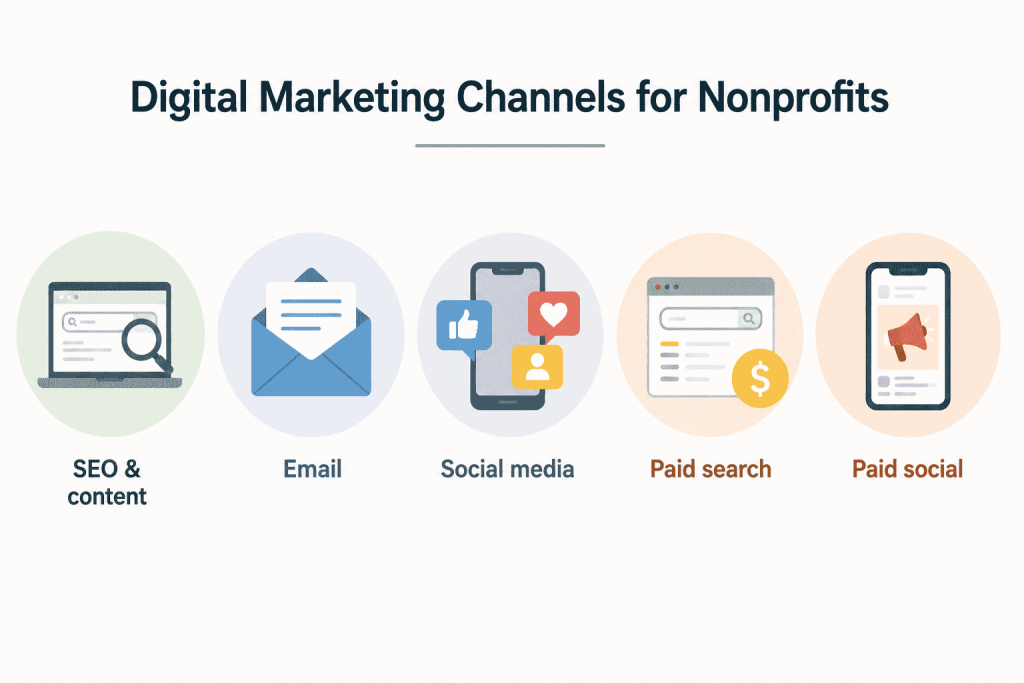
Once you know your goal, the next question is which channels actually support it. A useful digital marketing strategy for nonprofit organizations doesn’t try to do everything at once; it matches each of the digital marketing channels for nonprofits to the outcome it’s genuinely good at driving.
| Channel | Primary Outcome(s) | Typical Nonprofit Cost | Best For |
| SEO & content | Awareness, donations (via search intent) | Low cost, mostly staff time | Long-term, compounding visibility |
| Donations, volunteers, community | Very low cost, often free tiers | Nurturing people who already know you | |
| Social media | Awareness, community | Low cost, mostly staff time | Storytelling and peer-to-peer sharing |
| Paid search (incl. Google Ad Grant) | Awareness, donations | Free to low cost via the Grant | Capturing people already searching for your cause |
| Paid social | Awareness, community (campaign-specific) | Optional, small test budgets | Event promotion, time-bound campaigns |
That’s what digital marketing for nonprofit teams actually looks like in practice. Here’s each channel in more depth.
SEO and Content Marketing for Nonprofits
SEO is the highest long-term-value channel on this list, since there’s no per-click or per-send cost once a page is published. Good nonprofit SEO starts with evergreen content built around the questions your donors, volunteers, and beneficiaries are already searching for:
- Pages that explain your mission and programs in plain language
- “How to help with [cause]” content
- Program-specific pages that answer real, recurring questions
Keep the on-page basics simple:
- A clear page title for every page
- One clear call to action per page (donate, volunteer, or learn more, not all three competing for attention)
- A mobile-friendly site, since most traffic to nonprofit websites now arrives on a phone
One connection worth making early: SEO content built around the same terms as your Google Ad Grant keywords reinforces both channels at once. If your site has deeper technical issues holding back rankings, our technical SEO checklist walks through the fixes that matter most.
Email Marketing for Nonprofits
Email is arguably the highest-ROI channel for nonprofit email marketing, because you own the list outright and aren’t at the mercy of a social platform’s algorithm. That ownership is paying off: M+R’s 2026 Benchmarks study found that nonprofit email revenue grew 16% on average in 2025, with organizations raising about $54 for every 1,000 fundraising emails sent, and average list sizes growing 5% over the year.
Segment by audience type, since donors, volunteers, and general subscribers all need different messages. Start with three automations, not thirty:
- A welcome sequence for new subscribers
- An automatic thank-you or receipt for donors
- A simple win-back message for donors or volunteers who’ve gone quiet
Most major email tools, including Mailchimp and Constant Contact, offer nonprofit discounts or free tiers, which changes the cost calculus considerably compared to a for-profit business.
Social Media Marketing for Nonprofits
The real strength of nonprofit social media marketing is community-building and storytelling, not direct response. Pick one or two platforms where your actual audience already spends time rather than trying to maintain a presence everywhere at once. A well-run single account beats three neglected ones.
What tends to work best:
- Volunteer and donor spotlights
- Behind-the-scenes program content
- Simple asks to share, not just to donate
That engagement compounds: according to data cited by VolunteerHub, 53% of people who engage with a nonprofit on social media go on to volunteer for that organization.
One honest expectation to set: organic reach for a small account will be modest at first, and that’s normal. Consistency compounds slowly here. It doesn’t produce overnight virality, and any guide that promises otherwise isn’t being straight with you.
Paid Media and the Google Ad Grant
This is where digital marketing for nonprofits has a real advantage over standard business marketing. Through the Google Ad Grants program, eligible 501(c)(3) organizations receive up to $10,000 per month in free Google Search advertising, applied for through Google for Nonprofits.
The Grant isn’t unconditional. Accounts must:
- Maintain a minimum 5% click-through rate
- Avoid single-word or overly generic keywords
- Use geotargeting and clear conversion tracking
Those rules exist to keep ad quality high, and they reward the same focused, specific keyword targeting that good SEO content already uses.
This guide covers the strategic case for the Grant, not the full application walkthrough, since that’s a deeper topic on its own. Treat paid social as a secondary, optional tactic for a specific event or time-bound campaign, not an always-on channel for most small nonprofits. If you decide to add a modest paid budget alongside your Ad Grant account, our Google Ads budget guide walks through how to size it.
Budget-Conscious Prioritization: What to Do When Resources Are Tight
Every channel above is a good one. Doing all of them at once, on a small budget, isn’t realistic, and trying anyway is how most nonprofit marketing programs end up thin everywhere and effective nowhere.
Our guide to how to prioritize marketing channels when budget is limited covers this challenge more broadly. Here’s how it applies specifically to a nonprofit budget.
| Budget Tier | Priorities |
| $0 (staff time only) | Apply for the Google Ad Grant. Fix the website’s donate and volunteer pages. Set up one email welcome automation. Post consistently on the single platform your audience actually uses. |
| $200-500/month | Add a small paid social test budget for one campaign or event. Bring in a freelance writer or designer for a handful of key pages. |
| $500-2,000/month | Add a modest supplemental paid search budget alongside your Ad Grant account. Invest in more consistent content production. Consider light marketing automation tooling. |
The principle underneath all three tiers is the same: doing two channels consistently well beats doing five channels inconsistently. A limited budget is a reason to narrow your focus, not a reason to attempt everything at a shallow level.
A 90-Day Digital Marketing Roadmap for Small Nonprofits
If you’re building your nonprofit’s digital marketing from scratch, here’s a sequence that works.
Days 1-30: Foundation
- Submit your Google Ad Grant application
- Fix the website’s donate and volunteer pages so they’re clear and simple
- Set up one email welcome automation
- Audit your current social presence and pick one primary platform to focus on (our guide to marketing channels for small budgets can help you decide which one fits)
Days 31-60: Content and Outreach
- Publish two to four cornerstone pages or posts that answer the real donor and volunteer questions you identified in Section 1
- Launch your first properly segmented email campaign, sending different messages to donors, volunteers, and general subscribers instead of one blast to everyone
Days 61-90: Measure and Expand
- Review your first 90 days of results against the goal you set in Section 2
- Make a deliberate decision: add a second channel, or double down on what’s already working
- Don’t add channels by default just because 90 days have passed
Measuring What Matters: Metrics Beyond Just Donations
Donations are an easy number to track, but they’re not the only one that matters. Match your metrics to the outcome you’re working on:
| Outcome | Metrics to Track |
| Awareness | Website sessions, email list growth rate, social reach and shares |
| Donations | Donation conversion rate, average gift size, recurring-donor rate |
| Volunteers | Sign-up conversion rate, volunteer retention rate |
| Community | Event attendance, social engagement rate, user-generated content or shares |
Review these against the specific goal you chose in Section 2 each quarter, rather than tracking all of them with equal intensity. A goal you’re not measuring is just a hope.
You don’t need a complicated dashboard to do this well. A simple spreadsheet, updated once a month with your two or three priority metrics, will tell you more than a sprawling report nobody reads.
Conclusion
Across digital marketing for nonprofit organizations of every size, one pattern holds: the groups that see the best results are rarely the ones with the biggest budgets. They’re the ones that pick two or three channels tied to real goals, stay consistent with them, and use nonprofit-specific advantages like the Google Ad Grant to stretch limited resources further than a for-profit competitor ever could.
At some point, though, an in-house team reaches its capacity. If that happens, working with a digital marketing agency for nonprofits, or bringing in outside digital marketing services for nonprofits for a single channel like email or paid search, is a reasonable next step rather than a sign that something went wrong. Scopic Studios’ certified team (Google, HubSpot, Semrush) covers the full range of digital marketing services for organizations that reach that point.