
Listen to article
Key Takeaways
- Digital marketing agency pricing for most small-to-mid-market businesses runs $1,500-$10,000/month, but the number on a proposal rarely reflects what you will spend once platform fees, tools, and overages are added.
- Three models cover nearly every commercial agency arrangement: monthly retainers, percentage of ad spend, and hybrid structures that combine both. Each is the right choice in specific situations and the wrong one in others.
- Agencies account for roughly 21% of the average marketing budget, according to Gartner’s 2025 CMO Spend Survey, and 39% of CMOs are actively looking to reduce that share. Knowing how fees are structured is how you negotiate from a position of knowledge, not guesswork. (Gartner, 2025)
- The hardest part of evaluating agency pricing is not comparing numbers; it is comparing what those numbers include. Two $5,000/month proposals can represent completely different levels of service, seniority, and scope.
- Measuring marketing ROI is the #1 challenge marketers face in 2026, cited by 33% of respondents in HubSpot’s State of Marketing Report, which means connecting your agency fee to a clear performance framework before you sign is more important than the fee itself. (HubSpot, 2026)
- Project-based fees can still be useful for one-off needs like audits, campaign launches, or website updates, but most ongoing digital marketing agency relationships are structured around retainers, percentage-of-spend fees, or hybrid models.
Digital marketing agency pricing typically runs between $1,500 and $10,000 per month for most small-to-mid-market engagements, though scope, channel mix, and the seniority of the team behind the work shift that range substantially in either direction.
Here is the problem most pricing guides do not address: that number tells you almost nothing useful on its own. Two proposals at $4,000/month can represent wildly different programs; one covering a senior strategist managing two channels with monthly reporting and clear deliverables; the other covering a junior coordinator managing one channel with a quarterly check-in and a scope vague enough to generate overages every month.
This guide explains the three main pricing structures agencies use, what legitimately drives costs up or down, the fees that almost never appear in the headline number, and the specific questions that separate a well-structured agency engagement from an expensive lesson.
How Much Do Marketing Agencies Charge? Cost Benchmarks by Service Type
Before diving into how agencies structure their fees, it helps to anchor yourself in what different service lines cost. The ranges below reflect typical market rates for ongoing engagements and are based on what businesses of various sizes commonly encounter when evaluating proposals.
Typical Cost Benchmarks by Service Type
| Service | Typical Monthly Range | Notes |
| SEO (ongoing retainer) | $1,000 – $8,000/month | Single-channel, ongoing optimization |
| PPC / Paid Media Management | $1,500 – $10,000/month | Management fee only; ad spend is additional |
| Social Media Management | $1,000 – $7,000/month | Content creation and management vary widely |
| Content Marketing | $2,000 – $10,000/month | Depends heavily on volume and format |
| Email Marketing | $500 – $3,500/month | Automation complexity affects the upper end |
| Full-Service (3+ channels) | $5,000 – $25,000+/month | Multi-channel with strategy and reporting |
A few things this table does not show: PPC management fees are always on top of your actual advertising budget; the fee covers agency management work. “Full-service” varies so much between agencies that the range is almost meaningless without a scope conversation. And creative production: ad design, video, landing pages, often sit outside these numbers entirely.
What a Small Business Pays vs. an Enterprise Account
Digital marketing agency cost scales significantly with business stage, and not just because enterprises run bigger programs. The underlying dynamics change, too. An SMB retainer typically involves a smaller team with broader responsibilities per person; an enterprise engagement often involves dedicated specialists per channel, custom reporting infrastructure, and more layers of account management.
Common ranges by business size, based on typical engagement patterns:
- Small business / startup (1-50 employees): Single-channel programs usually fall between $1,000 and $3,000/month. Multi-channel programs covering SEO plus paid media or social tend to start around $3,500-$5,000.
- Mid-market (51-250 employees): A two-to-three channel program with strategy, execution, and regular reporting typically runs $4,000-$12,000/month.
- Enterprise (251+ employees): Multi-channel programs with dedicated teams and custom reporting commonly exceed $12,000/month and often reach $25,000+.
For context: the Gartner 2025 CMO Spend Survey found that companies allocate an average of 7.7% of revenue to marketing overall, with agencies representing approximately 21% of that total budget. For a company generating $5M in annual revenue, that implies a total marketing budget of around $385,000 and an agency allocation of roughly $80,000/year or about $6,700/month. These are averages across large companies; small businesses often allocate proportionally more or less, depending on growth stage. (Gartner, 2025)
The Three Main Agency Pricing Models
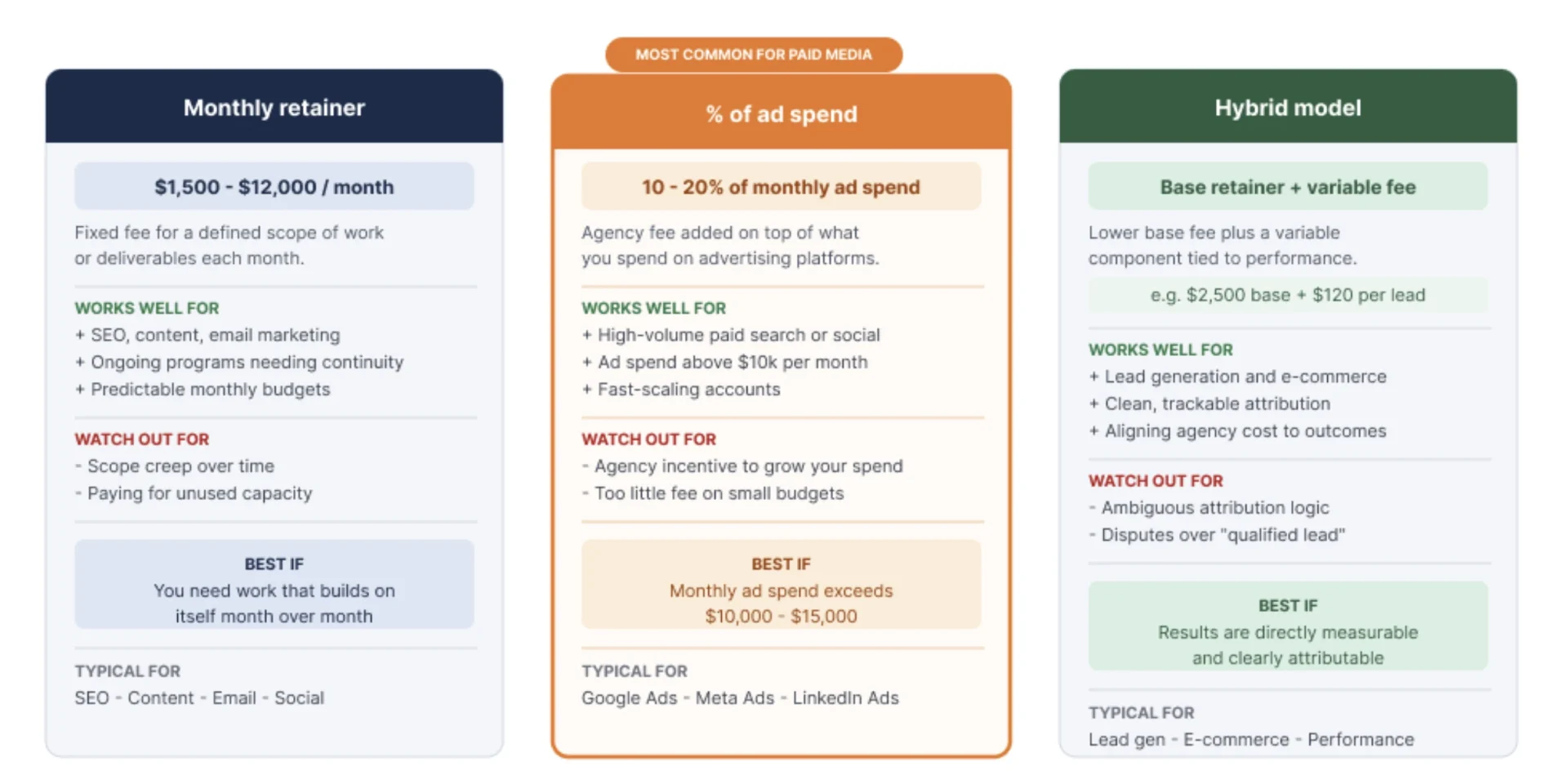
Most pricing structures fall into three categories. Knowing how each works and where each breaks down puts you in a much stronger position when proposals land in your inbox.

Monthly Retainer: Predictable Cost, Defined Scope
A fixed monthly fee in exchange for a defined scope of work. It is the most common structure for ongoing SEO, content marketing, and social media management, and the one most buyers default to because it is the most familiar.
- Where it works well: Any ongoing function that builds on itself month over month: SEO, content, email, is a natural fit. The agency learns your brand, compounds on previous work, and optimizes over time rather than starting from scratch.
- Where it breaks down: Two failure modes are common. Scope creep: requests quietly expanding beyond what was agreed, and misaligned pacing: a seasonal business paying full price during its off-peak months. Both are preventable with clear contract language, but worth watching for.
- One practical note: deliverable-based retainers tend to be cleaner than hour-based ones. When the fee is tied to hours, every new request becomes a negotiation. When it is tied to deliverables, both sides know exactly what the month covers.
For a deeper comparison of retainer vs. performance-based structures, see our post on agency retainer vs. performance-based pricing.

Percentage of Ad Spend: Scales with Your Budget
The agency charges a percentage of your total advertising budget as its management fee — on top of what you spend on media. This model is standard in paid media management, and it works well in specific situations.
- How it works in practice: $20,000/month in Google Ads at a 15% management fee means your total monthly commitment is $23,000; $20,000 to the platform, $3,000 to the agency. The fee scales with your budget in both directions.
- The minimum fee problem: Below roughly $8,000-$12,000/month in ad spend, the percentage yields too little for the agency to properly staff the work. A 15% fee on $3,000/month is $450; not enough for meaningful strategy time. At that level, a flat retainer usually delivers better value.
- Worth noting: The % of spend model gives agencies a financial incentive to grow their budget, regardless of whether growth is optimal. That is not inherently a problem, but spending decisions should be driven by performance data, not by fee structure.
For more on how paid media management fees are structured, see our PPC services page.

Hybrid Fees: Combining a Base Retainer with Performance Components
A hybrid model pairs a lower base retainer with a variable fee tied to results: leads generated, revenue attributed, and ROAS achieved. In theory, the client gets cost aligned with performance, the agency gets a floor plus upside.
- Where it works: Direct-response programs and e-commerce campaigns where attribution is relatively clean. When the agency’s work clearly connects to a measurable outcome, a performance component makes sense for both sides.
- The catch: Hybrid contracts require more upfront agreement than they appear to. What counts as a “qualified lead”? How is revenue attributed across multiple touchpoints? Who arbitrates disputes? These definitions need to be written before work starts.
See how these arrangements play out in practice in our post on agency retainer vs. performance-based pricing.
What Actually Drives Agency Costs Up or Down
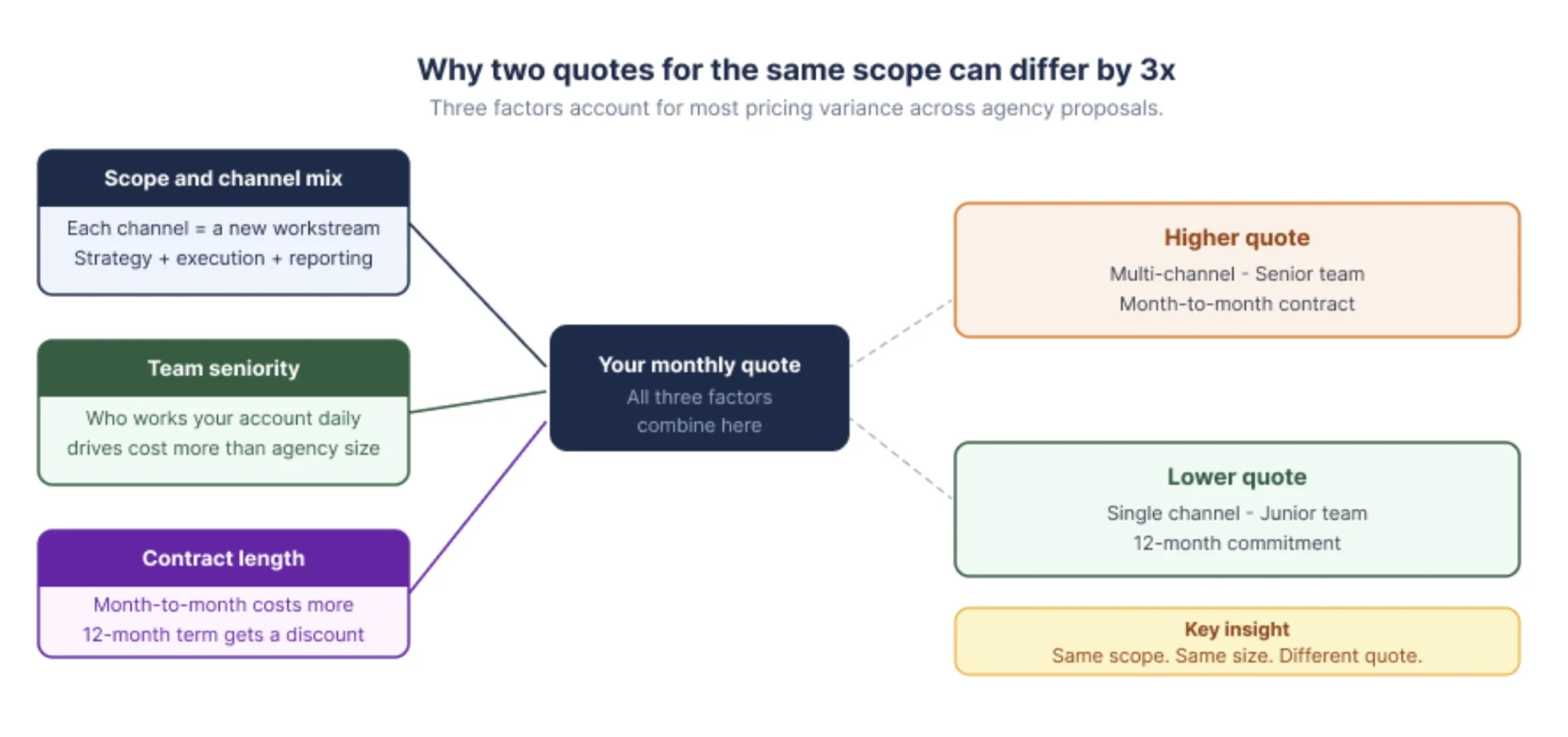
Two agencies, similar credentials, quotes of $3,000 and $9,000 for what looks like the same scope. This happens constantly. Three factors account for most of that gap.
Scope and Channel Mix
The strongest single driver of digital marketing agency cost is channel count. Each channel you add brings its own strategy, execution, and reporting workstream, and that workstream comes with a price tag.
A two-channel program (SEO + paid search) costs more than SEO alone. A four-channel program costs more than two. When comparing proposals at the same monthly fee, always check how many channels are covered and at what depth. Three channels covered shallowly is not the same investment as one channel done properly.
For a clear picture of what service-level scope actually looks like month to month, see our post on what to expect each month from your digital marketing agency.
Team Seniority and Agency Structure
Marketing prices vary significantly based on who is doing the work, not the credentials on the agency’s about page, but the person sitting in your account on a Tuesday afternoon.
A boutique agency may charge less and give you direct, weekly access to a senior strategist. A larger agency may charge more and route your account through several layers of coordination, with senior input appearing mainly at kickoff and quarterly reviews.
Simple test: ask any agency you are evaluating who specifically will work on your account, what their role is, and how many accounts they currently manage. That answer tells you more than any case study.
Contract Length and Cancellation Terms
Month-to-month costs more per month than a 6- or 12-month commitment. This is rational agency pricing; a client who can cancel with 30 days’ notice is a revenue risk, and that risk is priced in.
A practical middle ground: negotiate a 3-month pilot at a defined scope and rate, with a clear evaluation point and the option to extend. Most well-structured agencies will accept this structure.
Other Agency Pricing Structures You May See in Proposals
The 3 models above cover the most common structures for ongoing digital marketing support. However, agency proposals may also include project-based fees, performance-based pricing, or blended arrangements depending on the scope, timeline, and level of risk involved.
Project-Based Fees: Clarity for Defined Outcomes
Project-based pricing charges a fixed fee for a specific, finite deliverable. The agency provides a quote for the entire project—including drafts, meetings, and final deliverables—and you pay that amount regardless of the hours invested. This model works best for well-defined initiatives with a clear start and end date: website redesigns, product marketing campaigns, SEO audits, or brand refreshes.
When Project Pricing Makes Sense
Project-based models are often best for early-stage startups that need specific deliverables without committing to ongoing retainer costs. They’re also ideal for marketers who only need help with one or two very specific projects per year. The pay-per-project model is a great way to test out an agency before a longer-term commitment, giving you a low-risk entry point to evaluate execution quality and cultural fit.
The Core Benefit: Cost Certainty
The primary advantage is cost certainty. You know exactly what you’ll pay before work begins, which simplifies budgeting and internal approvals. There’s no ambiguity about monthly spend or surprise invoices.
The Core Risk: Scope Creep
The primary risk is scope definition. Poorly defined scope leads to change orders, budget overruns, and tension between client and agency. A project scope of work must be exhaustively detailed, covering deliverables, revision rounds, and assumptions. If the scope is confined to the quoted parameters, any changes midway through may incur additional fees. This rigidity also means less flexibility for strategy pivots or leveraging agency expertise for optimization as the project unfolds.
Operational Trade-Offs
Project-based engagements generally take more time to get off the ground due to the required written scope and signed proposal, which can affect timelines. If speed to execution matters, the upfront documentation overhead is worth factoring in. When evaluating agencies, a detailed marketing agency RFP can help clarify scope expectations and reduce friction later.
Performance-Based Pricing: Paying for Results
Performance-based pricing ties agency compensation directly to measurable outcomes—cost-per-lead, revenue share, or a percentage of ad spend. Unlike retainer or project models, payment scales with results, not hours or deliverables. This structure aligns agency incentives with your growth. Most agencies use a hybrid approach: a reduced base fee plus a performance bonus tied to exceeding agreed-upon KPIs.
How Hybrid Performance Models Work
The most common structures include a reduced base retainer combined with outcome-based incentives. The base fee covers ongoing work while the performance component rewards efficiency and scale. This approach balances predictability with alignment on your desired outcomes, creating incentives to optimize results.
When Performance Pricing Makes Sense
This model works best for scaled companies with established systems, historical data, and clear attribution. It’s not suited for foundational work—brand positioning, website builds, or early-stage campaigns—where results depend on variables outside the agency’s control. Success requires precise definitions: what counts as a qualified lead? How is attribution handled across channels? What metrics matter—customer acquisition cost, pipeline revenue, or lead quality? Vanity metrics like impressions or clicks don’t belong in performance contracts.
What to Watch For
Performance-based pricing requires careful contract structuring. Agencies need protection from external factors—product issues, sales team inefficiencies, market shifts—that can tank results despite strong marketing execution. Clients need transparency: robust tracking, agreed-upon benchmarks, and realistic targets based on historical performance. Without these safeguards, the model creates friction instead of alignment.
Hidden Costs: What Your Agency Fee Actually Covers
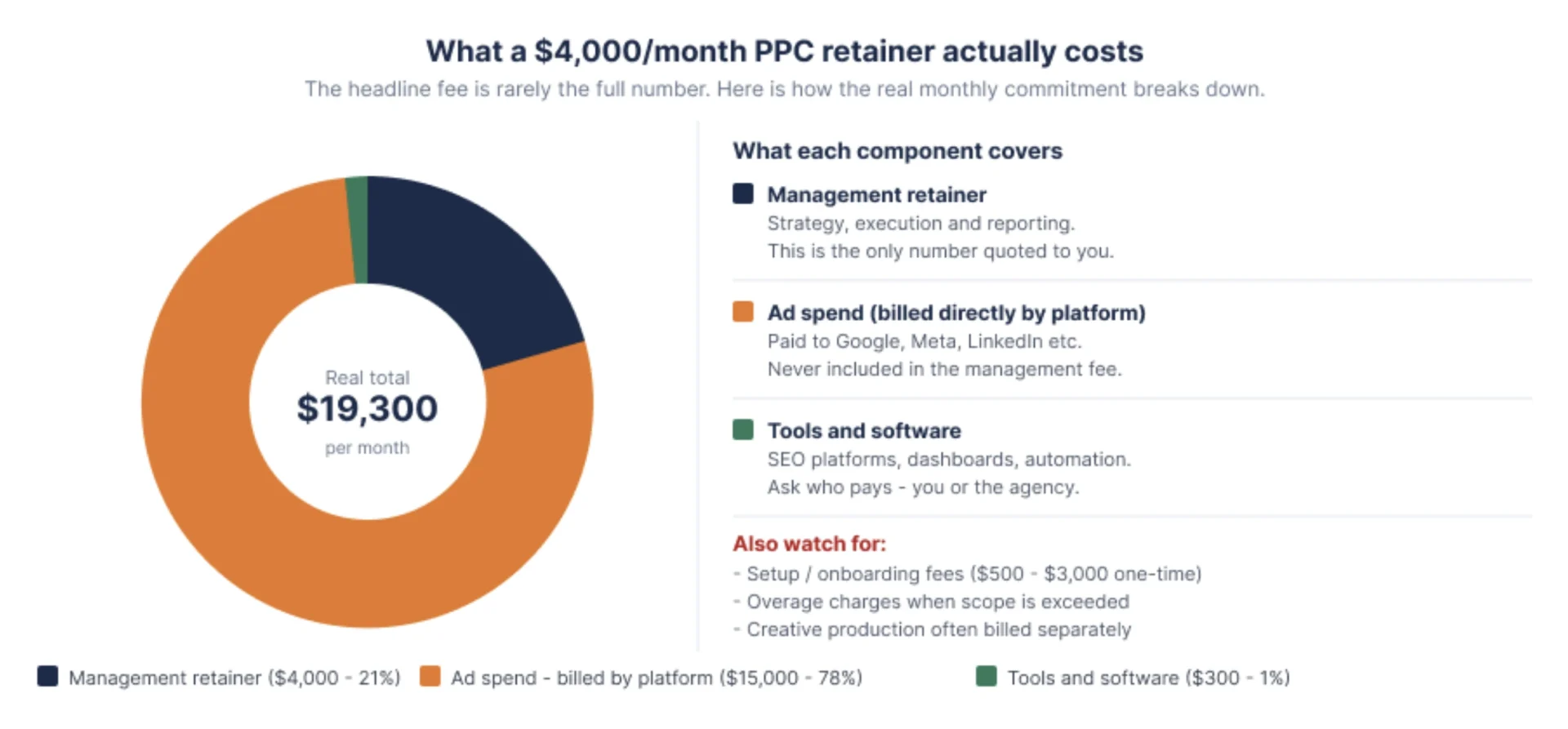
The headline retainer is almost never the full number. The fees below sit outside most quoted retainers, and together they often add 20-40% to the real monthly commitment.
Fees That Commonly Appear Outside the Retainer
- Platform and media fees. Ad spend on Google, Meta, LinkedIn, and other platforms is always billed directly by the platform. It is never included in a management fee. A $4,000/month PPC retainer that requires $15,000/month in ad spend is a $19,000/month commitment.
- Third-party tool subscriptions. SEO platforms, reporting dashboards, and specialized
keyword research tools
- Onboarding and setup fees. One-time fees for account setup, technical audits, or onboarding commonly range from $500 to $3,000 for SMB engagements. Usually disclosed, but not always proactively.
- Overage charges. Hours-based retainers generate overage charges when work exceeds the agreed threshold. Deliverable-based retainers may quote additional requests separately. Know the mechanism before you hit it.
- Creative production. Many retainers cover strategy and management, not asset production. If your campaigns require regular new ad creatives (they almost always do), that cost may be quoted separately. For a full breakdown of what a well-run engagement should include, see our post on what to expect each month from your digital marketing agency.
- The fix: Ask every agency for a total cost of engagement estimate; management fee, anticipated media spend, tools, and one-time fees combined. That is the only number worth comparing across proposals.
What “Full-Service” Actually Means (and Does Not Mean)
“Full-service” means something different at every agency. One agency’s full-service retainer includes ad creative, landing pages, and video. Another covers strategy and campaign management, with everything else quoted separately.
Before signing, ask for a written scope of inclusions and exclusions: Is the ad creative included? Are landing page builds covered? Does technical SEO include implementation or just recommendations? The answers matter more than the label.
Any proposal that responds to these questions with vague language about being “flexible” and “full-service” is telling you something about how scope disputes will be handled after you sign. For a clearer picture of what to expect at different price tiers, see our post on full-service vs. budget digital marketing agencies.
How to Evaluate Agency Quotes Before You Sign
Most buyers compare proposals by price. That is the least useful comparison you can make. Here is what actually predicts whether an engagement will deliver value.
Comparing Proposals on More Than Price
- Who works your account. Ask for names, roles, seniority, and how many accounts each person currently manages. A senior strategist on 4 accounts and a junior coordinator on 18 are not the same product at the same price.
- How success is defined. If a proposal does not include specific metrics, a reporting cadence, and clarity on what happens if performance falls short, it is not a complete proposal. Push for this before you sign.
- Data and account ownership. Every analytics account, ad account, pixel, and data asset your budget funds should be owned by your business; in writing. Agency-owned infrastructure is a hidden switching cost if the relationship ends.
- Exit terms. Standard notice periods run 30-90 days. Know what transfers cleanly at exit and what may require renegotiation. A well-organized agency has a clear answer ready.
For a full evaluation framework, see our post on how to evaluate a marketing agency proposal.
Six Questions to Ask Before Committing to a Pricing Model
These six questions resolve most of the ambiguity that leads to budget surprises later:
- How is scope defined, and what triggers an overage charge?Get the threshold in writing and understand the rate that applies above it.
- Isad spend billed separately, and are platform fees included? Confirm total monthly commitment, not just the management fee.
- Which tools does this program require, and who pays for them?Know exactly where tool costs appear in the budget.
- How is performance tracked, and who owns the data?All accounts and tracking infrastructure should be in your ownership from day one.
- What are the cancellation terms, and what happens to work in progress?Know the notice period and what transitions smoothly atexit.
- How are scope changes handled mid-engagement?Formal amendment or informal request,and does it cost extra?
Any well-structured agency will answer these directly. Vague answers are themselves useful data. For the full agency selection process, see our guide on hiring a digital marketing agency.
Key Client Risks to Negotiate
When evaluating agency partnerships, several common risk areas warrant careful attention during contract negotiation.
Hidden Fees
Watch for costs that aren’t transparent in the initial proposal: overage charges, software tool fees, rush fees, or revision limits. Request a detailed scope document that lists what’s included and what triggers additional charges. Clarify whether expenses like tool subscriptions, stock photography, or third-party services are included in the fee or billed separately. Getting this in writing prevents invoice surprises later.
Scope Creep
Vague deliverables invite misalignment. Define exactly what the agency will deliver: number of campaigns, content pieces, reports per month, revision rounds, and approval processes. A clear scope of work protects both sides. Without these details, you may find yourself paying for undefined work, or the agency may claim work falls outside the agreed scope.
Unclear Deliverables and Success Metrics
Before signing, agree on what success looks like. For retainers, specify measurable outputs (e.g., “5 blog posts per month” or “weekly reporting dashboards”). For performance models, define metrics clearly: What counts as a qualified lead? How is attribution measured? What are the baseline benchmarks? Vague success criteria create disputes when results don’t meet expectations.
Termination Terms and Contract Duration
Understand your exit options. Can you terminate with notice, or are you locked in? What happens to ongoing work or campaigns if you leave? How much notice must each side provide? For retainers, clarify whether you can pause the engagement without penalty. A strong agreement specifies duration, termination rights, and wind-down procedures.
The Model-to-Business-Stage Match
Not sure which pricing model fits your situation? Use this as a starting point.
| Business Stage | Best-Fit Model | Why |
| Early-stage startup, limited budget | Project-based or small retainer | Preserves flexibility while needs are still forming |
| Growing SMB, single-channel focus | Monthly retainer | Continuity matters; scope is manageable |
| SMB scaling paid media | % of spend (with floor) | Management complexity scales with budget |
| Mid-market, multi-channel program | Monthly retainer or hybrid | Predictability needed; performance components add alignment |
| Direct-response / e-commerce | Hybrid | Attribution is clean; performance-based component works |
| Enterprise, multi-team program | Retainer with SLAs | Complexity requires defined service levels |
The simplest heuristic: if your marketing attribution is clear and your agency has direct influence over measurable outcomes, a hybrid or performance component makes sense. If your marketing involves long buying cycles, brand-building activity, or multi-touch attribution that is difficult to isolate, a retainer protects both parties from disputes over what the agency actually caused.
Conclusion
Agency pricing is not complicated, but it is deliberately opaque. The fee on a proposal is a starting point. What matters is what sits behind it: who does the work, what is included, how success gets measured, and what happens when things need to change.
The buyers who get the most from agency relationships are not the ones who spend the most. They are the ones who ask the right questions before signing, define what good looks like from day one, and treat the pricing model as a tool.
If you are currently evaluating agency proposals and want a scope-specific conversation, the Scopic Studios team is available to talk through your program goals and give you a clear, honest estimate. As a full-service digital marketing agency working with businesses across SEO, paid media, content, email, and lead generation, we can walk you through exactly what your investment covers and what it should reasonably produce. Get in touch here.
FAQs
How much do marketing agencies charge per month?
Most digital marketing agencies charge between $1,500 and $10,000/month for small-to-mid-market engagements, with scope and channel mix as the primary drivers. Single-channel programs sit toward the lower end; multi-channel programs with strategy, execution, and reporting across three or more channels push costs significantly higher.
What is a typical digital marketing agency cost for a small business?
Small businesses running a focused single-channel program (SEO, social, or email) typically pay $1,000–$3,000/month. Adding a second channel, such as paid search, usually brings that to $3,500–$5,500/month. The total budget commitment for paid media programs must also account for ad spend, which is always billed separately by the advertising platform on top of the management fee.
Is a monthly retainer or a percentage of spend better for paid advertising?
It depends on your media budget. Above roughly $10,000-$15,000/month in ad spend, the % of spend model tends to align the agency’s management effort with the actual complexity of the account. Below that level, the percentage often yields too little for the agency to staff the work properly, making a flat retainer the more practical arrangement.
What hidden fees should I watch for in an agency contract?
The four most common categories: advertising platform fees (billed separately, always), third-party tool subscriptions (SEO software, reporting platforms, automation tools), onboarding or setup fees, and overage charges for work outside the defined scope. Always ask for a total cost of engagement estimate before comparing proposals.
How do I know if an agency’s pricing is fair?
Price is the wrong benchmark. The relevant signals are: (1) scope clarity – you know exactly what is and is not included, (2) team transparency – you know who specifically will work the account and at what seniority, and (3) performance definition – you have agreed on success metrics before signing. A vague scope at a low price is almost never a better value than a clearly defined scope at a higher price.
About Digital Marketing Agency Pricing 2026: Hidden Costs Revealed Guide
This guide was written by Meri Tiratsyan and reviewed by Sonja Somborac, SEO Project Manager at Scopic Studios.
Scopic Studios delivers exceptional and engaging content rooted in our expertise across marketing and creative services. Our team of talented writers and digital experts excel in transforming intricate concepts into captivating narratives tailored for diverse industries. We’re passionate about crafting content that not only resonates but also drives value across all digital platforms.