Listen to article
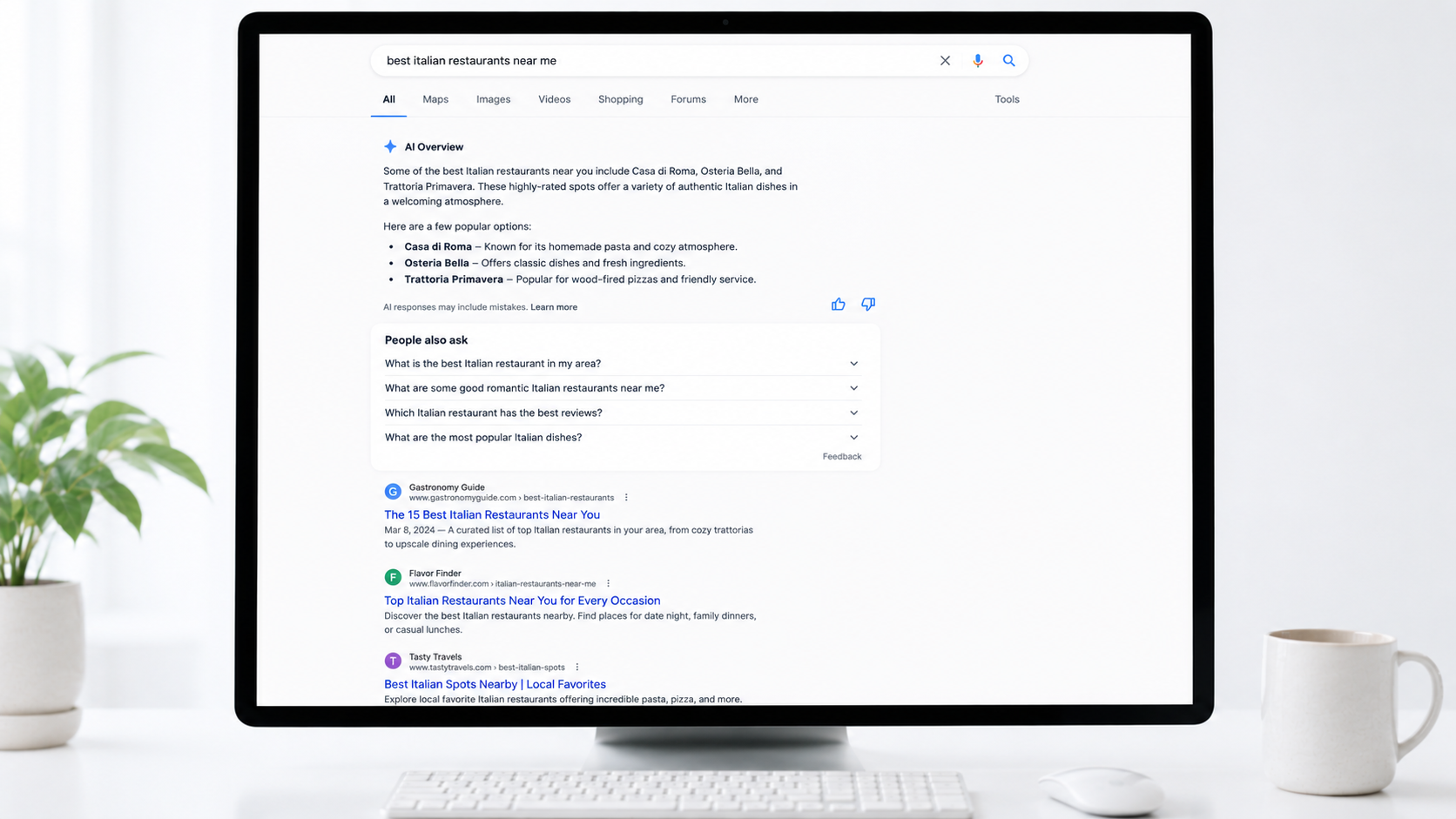
If your company operates in several markets, general SEO advice isn’t enough. Local SEO is what helps companies reach customers who are not only looking for your services but are also located nearby.
This means location pages, Google Business Profile (GBP) management, citations, reviews, and tracking are more important than ever for companies competing in different locations or markets.
Whether you’re just learning about local SEO for multiple locations or looking to improve your current strategy, this guide breaks everything down. Keep reading to explore the core framework behind this strategy, how to prevent keyword cannibalization, and more.
What Is Multi-Location SEO?
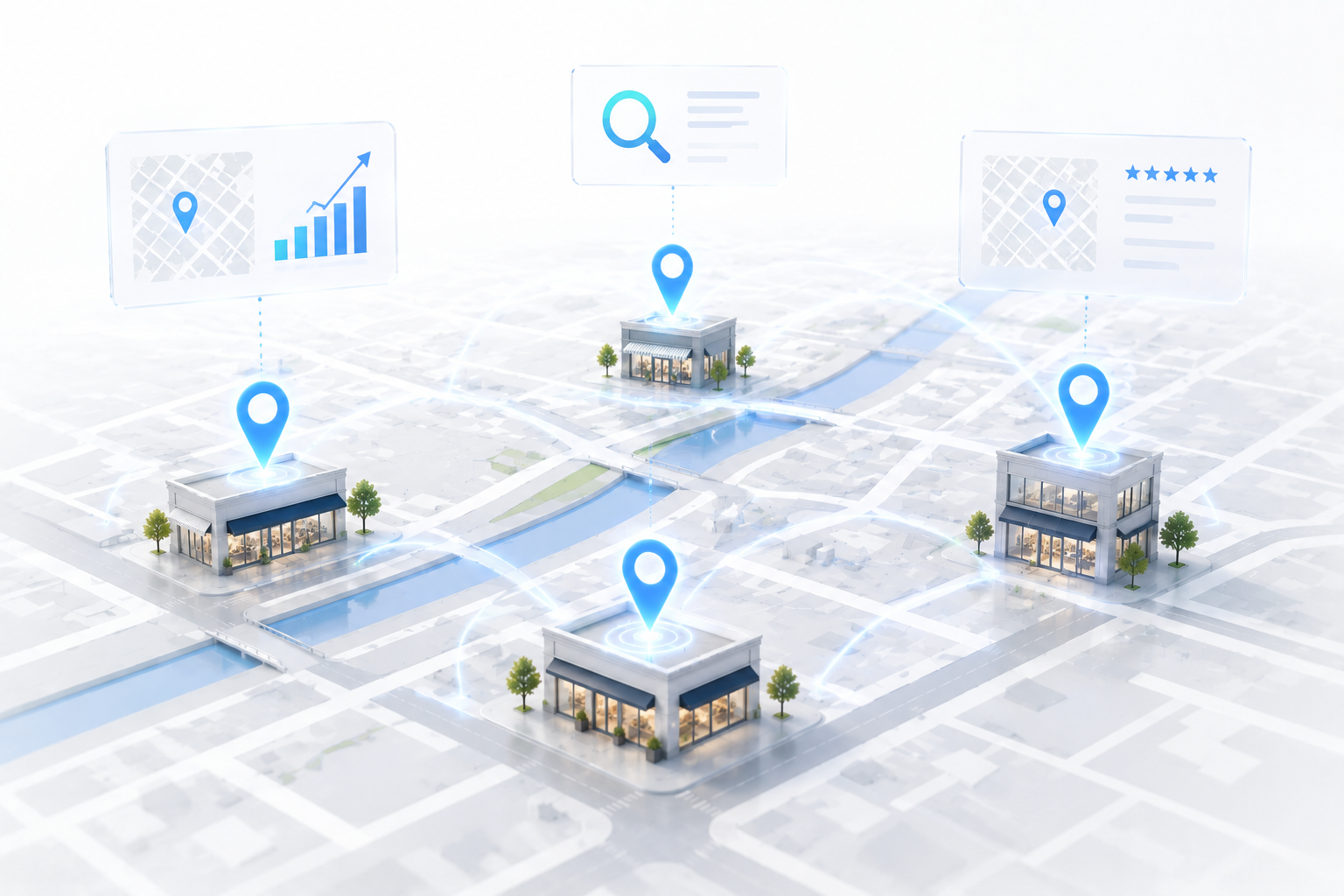
Multi-location SEO is the process of optimizing a business’ online presence so each physical location can rank in local search results. Instead of promoting a single office or storefront, SEO for a multi-location business helps every location appear when nearby customers search for relevant products or services.
Unlike standard local SEO, which focuses on one location, multi-location SEO requires optimizing multiple location pages, Google Business Profiles, local citations, and reviews while maintaining a consistent brand across every market. It also differs from broader organic SEO by targeting location-specific searches rather than general, non-geographic keywords.
Why Multi-Location Businesses Need a Different Local SEO Strategy
As the number of locations grows, so does the complexity of managing local SEO. Each location serves a different audience, competes with different businesses, and needs its own optimized web page, Google Business Profile, citations, and reviews.
Without a structured strategy, businesses can run into issues such as duplicate content, inconsistent business information, and keyword cannibalization, making it harder for individual locations to rank.
A scalable local SEO strategy helps each location compete in its own market while strengthening the visibility of the business as a whole. As businesses continue to expand, many partner with the best local SEO agencies to manage optimization at scale, maintain consistency across locations, and maximize their local search performance.
Local SEO Strategy for Multiple Locations: The Core Framework
A successful multi-location SEO strategy isn’t built around a single tactic. Instead, it relies on a repeatable system that can be applied consistently across every location while allowing each one to compete in its local market.
The framework consists of location pages, GBP governance, NAP consistency, localized on-page SEO, review management, local links and citations, and reporting.
Together, these components help search engines understand where your business operates, improve local visibility, and drive more qualified traffic to each location.
Build Location Pages That Can Rank Without Creating Duplicate Content
Location pages are the foundation of any successful multi-location SEO strategy. They help search engines understand where you operate and give potential customers location-specific information when they’re ready to take action.
Not sure where to start? Focus on building pages with the right core elements and creating content that’s genuinely localized.
What Every Multi-Location Location Page Should Include
Every location page should contain the information customers need while sending clear local relevance signals to search engines.
A simple way to think about it is to put yourself in your customer’s shoes. What information would you want before visiting or contacting that location? Answering that question will help you create pages that are useful for both users and search engines.
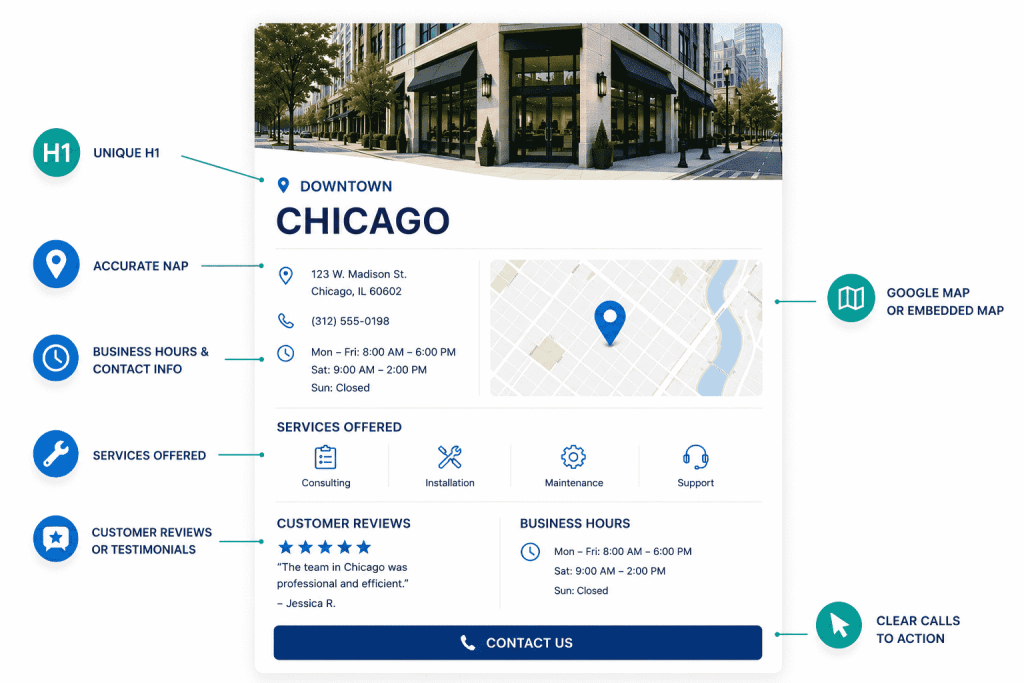
At a minimum, each page should include:
- A unique title tag, meta description, and H1.
- Accurate business name, address, and phone number (NAP).
- Business hours and contact information.
- A description of the services offered at that location.
- A Google Map or embedded map.
- Clear calls to action.
- Customer reviews or testimonials from that location when possible.
Depending on your business, you can also include team members, photos, service areas, parking information, or other details that make the page genuinely useful.
How to Localize Copy, Proof, FAQs, and Internal Links
The best location pages feel like they were written specifically for that community. Instead of changing only the city name, tailor the content to reflect the local market.
Mention services that are particularly relevant for that location, highlight local case studies or testimonials, answer location-specific FAQs, and reference nearby landmarks or neighborhoods when appropriate.
Internal links should also support users by connecting related location pages, nearby offices, or relevant service pages.
These additions make each page more valuable for visitors while helping prevent duplicate content across your website.
Local On-Page SEO for Multi-Location Businesses
Alongside unique content, every location page should follow on-page SEO best practices. Optimize title tags, meta descriptions, headers, image alt text, and URLs with relevant local keywords without overusing them.
Add structured data where appropriate, ensure the page loads quickly, and make it easy for users to find directions or contact the location.
If you’re managing dozens or even hundreds of locations, some of the best on-page SEO tools can help you audit metadata, identify duplicate content, monitor internal links, and uncover optimization opportunities at scale.
While tools can streamline the process, a strong local SEO strategy still depends on creating high-quality, location-specific pages.
Optimize Google Business Profiles Across Every Location
Your Google Business Profile is one of the strongest local ranking signals. Every location should have its own fully optimized profile with accurate, up-to-date information. As your business grows, consistency becomes just as important as optimization.
For each location, make sure you:
- Claim and verify every GBP under a centralized business account.
- Select the most relevant primary and secondary categories.
- Complete all business information, including hours, services, contact details, and attributes.
- Write a unique business description that accurately reflects the location.
- Upload high-quality photos regularly to keep profiles fresh.
- Monitor the Q&A section and provide accurate, timely responses.
- Establish a review response workflow so customer feedback is acknowledged consistently.
- Create a governance process for updating business information, managing permissions, and auditing profiles across all locations.
As your business scales, AI Google Business Profile optimization can help strengthen your overall strategy. Rather than simply automating routine tasks, AI can uncover keyword opportunities, identify competitor gaps, analyze customer reviews for sentiment and trends, recommend improvements to your business descriptions and services, and provide insights into the relevance and prominence signals that influence local rankings.
Citations, Reviews, and Local Trust Signals at Scale
If you’re wondering how to do local SEO for multiple locations, building trust beyond your website is a critical part of the process. Search engines evaluate signals such as consistent business information, customer reviews, and locally relevant backlinks to determine how trustworthy and relevant each location is.
How to Keep NAP Consistent Across All Locations
NAP (Name, Address, and Phone Number) consistency is one of the foundations of multi-location SEO. Every location should display the exact same business information across your website, Google Business Profile, directories, social media profiles, and other online listings.
Even small differences, such as abbreviating “Street” on one listing but spelling it out on another, can create confusion for search engines. Regularly auditing your citations and updating outdated listings helps maintain consistency and strengthens your local presence.
How to Operationalize Review Generation and Responses
Customer reviews influence both local rankings and purchasing decisions. Instead of collecting reviews only when someone remembers to ask, build review requests into your existing customer journey.
For example, you can automatically send review requests after a completed service, purchase, or appointment. Establish clear response guidelines so every location responds to both positive and negative reviews in a consistent, professional, and timely manner.
How to Earn Locally Relevant Backlinks and Mentions
Local backlinks and brand mentions help strengthen each location’s authority within its community. Rather than focusing solely on high-authority national websites, look for opportunities to earn links from organizations and publications that are relevant to each market.
Consider partnering with local businesses, sponsoring community events, joining chambers of commerce, contributing to local publications, or supporting nonprofit organizations.
How to Do Local SEO for Multiple Locations Without Cannibalization
One of the most common SEO mistakes for multi-location businesses is keyword cannibalization.
This occurs when multiple pages target the same keywords and search intent, causing them to compete against each other instead of helping your overall visibility. Rather than strengthening your rankings, duplicate or overlapping pages can make it harder for search engines to determine which page should rank.
So how can you avoid keyword cannibalization?
It comes down to giving each page a clear purpose and making it genuinely relevant to its local audience. Here are a few best practices to follow:
- Create unique location pages. Avoid copying the same template and simply replacing the city name. Each page should include original copy, location-specific information, testimonials, FAQs, photos, and other details that make it valuable to local users.
- Target location-specific keywords. Optimize each page for searches relevant to that market, such as “HVAC services in Phoenix” instead of using the same generic keyword across every location.
- Strengthen your internal linking. Link related location pages, service pages, and regional hubs where it makes sense. This helps search engines understand your site structure while improving navigation for users.
- Match one page to one search intent. Your homepage, service pages, and location pages should each serve a distinct purpose. Avoid creating multiple pages that target the same keywords or answer the same user query.
- Audit your content regularly. As your business grows, periodically review your website for duplicate content, overlapping keywords, outdated location pages, and broken internal links before they begin affecting rankings.
The goal isn’t simply to create more pages; it’s to create the right pages.
When every location has unique, valuable content that targets a distinct audience and search intent, search engines can better understand your website. This allows each location to compete in its own market without competing against the others.
Multi-Location SEO Tracking: What to Measure by Location
If you’re investing in local SEO for multiple locations, tracking performance at the business level isn’t enough. Multi-location SEO tracking allows you to see how each location is performing, identify what’s working, and uncover opportunities for improvement.
Rather than focusing only on overall website traffic, monitor metrics for each individual location, including:
- Google Business Profile insights, such as profile views, searches, direction requests, website clicks, and phone calls.
- Local keyword rankings to see how each location performs for its target search terms.
- Organic landing page performance, including traffic, engagement, and conversions for individual location pages.
- Calls and form submissions to measure how many qualified leads each location generates.
- Location-level conversions, such as appointments booked, purchases made, or other business goals tied to specific locations.
Reviewing these metrics regularly helps you identify high-performing locations, spot underperforming markets, and prioritize optimization efforts where they’ll have the greatest impact. Over time, this data-driven approach makes it easier to scale your strategy while continuously improving results across every market.
How to Scale Multi-Location SEO for Service-Based Businesses and Franchises
A successful multi-location SEO strategy should be scalable from the start. Whether you manage multiple service locations or a franchise network, every location needs a consistent SEO foundation while remaining relevant to its local market.
For service-based businesses, that means creating unique location pages and optimizing each Google Business Profile. A successful multi-location SEO strategy for franchises requires balancing brand consistency with local flexibility.
Establish clear standards for location pages, business listings, reviews, and content while giving individual locations the ability to tailor their presence to their communities. This approach helps every location compete more effectively as your business grows.
Final Checklist for Local SEO for Multiple Locations
Successfully implementing local SEO for multiple locations doesn’t happen overnight. However, following a structured framework can help every location improve its visibility and attract more local customers.
Use this checklist as a starting point for building a scalable local SEO strategy for multiple locations:
✓ Create unique, high-quality location pages.
✓ Optimize and regularly update every Google Business Profile.
✓ Keep your NAP information consistent across all listings.
✓ Implement localized on-page SEO for every location.
✓ Build a process for generating and responding to customer reviews.
✓ Earn locally relevant citations, backlinks, and brand mentions.
✓ Prevent keyword cannibalization with unique content and clear search intent.
✓ Track rankings, Google Business Profile insights, traffic, and conversions for each location.
✓ Regularly audit and refine your strategy as you add new locations.
Managing SEO for multi-location businesses can become increasingly complex as your business grows. If you’re looking for a partner to help build, manage, or scale your strategy, Scopic Studios’ SEO services can help you improve local visibility, generate qualified traffic, and support long-term growth across every market you serve.
FAQs About Local SEO for Multiple Locations
What is multi-location SEO?
Multi-location SEO is the process of optimizing a business’ online presence so each location can rank in local search results. Effective SEO for multi-location businesses includes optimizing location pages, Google Business Profiles, citations, reviews, and localized content.
How is multi-location SEO different from local SEO?
Local SEO focuses on a single location, while multi-location SEO applies those same principles across multiple locations. It also requires a scalable strategy to manage location pages, business listings, and local rankings consistently.
How many location pages should a multi-location business create?
Create one dedicated page for each physical location you want to rank. Each page should include unique, location-specific content and follow local on-page SEO for multi-location businesses best practices.
How do you avoid duplicate content across location pages?
Give every location page unique copy, testimonials, FAQs, images, and local information. Avoid simply swapping city names and ensure each page targets its own location and search intent.
What should you track in multi-location local SEO?
For multi–location local SEO, track Google Business Profile insights, local keyword rankings, organic traffic to location pages, calls, form submissions, and location-level conversions.
Do franchises need a different SEO strategy?
Yes. A successful multi-location SEO strategy for franchises balances brand consistency with local flexibility. Establishing clear standards for location pages, Google Business Profiles, reviews, and content helps every franchise location compete effectively in its local market.
About Local SEO for Multiple Locations Guide
This guide was authored by Baily Ramsey, and reviewed by Sonja Somborac, SEO Specialist at Scopic Studios.
Scopic Studios delivers exceptional and engaging content rooted in our expertise across marketing and creative services. Our team of talented writers and digital experts excel in transforming intricate concepts into captivating narratives tailored for diverse industries. We’re passionate about crafting content that not only resonates but also drives value across all digital platforms.