

Listen to article – This audio is generated by AI
Content syndication is the process of redistributing original content across third-party websites or platforms. By redistributing articles, whitepapers, or even videos already on your website, you can achieve greater reach, generate referral opportunities, and support demand generation.
But a content syndication strategy involves more than just searching for opportunities. It must also account for the SEO risks associated with duplicate content and put the right guardrails in place to ensure syndication benefits your company.
Keep reading to learn more about the relationship between content syndication and SEO, how it works, and the six steps to building an effective content syndication strategy.
What Is Content Syndication?
Content syndication is a content distribution approach that involves publishing existing assets on external websites, industry platforms, or partner networks. It’s essentially a way to get more eyes on the content you’ve already created, helping businesses connect with audiences beyond their own websites.
Content Syndication vs. Content Distribution
While content syndication and content distribution both help businesses reach a wider audience, they aren’t quite the same. Content distribution is the broader practice of sharing and promoting content across different channels, such as social media, email, and paid platforms. Depending on their goals, businesses may manage this process in-house or work with content distribution agencies to expand their reach.
Content syndication marketing, on the other hand, is a specific form of distribution that involves republishing existing content on third-party websites or partner networks. Put simply, syndication falls under the larger content distribution umbrella, with a specific focus on giving existing content a new home and audience.
Content Syndication vs. Content Repurposing
The key difference between syndicated content and content repurposing comes down to what happens to the original asset. With syndication, the content stays largely the same but appears on another website, platform, or partner channel.
Content repurposing takes the original idea in a new direction. A detailed report might become a blog post, infographic, or short video series. Rather than simply giving content another place to live, repurposing reshapes it to suit different formats, channels, or audience preferences. For instance, B2B content repurposing statistics show that social media is the leading content distribution channel in B2B marketing, with 90% of marketers utilizing it.
Here’s a quick table to help you better understand the differences between content syndication, distribution, and repurposing:
| Approach | What It Means | What Happens to the Content |
| Content syndication | Republishing existing content on third-party websites, platforms, or partner networks | The original content stays the same or is only slightly modified |
| Content distribution | Sharing and promoting content across channels such as email, social media, paid platforms, and third-party networks | Content is delivered through multiple channels and may take different forms |
| Content repurposing | Transforming an existing asset into a new format or adapting it for another channel | The content is reshaped, such as turning a report into a blog, video, or infographic |
How Does Content Syndication Work?
Content syndication starts by choosing the asset you want to publish on external sites. This may be an existing blog post, whitepaper, case study, video testimonial, or another piece of content that’s relevant to your target audience.
Since there are different types of content syndication, what’s important is choosing content that provides real value to readers, whether through notable results, useful insights, or information that meets them where they are in the sales cycle.
You then need to decide where you want your content to be published, considering both organic opportunities and paid partnerships. Once published, proper attribution helps connect the syndicated version to the original source, while tracking links and other metrics allow you to measure traffic, engagement, and leads generated from each channel.
Organic and Partner Syndication
Strategic partnerships help companies extend their content’s reach through relevant third-party channels without relying solely on paid promotion. This may involve working with publishers or industry partners that republish existing content, as well as sharing it through newsletters and owned communities.
The right content syndication sites depend on your audience and goals. Rather than publishing everywhere, focus on channels that are relevant to your industry, reach the people you want to connect with, and align with the type of content you’re sharing.
Paid B2B Content Syndication
The second option is to look for paid content syndication opportunities. With B2B content syndication, businesses typically partner with third-party platforms to distribute gated assets such as whitepapers, reports, or eBooks to targeted audiences.
Users provide their contact information to access the content, allowing businesses to generate leads and support broader demand generation efforts. To turn that interest into qualified opportunities, Scopic Studios’ lead generation services can help you build a strategy that attracts the right prospects and moves them further along the sales funnel.
Benefits of Content Syndication for B2B Marketing
Content syndication marketing offers an array of benefits when carried out carefully and with a clear plan. These include:
- Greater reach: The more you share your content across relevant platforms and websites, the more opportunities you have to reach new audiences. That’s why it’s important to partner with platforms that align with your target audience and content type, leading to increased brand discovery and visibility.
- Content efficiency: You could create new content for each platform you want to publish on, but that’s not always the most efficient strategy. B2B content distribution statistics show that 59% of B2B marketers rank blogs as the most valuable channel for their content distribution efforts. Syndication allows businesses to get more value from these existing assets rather than creating something from scratch for every channel, saving time and resources.
- Referral opportunities: Publishing content on relevant third-party platforms can drive qualified referral traffic to your website by reaching audiences already interested in your industry, expertise, or solutions.
- Demand generation and lead capture: Syndicating valuable content can help generate interest among potential buyers, while gated B2B content syndication can capture contact information from prospects in exchange for access to an asset.
Content Syndication and SEO: Risks to Consider in Your Strategy
Google generally doesn’t treat duplicate content as a spam violation, but content syndication SEO can still create SEO challenges. Since a canonical URL is the URL Google selects as the most representative version from a set of duplicate or very similar pages, it may choose a different canonical URL than the one you prefer, particularly if the signals across the pages aren’t clear or consistent.
This becomes especially important when your content is republished by a larger or more authoritative publisher. In some cases, the syndicated version may appear in search results instead of the original source, meaning the publisher could receive the organic visibility and clicks you intended to drive to your own site.
This is exactly why syndication agreements should consider how third-party versions are handled from an SEO perspective, including indexation and signals that help search engines understand the relationship between the original and syndicated pages.
The risks of syndicated content SEO shouldn’t be overlooked or treated as an afterthought. With our SEO services, your company will be better equipped to protect its organic visibility while making content syndication part of a broader, carefully planned SEO strategy.
How Google Handles Syndicated Content
So, what does Google recommend when the same or similar content appears across different websites?
When it comes to SEO content syndication, Google Search Central provides specific guidance on how syndicated versions should be handled. Google states that, “The canonical link element is not recommended for those who want to avoid duplication by syndication partners, because the pages are often very different. The most effective solution is for partners to block indexing of your content.”
Put simply, relying on a canonical element alone may not be the best approach for syndicated content. Instead, Google recommends preventing the partner version from being indexed when you don’t want it appearing in search results.
Pro tip: Use a URL inspection tool to check which page Google considers canonical.
How to Syndicate Content Without Hurting SEO
If you want to syndicate content without hurting SEO, start by publishing the original version on your own website before sharing it with syndication partners. From there, set clear expectations with each partner about how the republished version will be handled.
When possible, ask partners to prevent the syndicated version from being indexed using a noindex rule. You can also include clear attribution and a link to the original content to help readers identify the source.
If a partner can’t or won’t block indexing, consider syndicating an excerpt or adapted version that directs readers to the full content on your website rather than republishing the entire piece.
Once the content is live, use Google Search Console to monitor which URL Google has selected as canonical. Continue checking syndicated pages over time to see whether third-party versions are appearing in search results. Keep in mind that attribution alone doesn’t guarantee that Google will prioritize your original page, so indexation and canonical selection should remain part of your ongoing monitoring.
How to Build a Content Syndication Strategy
We’re not just here to tell you the importance of content syndication strategies. Knowing how to build one is just as critical.
Here are the six steps you should know about:
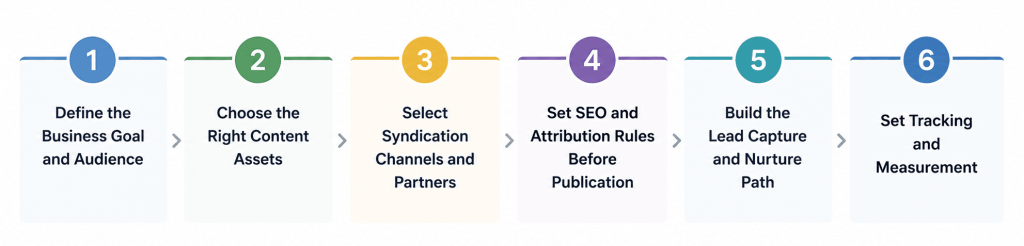
1. Define the Business Goal and Audience
The first step of any content syndication strategy is to define what you want to achieve and who you want to reach. Your goals will shape everything from the content you choose to the channels you use and the metrics you track.
For example, a strategy focused on reach and brand awareness will look different from one designed to generate qualified leads and contribute to your sales pipeline. Once you have a clear goal, define your target audience so you can focus your syndication efforts on the platforms and content most likely to reach them.
2. Choose the Right Content Assets
Don’t assume that every piece of content should be used in your strategy. Focus on high-value assets such as research, guides, case studies, white papers, webinars, and strong evergreen articles.
Remember, the purpose is to extend the reach and value of content that already resonates with your audience. So, when choosing which assets to syndicate, consider their relevance, quality, longevity, and ability to support the goals defined in the previous step.
3. Select Syndication Channels and Partners
Next, determine where your content should be published and which content syndication partners can help you reach the right audience. Rather than focusing on domain authority alone, consider factors like audience fit, industry relevance, lead quality, and how each partner distributes your content.
Some of the main content syndication channels include:
- Publisher and industry sites: Relevant publications and niche websites can republish your content to help you reach established audiences in your industry.
- Partner newsletters: Industry partners can feature or link to your content in their email newsletters, helping you reach a targeted subscriber base.
- Self-publishing platforms: Platforms that allow you to republish or adapt existing content can help extend its reach to new audiences.
- Paid B2B syndication networks: These networks distribute content across targeted channels, often using filters such as industry, job title, or company size to support lead generation.
When evaluating content syndication sites, platforms, and networks, it’s also important to review indexation terms before moving forward, especially if your content will be republished on an indexable page. This helps ensure each partnership supports both your broader marketing goals and SEO strategy.
4. Set SEO and Attribution Rules Before Publication
Before your content goes live on a third-party site, establish clear content syndication SEO and attribution requirements with your partner. Define the original URL, whether the syndicated version should be indexed, and how the original source should be credited and linked.
You should also decide how you’ll monitor the content once it’s published. This allows you to check how syndicated versions appear in search results and identify potential indexation or canonicalization issues early.
5. Build the Lead Capture and Nurture Path
For paid or B2B campaigns, content syndication lead generation doesn’t end when someone downloads your asset. You also need a clear process for turning that initial interest into a meaningful opportunity.
Determine what information to collect through your forms, how leads will be qualified and routed to your CRM, and what happens next. Depending on the lead’s intent and stage in the buying journey, this may involve a nurture sequence or a direct handoff to your sales team.
6. Set Tracking and Measurement
The final step is to define your content syndication metrics so you can understand what’s working and where adjustments are needed. Use UTM parameters and lead source tracking to identify which partners and channels are driving referral traffic, leads, and conversions.
When deciding how to measure content syndication, look beyond traffic alone. Track metrics such as cost per lead (CPL), MQL and SQL quality, influenced pipeline, and conversions based on your campaign goals.
For syndicated content that can appear in search results, monitor indexation and canonical selection as part of your SEO tracking as well.
Content Syndication Best Practices
So, what should you do, and what should you definitely avoid?
Here’s a quick chart of content syndication best practices to keep in mind:
| Do | Don’t |
| Prioritize high-quality, valuable content | Syndicate every asset you create |
| Choose partners based on audience and goal alignment | Select partners based on domain authority alone |
| Agree on indexation terms before publication | Wait until SEO issues arise to discuss indexation |
| Include clear attribution to the original source | Assume attribution alone protects organic visibility |
| Track performance by channel and partner | Focus on reach or traffic alone |
| Adapt content or use excerpts when appropriate | Republish full content when it creates unnecessary risk |
How to Measure Content Syndication Performance
Knowing how to measure content syndication starts with connecting your metrics to the goals you set at the beginning of your strategy. A campaign designed to increase brand awareness, for example, shouldn’t be measured in the same way as one focused on generating qualified leads.
Here are the main content syndication metrics to consider:
- Awareness metrics: Reach, impressions, content views, and audience growth can show how effectively your content is reaching new people.
- Engagement and referral metrics: Referral traffic, click-through rates, time on page, and other engagement signals can help you understand whether syndicated audiences are taking the next step.
- Lead generation metrics: Track leads generated, CPL, conversion rates, and the quality of MQLs and SQLs to evaluate lead generation performance.
- Revenue and pipeline metrics: Influenced pipeline, opportunities, and revenue can help connect syndication efforts to broader business outcomes.
- SEO health metrics: Monitor indexation, Google-selected canonicals, and the search visibility of original and syndicated pages to identify potential SEO issues.
When Content Syndication Is — and Is Not — Worth It
B2B content syndication can be a worthwhile investment, but only when the right foundations are in place. Before adding it to your strategy, consider the quality of your existing content, who you want to reach, and what happens after someone engages with your asset.
Content syndication may be a good fit if you have:
- Strong existing content with proven value
- A clearly defined ideal customer profile
- Longer buying cycles that require multiple touchpoints
- A measurable lead nurturing process
It may not be worth it if you have:
- Weak or outdated source content
- Limited tracking or no clear success metrics
- Partners whose audiences don’t align with your target market
- No clear agreement on indexation or lead ownership
Ultimately, content syndication works best as part of a broader strategy, where every new touchpoint has a clear purpose and a way to measure its impact.
Final Thoughts
Content syndication can be a valuable way to expand the reach of your existing content, but a well-planned content syndication strategy is what helps you increase visibility while minimizing potential SEO risks.
At Scopic Studios, we offer SEO copywriting services to ensure your content is up to date, supports your goals, and follows the right SEO practices to minimize potential risks. With expert guidance, you can turn content syndication into a valuable part of your broader content strategy while getting more from the assets you already have.
FAQs About Content Syndication Strategies
What is content syndication in digital marketing?
Content syndication in digital marketing is the practice of republishing existing content on third-party websites, platforms, or partner networks to reach a wider audience and increase brand visibility.
Does content syndication hurt SEO?
Content syndication doesn’t inherently hurt SEO, but it can create issues if duplicate versions aren’t handled properly. Clear indexation rules and ongoing monitoring can help ensure content syndication SEO supports your strategy without competing with the original content.
How do you syndicate content without hurting SEO?
To syndicate content without hurting SEO, publish the original on your website first and establish clear indexation rules with syndication partners. When possible, ask partners to block their version from being indexed and provide clear attribution to the original source.
What is the difference between content syndication and content distribution?
Content distribution is the broader practice of sharing content across different channels, while content syndication marketing is a specific tactic that involves republishing existing content on third-party platforms or partner networks.
What content works best for syndication?
High-value, evergreen assets typically work best for a content syndication strategy, including research, guides, case studies, white papers, webinars, and articles that have already proven valuable to your audience.
How do you measure content syndication?
To understand how to measure content syndication, track metrics that align with your goals, such as reach, referral traffic, engagement, leads, conversions, pipeline impact, and SEO health.
Is B2B content syndication good for lead generation?
Yes, content syndication lead generation can be effective when you have a clear ICP, strong lead qualification criteria, and a nurture process in place. Success ultimately depends on reaching the right audience and generating leads that have real potential to convert.
About Content Syndication Strategy Guide
This guide was authored by Baily Ramsey, and reviewed by Sonja Somborac, SEO Specialist at Scopic Studios.
Scopic Studios delivers exceptional and engaging content rooted in our expertise across marketing and creative services. Our team of talented writers and digital experts excel in transforming intricate concepts into captivating narratives tailored for diverse industries. We’re passionate about crafting content that not only resonates but also drives value across all digital platforms.