Listen to article
95% of B2B buyers aren’t actively in the market for your product or service. We know that may sound discouraging, but this statistic highlights the importance of building realistic marketing strategies.
So how does this apply to the lead generation vs demand generation debate?
If you only focus on lead generation, you’re competing for the small percentage of buyers who are actively looking for a solution. If you only focus on demand generation, you can build awareness and interest, but you may miss opportunities to turn that interest into qualified leads.
That’s exactly why we believe this debate is a trap. Rather than choosing one over the other, the key is finding the right mix for your growth stage and learning how to use both strategies together.
Keep reading to learn the key differences between lead generation and demand generation, explore a stage-by-stage framework for how they work together, and discover tips for choosing a partner that can manage both strategies.
What’s Actually the Difference Between Lead Generation and Demand Generation?
What is demand generation vs. lead generation?
Here’s what you need to know:
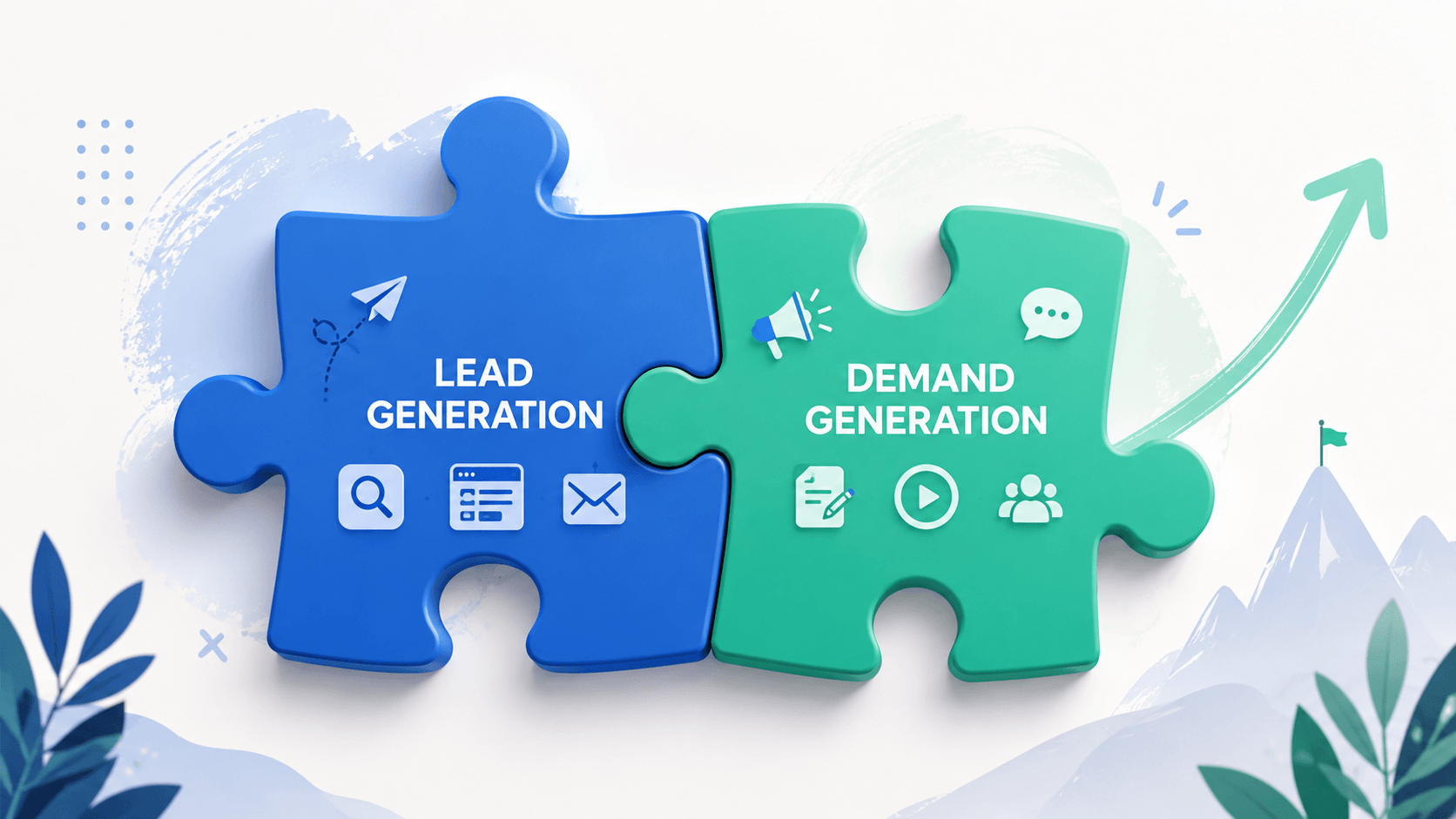
- Lead generation focuses on capturing existing demand. Think forms, gated content, paid search, and outbound messaging. You’re converting existing interest into identifiable prospects.
- Demand generation creates demand where there wasn’t any yet. This strategy leans more into thought leadership, podcasts, paid social, PR, community building, and dark social. You’re building the awareness that turns into intent later.
Why the “vs.” Framing Is (Mostly) Wrong – And What to Do About It
At Scopic Studios, we don’t see lead generation and demand generation as opposing strategies. In fact, we see them as two parts of the same growth engine.
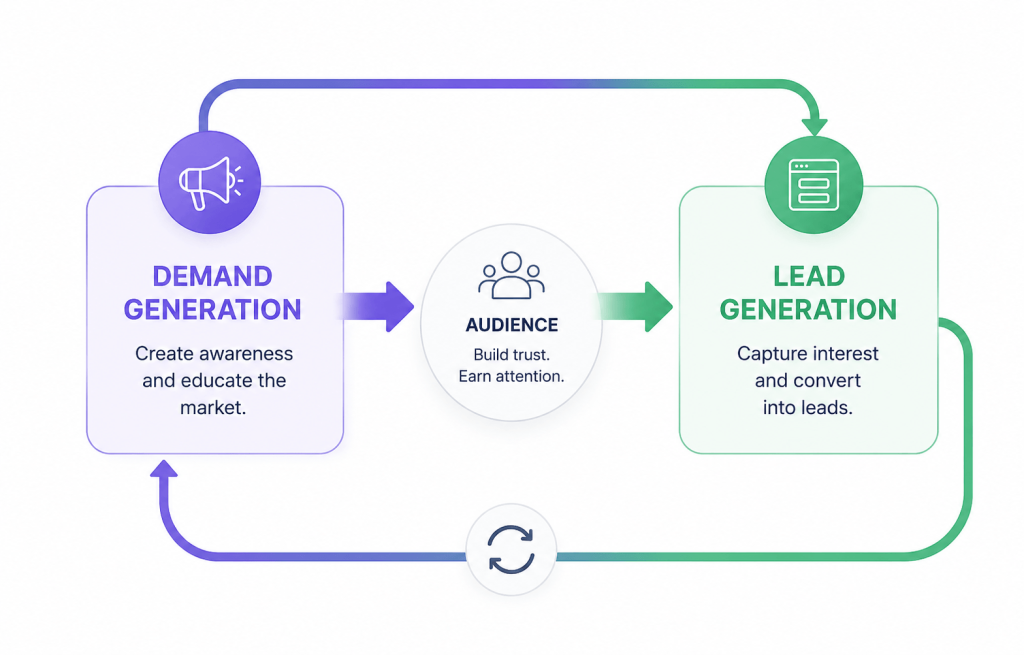
While they focus on different areas, we consider them sequential stages of the same revenue motion. The image below shows how these separate yet interconnected approaches work together:
Unfortunately, a big mistake companies make is treating them as an either-or decision or focusing all their efforts on one area and considering the other a “nice-to-have” when time and budget allow.
We’ve seen it all before. But the problem is that neither strategy is usually enough on its own.
Remember the 95% statistic we mentioned above? If your entire strategy is built around capturing that 5%, you’re competing with every other vendor for the same tiny sliver of the market, and your costs will likely go up every quarter.
On the other hand, demand generation can become more of a brand-building exercise than a revenue-driving one when handled alone. You can put out the best podcast in your industry, but if there’s no way to capture leads when those prospects eventually enter the market, you’re handing them to your competitors at the moment of intent.
All this to say that demand generation and lead generation should feed into each other. Demand generation helps create awareness and trust, making lead generation more effective. Lead generation helps validate whether your demand generation efforts are reaching the right audience and driving meaningful opportunities.
Demand Generation vs. Lead Generation: A Stage-by-Stage Framework
We can talk all day about how these strategies work together, but until you see a real framework, it may not fully click. To help illustrate the balance between lead generation and demand generation, here are four stages to guide your approach.
Stage 1: Pre-Product-Market Fit – Almost All Lead Gen
This is where it all begins. Depending on your experience in the industry, you may still be validating exactly who your ideal customers are and what messaging resonates most with them.
If you’re in the early stages of bringing a product or service to market, your primary goal is to generate conversations. This may include outbound outreach, founder-led sales, paid search targeting bottom-of-funnel keywords, and highly targeted LinkedIn ads aimed at a clearly defined ICP.
At this stage, SEO typically isn’t the priority. While we’re strong supporters of online visibility, SEO can take six months or more to generate meaningful results. For early-stage companies that are still refining their offering or may need to pivot, that timeline often makes other channels a better investment.
At this stage, we recommend allocating roughly 85-90% of your efforts to lead generation and 10-15% to demand generation.
Stage 2: Early Traction – Lead Gen Heavy, Demand Gen Foundation
With a clear ICP in place, you can start scaling the lead generation initiatives that got you here while laying the demand generation foundation that will pay off later.
You can continue focusing on lead generation strategies such as paid search, paid social campaigns with strong lead capture, outbound outreach, and intent data.
At the same time, you can start investing more heavily in demand generation. This may include developing a clear point of view, launching a podcast or newsletter, building founder thought leadership on LinkedIn, and building an SEO strategy around 5-10 priority keywords.
At this stage, we recommend allocating roughly 65-70% of your efforts to lead generation and 30-35% to demand generation. Content marketing services can be particularly valuable here, as developing a sustainable content strategy now will help support the next stage of growth.
Stage 3: Scaling – The Inversion Point
This is the stage where many companies get lost in the demand vs. lead generation debate.
The challenge is that continuing to push lead generation harder and harder can eventually lead to rising customer acquisition costs, lower-quality MQLs, and growing friction between sales and marketing. Understanding how to avoid low-quality leads becomes increasingly important at this stage, which is why companies should shift more of their investment toward demand generation and audience-building initiatives.
During this stage, we recommend allocating roughly 35-45% of your efforts to lead generation and 55-65% to demand generation.
Most of the new budget goes into demand generation initiatives such as branded content, organic social, podcasts (both your own and sponsorships), category-defining research, PR, and community-building efforts. Lead generation narrows to the channels that consistently convert, such as a focused set of paid keywords, retargeting campaigns, and high-intent capture.
And now’s the time to invest in SEO services, as compounding organic traffic starts to pay off. At this stage, SEO functions more as a demand generation channel than a lead generation one. The goal is to build visibility, credibility, and market presence long before buyers are ready to fill out a form.
Stage 4: Category Leader – Demand Gen Is the Moat
At this stage, demand generation isn’t just a tactic; it’s a competitive advantage. The companies that invested in it during the earlier stages often have a clear edge over those that didn’t.
Here, we recommend increasing demand generation efforts even more. Roughly 70-80% of your marketing investment should go toward demand generation, with the remaining 20-30% focused on lead generation.
Lead generation is now primarily the capture infrastructure sitting beneath a much larger demand engine. Demand generation encompasses brand building, category creation, customer marketing, executive thought leadership, communities, owned media, and the long-term compounding effects of content.
This is where marketing strategy consulting can be particularly valuable. The positioning decisions you make at this stage can shape how your company is perceived for years to come.
The trap to avoid? Cutting demand generation investments during a slow quarter to hit short-term lead targets. It may work in the short term, but it can undermine the long-term momentum you’ve spent years building.
How Demand Gen and Lead Gen Actually Work Together
Demand generation creates interest and familiarity with your brand. Lead generation captures that interest. Sales converts it into revenue.
If any of the three breaks down, the other two often get blamed, and that’s how marketing and sales end up at war.
But as we’ve discussed, it’s time to move past the lead vs. demand generation debate and understand how these strategies work together.
Here’s how the process typically works:
Top of Funnel (TOFU): Demand Creation
This is where demand generation takes place. Think podcasts, social media, PR, top-of-funnel SEO, and paid social campaigns focused on reach and engagement. There are usually no forms or gates involved. The goal is to build familiarity with people who aren’t actively looking for a solution yet.
Middle of Funnel (MOFU): Lead Generation
This is where lead generation comes in. Channels such as branded search, retargeting, gated content for high-intent topics, intent data, and outbound outreach help identify and engage buyers who are already showing signs of interest. The goal is to capture and convert the demand you’ve already created.
Bottom of Funnel (BOFU): Sales Conversion
This is where lead routing, qualification, follow-up, and sales conversations happen. It’s the stage that determines whether all the work above ultimately turns into revenue.
We should note that there’s one important factor often gets overlooked: dark social. These are the buying conversations that happen in Slack communities, LinkedIn messages, private groups, email threads, and other channels that attribution tools can’t track.
The reality is that a portion of your pipeline is influenced by demand generation efforts you’ll never be able to measure directly. That’s why companies that only invest in activities they can attribute often end up underinvesting in the channels that drive long-term growth.
Common Pitfalls When Choosing Between Demand Gen and Lead Gen
As a leading digital marketing company, we’ve learned a thing or two about balancing these strategies. To help you avoid costly mistakes, let’s look at some of the most common pitfalls.
- Picking one and ignoring the other. If your strategy sidelines either demand generation or lead generation, you’re likely missing opportunities to both engage and convert potential customers. Remember, the balance between the two should depend on your stage of growth.
- Measuring demand gen with lead gen metrics. If you judge a podcast by the number of leads it generates, you’ll likely kill it before it has a chance to work. Demand generation often takes months to compound. Instead, look at leading indicators such as branded search volume, direct traffic, self-reported attribution, and engagement from your target audience.
- Gating everything to hit MQL targets. Every gated asset creates friction. While some high-intent content should be gated, most top-of-funnel content should be freely accessible. The demand generation value comes from consumption and engagement, not just email addresses.
- Treating attribution as absolute truth. Attribution tools can only measure part of the buyer journey. Many buying conversations happen in private channels, communities, direct messages, and word-of-mouth referrals. Use self-reported attribution alongside platform data to build a more complete picture.
- Cutting demand gen first when budgets get tight. Lead generation results tend to be easier to measure, which makes demand generation an easy target during budget cuts. The problem is that the impact of reducing demand generation often doesn’t show up until months later, when pipeline growth begins to slow.
- Not aligning the mix to your stage of growth. A Stage 1 startup running a Stage 4 demand generation strategy can burn through cash without generating enough opportunities. Meanwhile, a Stage 3 company relying on Stage 1 lead generation tactics may eventually hit a customer acquisition cost ceiling. Match the mix to where your business is today.
How to Choose a Demand Gen and Lead Gen Partner
By now, it should be clear that the goal isn’t to choose between demand generation and lead generation. Instead, you need a partner that understands how to balance both based on your business goals and stage of growth.
Not sure how to narrow down your options?
Here’s a quick checklist:
- They ask what stage you’re in before recommending a solution. If the first conversation focuses on deliverables and retainers instead of your business goals, growth stage, and challenges, that’s worth paying attention to.
- They’ve successfully executed both strategies. A performance-focused agency may naturally lean toward lead generation, while a content-focused agency may prioritize demand generation. The right partner understands both and knows when to increase or decrease investment in each.
- They have a measurement plan that goes beyond MQLs. Ask how they evaluate demand generation efforts. If every metric revolves around lead volume, they may be missing part of the picture. Look for discussions around branded search, share of voice, pipeline contribution, self-reported attribution, and overall business impact.
- They provide case studies with context. Anyone can showcase results. What matters is understanding the client’s stage of growth, the strategy they implemented, and the trade-offs involved along the way.
- They prioritize strategy before channels. The right digital marketing services partner will focus on positioning, goals, and business strategy before discussing tactics. Channels are important, but they should support the strategy, not define it.
Conclusion and Key Takeaways
Repeat after us: lead generation vs. demand generation is not a competition. It’s a balancing act, and the right mix depends on your stage of growth.
While this article provides a framework for balancing lead generation and demand generation at different stages of growth, there’s no one-size-fits-all approach. The right strategy depends on your company’s unique goals, challenges, market position, and long-term vision.
That’s why it’s important to evaluate your specific needs rather than following any framework blindly. The companies that see the best results are the ones that adapt their strategy as they grow.
At Scopic Studios, we help businesses develop marketing strategies that balance short-term lead generation with long-term demand creation. If you want to build the right mix for your business, contact us to learn how we can help.
FAQs About Lead Generation vs Demand Generation
What is demand generation vs. lead generation in plain English?
Demand generation is the process of building awareness, interest, and trust with potential buyers before they’re ready to purchase. Lead generation focuses on identifying and capturing those buyers once they show intent.
Which is better for B2B - demand generation or lead generation?
When comparing B2B demand generation vs. lead generation, neither approach is “better.” The right mix depends on your company’s stage of growth, goals, and market position. Early-stage businesses often rely more heavily on lead generation, while established companies typically invest more in demand generation to build a long-term competitive advantage.
Is lead generation dead?
No, lead generation is far from dead. Businesses still need a way to identify and engage interested prospects. The challenge is that lead generation works best when it’s supported by demand generation efforts that build awareness, trust, and familiarity before buyers enter the market.
How much should I spend on demand gen vs lead gen?
There’s no universal answer. Early-stage companies may allocate 85-90% of their efforts to lead generation and 10-15% to demand generation. As businesses grow and establish market traction, demand generation often becomes a larger share of the marketing mix.
How do I measure demand generation if there's no form fill?
Demand generation should be measured using indicators such as branded search volume, direct traffic, share of voice, content engagement, self-reported attribution, and pipeline influence. These metrics help show whether your brand is becoming more visible and memorable to potential buyers.
When does it make sense to shift from lead gen to demand gen?
Most companies begin increasing demand generation investments once they have a clear ideal customer profile and a repeatable revenue engine. As growth continues, demand generation typically becomes a larger priority because it helps reduce customer acquisition costs and support long-term growth.
Can a small B2B company do demand generation, or is it only for big brands?
Yes, small B2B companies can absolutely invest in demand generation. In fact, founder-led content, thought leadership, newsletters, and organic social media can be effective demand generation tactics without requiring a large budget. The key is scaling efforts to match your stage of growth.
What's the difference between demand generation and demand creation?
Demand creation focuses on generating awareness and interest among future buyers, while demand generation encompasses the broader process of creating, nurturing, and capturing that demand throughout the buyer journey.
About Lead Generation vs Demand Generation Guide
This guide was authored by Baily Ramsey, and reviewed by Sonja Somborac, SEO Specialist at Scopic Studios.
Scopic Studios delivers exceptional and engaging content rooted in our expertise across marketing and creative services. Our team of talented writers and digital experts excel in transforming intricate concepts into captivating narratives tailored for diverse industries. We’re passionate about crafting content that not only resonates but also drives value across all digital platforms.