
Listen to article
AI is quickly becoming the go-to way to find information. In fact, OpenAI recently revealed that ChatGPT infrastructure supports 800 million users, demonstrating its readiness to handle this growing search demand.
Unlike Google, however, major AI engines don’t give brands a straightforward dashboard, ranking position, or impressions report. So how do companies know where they stand across ChatGPT, Perplexity, and Google AI Overviews?
It’s complicated, but not impossible. That’s why we’re covering how to track brand mentions in AI search, how each major platform differs, and how to turn those insights into action.
What Does It Mean to Track Brand Mentions in AI Search?
Tracking brand mentions in AI search goes beyond simply asking whether your company has been cited. It’s about understanding where, how often, and in what context your brand appears across AI-generated responses for relevant search queries.
It’s also important to understand the difference between mentions and citations. A mention means your brand appears within the AI-generated answer itself, while a citation means your website is directly referenced as a source. This distinction matters because brands can still gain visibility and authority even when users never click through to the website.
Since AI search engines are designed around answer-first experiences, brand mentions can influence awareness, trust, and purchase consideration without relying entirely on traffic. In many cases, these mentions act as measurable signals of brand authority and visibility within AI-driven search experiences.
This is one of the biggest differences between traditional SEO and AI search visibility:
- Traditional SEO: Professional SEO services focus on where your website ranks within a list of search results.
- AI search visibility: Focuses on whether your brand appears in the AI-generated answer at all and how prominently it is positioned within the response. Many businesses now use generative engine optimization services to increase their chances of being cited and recommended by AI search engines.
Why Tracking Brand Mentions in AI Search Matters Now
Before jumping into how to track brand mentions in AI search engine results, let’s start with something important: why this matters in the first place.
If we had to summarize it in one sentence, it would be this: optimizing for AI search and tracking brand mentions is no longer optional. As AI-powered search experiences continue reshaping how people discover information, businesses need visibility into how their brands appear across these platforms.
Here are a few reasons why this matters now more than ever:
- The “black box” problem: AI platforms don’t provide the same level of transparency as traditional search engines. Unlike Google Search Console, platforms like ChatGPT and Perplexity don’t offer native analytics dashboards for brand visibility, meaning businesses need to track these insights themselves.
- AI search is increasingly influencing trust: One study found that nearly half of respondents said AI influences which brands they trust. If your business isn’t visible in these experiences, you could be missing valuable awareness and consideration opportunities.
- Customer consideration is happening earlier: By the time users click on a website, AI may have already shaped their perception of competing brands, products, or services. Tracking brand mentions helps businesses understand how they are being represented before the customer even visits their site.
- AI visibility can compound over time: As brands appear more consistently across AI-generated responses, they may improve long-term visibility, familiarity, and perceived authority within these platforms. Tracking mentions helps businesses monitor that momentum and identify opportunities to improve their presence over time.
How ChatGPT, Perplexity, and Google AI Overviews Differ (and Why That Changes How You Track Each)
If you’re learning how to track brand mentions in AI search, one of the most important pieces of advice we can offer is not to treat all AI search engines the same.
ChatGPT, Perplexity, and Google AI Overviews all differ in how they work, with each engine pulling from different sources and handling citations and links differently. In other words, tracking brand mentions isn’t a single workflow but rather a set of separate processes tailored to each platform.
Tracking Brand Mentions in ChatGPT
Tracking brand mentions in ChatGPT can be difficult because responses vary based on the model, prompt, and whether live web retrieval is being used.
Some answers rely on pretrained knowledge that may not update frequently, while others use live web retrieval (RAG) to surface more current information. This means brand visibility can change depending on the query and timing.
ChatGPT also handles citations inconsistently. Brands are often mentioned without clickable links, making referral traffic and attribution harder to track through traditional analytics.
Because responses can differ significantly between runs, it’s best to test the same prompt 3 to 5 times to identify recurring mentions and patterns.
Tracking Brand Mentions in Perplexity
Perplexity is generally the easiest AI search engine to track because its responses consistently include numbered citations with clickable links. This makes it much simpler to identify referral traffic and source visibility.
For the clearest insights, combine prompt-level monitoring with GA4 referral tracking for traffic coming from Perplexity domains.
Perplexity also prioritizes fresh content more heavily than ChatGPT, meaning newer articles, updates, and recently published pages are more likely to appear in responses.
Tracking Brand Mentions in Google AI Overviews
Google AI Overviews play by a slightly different set of rules than ChatGPT and Perplexity. Instead of acting like standalone AI assistants, they appear directly in Google search results and combine traditional SEO ranking signals with AI-generated summaries.
To track visibility, you’ll want to combine Google Search Console data with manual SERP monitoring and SEO platforms that track AI Overview appearances. Filtering informational queries can help you spot where AI Overviews are being triggered and whether your brand is being featured.
And this matters more than ever. AI Overviews are now appearing across a growing share of informational searches, especially in competitive SaaS and technology spaces where visibility can directly influence brand discovery.
How to Track Brand Mentions in AI Search: A Step-by-Step Methodology
We’re not just telling you how these engines differ; we’re breaking it down into step-by-step instructions so you can better understand how to apply these insights to your company.
Step 1: Work Out Your Prompt Set and Competitive Set
Do as the customers do. Create 20 to 30 prompts that mirror the way real buyers communicate with AI. This includes brand queries (your brand name plus variants), category queries (“best [category] for [use case]”), comparison queries (“[your brand] vs. [competitor]”), and problem queries (“how do I solve [pain point]?”).
Here are some examples of what these prompts may look like for a software company:
- Brand queries: “Is [brand] worth it for a growing SaaS company?”
- Category queries: “What’s the best CRM for a remote sales team?”
- Comparison queries: “Best alternative to [competitor]”
- Problem queries: “What’s the best way to manage customer onboarding?”
For AI search, your competitive set isn’t just other software companies; it’s also the websites AI engines frequently pull information from. That’s why you should track 3 to 5 direct competitors and high-visibility sources like Reddit, G2, Wikipedia, or industry publications. In many cases, these platforms compete for AI visibility just as much as traditional competitors do.
Step 2: Run a Manual Baseline Across All Three Platforms
Run the prompts, then run them again. And then again. (And maybe a couple more times.) You should test each prompt 3 to 5 times across ChatGPT, Perplexity, and Google AI Overviews using incognito or logged-out sessions to reduce personalization.
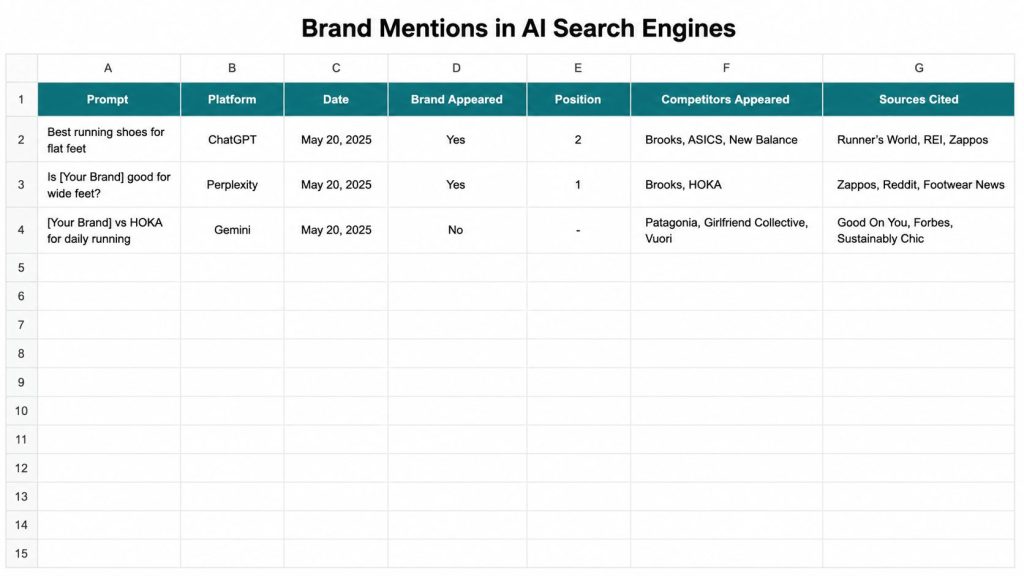
Make sure to keep detailed records of your results. This can be as simple as a spreadsheet tracking the prompt, platform, date, whether your brand appeared, its position, which competitors appeared, and what sources were cited.
Here’s an example of how this may look for an ecommerce company:
The best part? This manual baseline is completely free to do in-house. It may take a few hours, but it gives your company a strong foundation for the rest of the process.
Step 3: Layer in Automated AI Visibility Tracking
Now that you’ve built a manual baseline, it’s time to automate. Manual tracking is helpful in the beginning, but it quickly becomes difficult to manage as the number of prompts grows, especially since AI responses can change from one search to the next.
AI brand monitoring tools solve this by running hundreds of prompts across multiple AI engines and tracking how often your brand appears compared to competitors. They also help you spot trends over time, making it easier to see whether your visibility is improving or declining.
For the best results, run automated tracking weekly for category and comparison prompts, and daily for brand and high-intent purchase queries where visibility changes can have a more immediate business impact.
Step 4: Cross-Reference with GA4 and Search Console
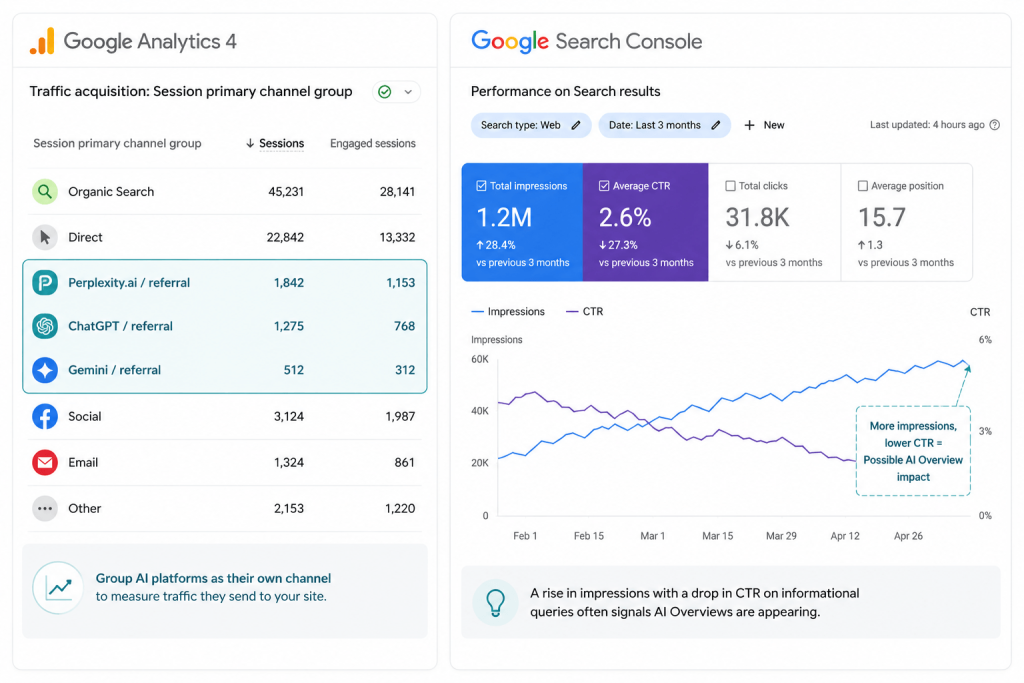
Next, you’ll want to configure GA4 to track traffic coming from AI platforms like Perplexity, ChatGPT (chat.openai.com / chatgpt.com), and other AI referrers as their own channel grouping. This makes it easier to measure how much traffic AI search engines are actually sending to your site.
You should also use Google Search Console to identify queries where AI Overviews may be appearing. A noticeable increase in impressions paired with a decline in click-through rate (CTR) on informational searches is often a strong indicator that AI Overviews are being triggered.
Just remember: analytics will never show the full picture. Many AI mentions (especially in ChatGPT) don’t include clickable links, meaning your brand may still be gaining visibility even when referral traffic appears low.
Here’s an example of what AI referral traffic and possible AI Overview signals may look like inside GA4 and Search Console:
Step 5: Standardize What You Record
To actually spot trends over time, you’ll need a consistent way to record your data across both manual and automated tracking.
Using the same tracking format across both manual and automated reports makes it much easier to compare results, identify trends, and spot changes in AI visibility over time.
At a minimum, your tracking should consistently record the prompt, platform, date, whether your brand appeared, competitors mentioned, and whether citations were included.
You can also add more detailed context, such as how your brand was framed in the response (definitive source, supporting reference, or brief mention), the overall sentiment (positive, neutral, or negative), whether a clickable citation link was present, and any additional notes that may help explain changes in visibility.
Want help tracking your AI search visibility? Generative engine optimization helps you improve, monitor, and grow your brand presence across AI search engines.
What to Measure: The Metrics That Actually Matter in AI Search
As we explore how to track brand mentions in AI search, we also need to understand what these metrics actually mean. Instead of focusing only on where your company ranks, it’s important to look at overall visibility, how often your brand is cited, how it’s framed in responses, and more.
Visibility Rate, Not Rank
If there’s one thing SEO professionals, GEO experts, and companies across industries can agree on, it’s this: visibility matters.
In AI search, one of the most important metrics to track is your visibility rate, which is the percentage of relevant prompt runs in which your brand appears. Unlike traditional search rankings, getting listed “first” or “third” in a single AI response doesn’t mean much because responses can vary dramatically between searches.
What matters more is consistency. If your brand regularly appears across 50 to 100 prompt runs, that’s a much stronger indicator of real AI visibility than a single high-ranking mention.
Share of Voice (Citation Share)
Share of voice is all about measuring how often your brand appears compared to competitors in AI-generated responses. Put simply, it shows how large a share of the AI conversation your brand owns within your industry or category.
You can calculate it using a simple formula:

For example, if your brand appears 30 times across a set of AI-generated responses and all tracked competitors appear a combined total of 120 times, your share of voice would be 25%.
Sentiment and Authority Framing
Word of mouth is important. While that once meant two people chatting over coffee, it now includes how AI search engines talk about your brand.
Is your brand being mentioned positively? Negatively? Is it being positioned as an authoritative source, or simply grouped with other supporting references?
These are all important signals to pay attention to when tracking AI visibility. In many cases, a few strong citations that frame your brand as a trusted authority can be far more valuable than dozens of brief mentions that don’t carry much influence.
Co-Mention and Competitive Context
Pay attention to who your brand gets mentioned alongside. If you consistently appear next to the same three or four competitors, that’s usually a strong signal that AI engines understand where your company fits within the market and category.
If platforms like Reddit, Wikipedia, G2, or industry publications are dominating the conversation instead of actual brands, that may signal an opportunity to adjust your strategy. In some cases, that could mean investing more in earned media, third-party reviews, community discussions, or authoritative content that AI engines are more likely to cite.
Trend Over Time (30–60 Day Windows)
Trying to read too much into a single data point is usually a waste of time. The real insights come from tracking trends over longer periods, with 30 to 60 days often being the sweet spot.
AI search results can fluctuate constantly from day to day, so it’s more important to focus on broader patterns in visibility, citations, and sentiment rather than reacting to every small change.
That’s why reviewing your data weekly or monthly tends to be much more effective than obsessing over individual prompt runs or daily fluctuations.
Common Pitfalls When Tracking Brand Mentions in AI Search
In addition to knowing how to track brand mentions in AI search engines, it’s just as important to know what not to do. Here are some of the most common mistakes companies make:
- Only tracking your brand name. If you’re not monitoring category and problem-based queries, you’re missing where a huge amount of AI-driven discovery actually happens.
- Treating rank like a traditional SEO metric. AI responses are constantly changing, so getting overly focused on whether you ranked “first” or “third” usually isn’t very meaningful. Focus on visibility rate instead.
- Tracking only once a month. AI search trends move quickly. Weekly tracking gives you a much better understanding of how your visibility is changing over time.
- Ignoring competitive context. A 30% visibility rate could be excellent, or terrible depending on how often competitors are being mentioned.
- Tracking without optimizing. Collecting data is only useful if it leads to action. Every tracking cycle should end with clear next steps or optimization opportunities.
- Confusing mentions with citations. A linked citation can drive referral traffic, while an unlinked mention is more about awareness and visibility. Both matter, but they should be measured separately.
- Overlooking Google AI Overviews because they “feel like SEO.” AI Overviews are their own visibility surface and should be tracked separately from traditional organic rankings.
Turning AI Visibility Data Into Action
Tracking brand mentions in AI search engines is only useful if the data actually leads to action. The goal isn’t to collect endless spreadsheets, dashboards, and reports; it’s to understand where your visibility stands, identify opportunities, and improve how often your brand appears in AI-generated responses.
Here are some of the most effective ways to turn AI visibility insights into growth opportunities:
- Identify and close AI blind spots: Review the category and problem-based prompts where your brand rarely appears and investigate why. In many cases, the issue comes down to missing pages, outdated content, weak authority signals, or content that simply doesn’t answer the query clearly enough for AI engines to surface it.
- Strengthen content for AI extraction: AI engines favor content that’s easy to understand and summarize. Adding concise 30 to 40 word answers beneath H2 headings, implementing FAQ schema, including proprietary statistics, and featuring named experts can all improve your chances of being cited in AI-generated responses.
- Pursue earned coverage on trusted domains: AI search engines tend to pull information from well-known, trusted websites more often than smaller or less-established sources. That’s why digital PR, third-party reviews, industry publications, and community-driven platforms can play a major role in improving your AI visibility and citation potential.
- Refresh your content every 30 to 45 days: Freshness matters in AI search. Recently updated content is significantly more likely to appear in AI-generated citations than stale pages, especially for fast-moving industries, SaaS topics, and informational searches where AI engines prioritize current information.
- Build topic clusters around core industry questions: AI systems like ChatGPT often break broad prompts into multiple related sub-queries before generating a response. Creating clusters of related content around the biggest questions in your industry increases the chances that your pages appear across multiple retrieval paths, strengthening your overall AI visibility.
The Bottom Line and Key Takeaways
By now, you should have a much clearer idea of how to track brand mentions in AI search. But it’s completely normal if this process still feels a little unfamiliar at first.
AI search has created a tracking gap that traditional SEO tools can’t fully fill, but that doesn’t mean companies can afford to ignore it. Tracking brand mentions across ChatGPT, Perplexity, and Google AI Overviews is quickly becoming a core part of modern marketing.
As you start monitoring visibility rate, share of voice, and authority framing, the process will become much easier to understand. Just remember: tracking only matters if it leads to action. The brands improving their content, authority, and visibility today are building an advantage that will become harder to catch up with over time.
As a leading AI digital marketing agency, we’ve learned how to navigate AI visibility tracking firsthand. If you want help optimizing your company for AI search engines, contact our team today.
FAQs About How to Track Brand Mentions in AI Search
How do I check if my brand is mentioned in ChatGPT?
Start by creating a list of prompts your customers are likely to search for, including brand, category, comparison, and problem-based queries. Then run those prompts multiple times in ChatGPT using logged-out or incognito sessions and record whether your brand appears, how it’s framed, and whether citations are included.
What’s the difference between an AI mention and an AI citation?
An AI mention is when your brand is referenced in an AI-generated response, even without a clickable link. An AI citation includes a linked source or reference pointing back to your website or content. Mentions help build visibility and awareness, while citations are more likely to drive measurable referral traffic.
Can Google Analytics track AI search traffic?
GA4 can track some AI search traffic, especially from platforms like Perplexity and ChatGPT when clickable citations are included. However, analytics won’t capture every mention because many AI-generated responses reference brands without sending users directly to a website.
How often should I track my brand mentions in AI search?
For most companies, weekly tracking is a good starting point. Brand and high-intent purchase queries may require daily monitoring, while category and informational prompts can often be reviewed weekly or biweekly to identify longer-term visibility trends.
What’s a good AI visibility rate?
There’s no universal benchmark because visibility rates vary heavily by industry and competition level. Instead of focusing on a “perfect” number, compare your visibility rate against competitors and monitor whether your brand is appearing more consistently over time.
How long does it take to improve brand visibility in AI search?
Most companies begin seeing changes within a few weeks to a few months, depending on how competitive their industry is and how aggressively they improve content, authority signals, and third-party visibility. AI visibility tends to improve gradually rather than overnight.
Do I need dedicated tools, or can I track manually?
You can start manually using spreadsheets, prompt testing, GA4, and Google Search Console. However, once you begin tracking larger prompt sets or multiple competitors, dedicated AI visibility platforms become much more efficient and scalable.
Is tracking brand mentions in AI Search a good bet for early-stage or smaller companies?
Yes. In fact, smaller companies can often benefit the most because AI search creates new opportunities for visibility outside of traditional search rankings. A strong content strategy, authoritative mentions, and clear expertise can help smaller brands appear alongside much larger competitors in AI-generated responses.
About How to Track Brand Mentions in AI Search Guide
This guide was authored by Baily Ramsey, and reviewed by Sonja Somborac, SEO Specialist at Scopic Studios.
Scopic Studios delivers exceptional and engaging content rooted in our expertise across marketing and creative services. Our team of talented writers and digital experts excel in transforming intricate concepts into captivating narratives tailored for diverse industries. We’re passionate about crafting content that not only resonates but also drives value across all digital platforms.