
Listen to article
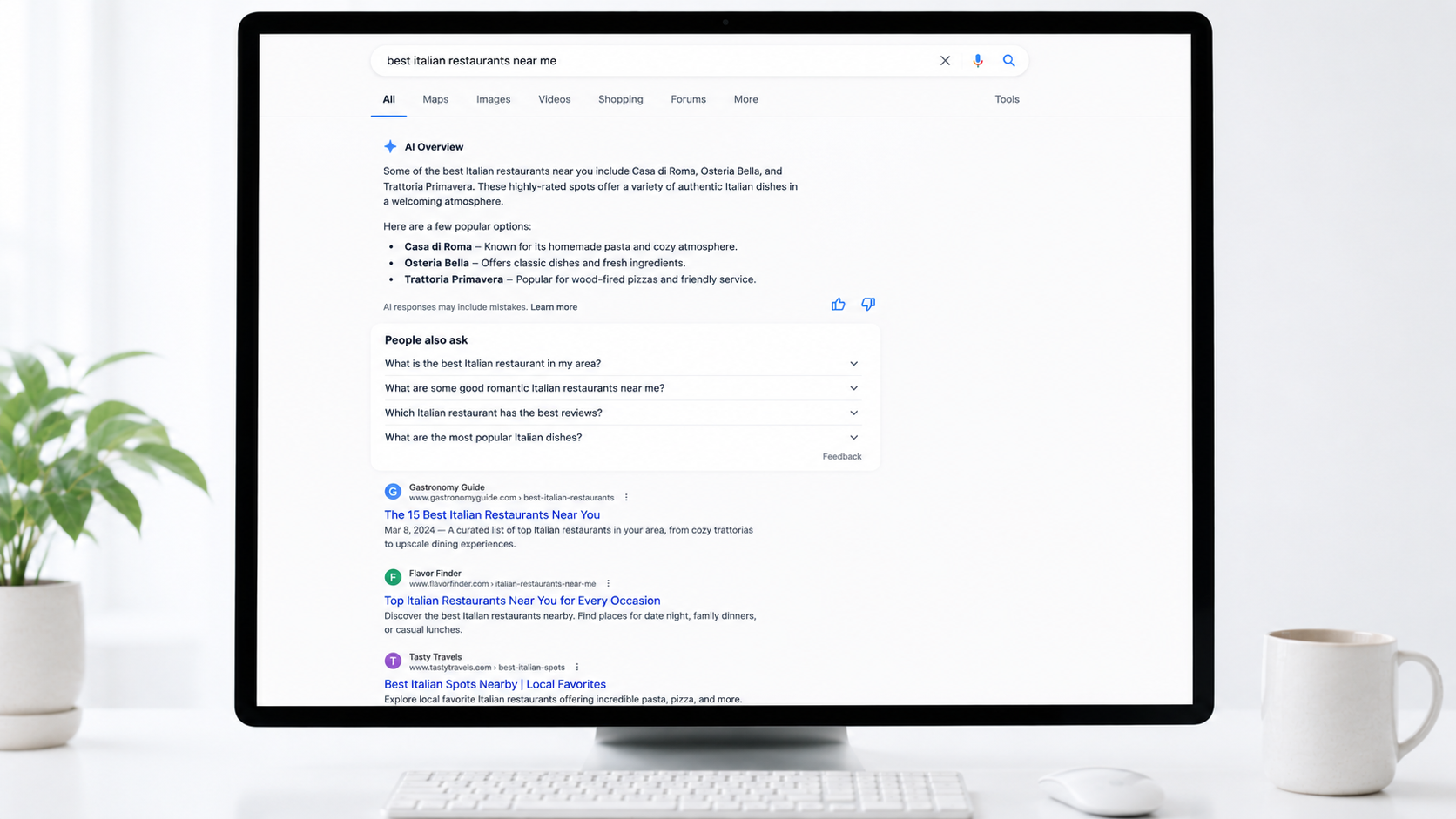
Over 58% of Google searches now end without a single click to an external website, according to WSI World (2025). That figure tells you something critical: ranking at the top of Google is no longer enough on its own. Search experience optimization (SXO) is the approach that bridges the gap between visibility and conversion, combining traditional SEO with user experience (UX) and conversion rate optimization (CRO) to turn search traffic into real business outcomes. In this guide, you will find the core pillars, key strategies, the right tools, and a step-by-step implementation process for building an SXO strategy in 2026.
What is Search Experience Optimization (SXO)?
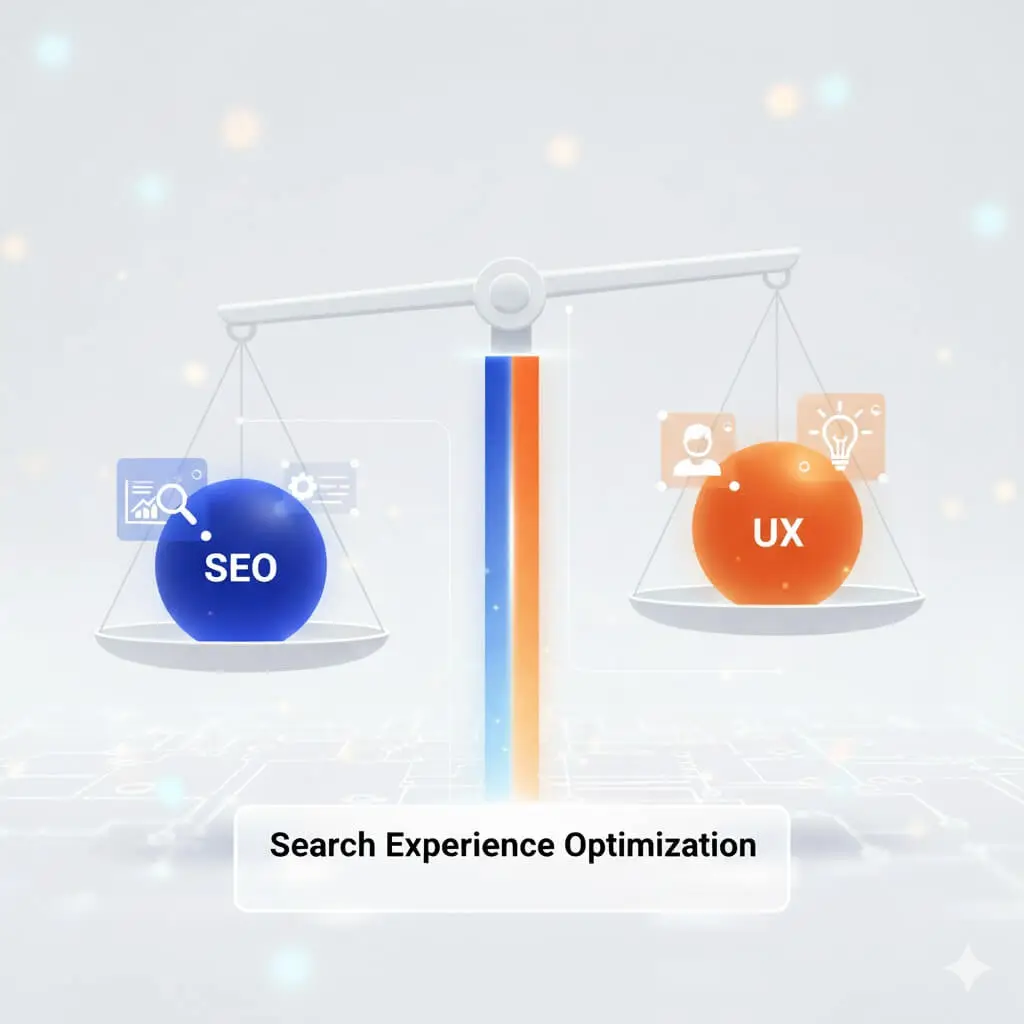
Search experience optimization (SXO) is a strategic approach that combines SEO, user experience (UX), and conversion rate optimization (CRO) to not only attract organic traffic but also deliver a website experience that converts visitors into customers. SXO has naturally emerged as the next step beyond traditional SEO: it uses keyword research, intuitive navigation, optimized site speed, and high-quality content to turn rankings into conversions and visitors into loyal customers.
While SEO gets people to your website, UX ensures they stay and engage, and CRO ensures those engagements turn into the actions that matter: purchases, sign-ups, inquiries, or downloads. SXO treats all three as a unified system rather than separate concerns.
SXO vs. SEO
Search engine optimization (SEO) is the practice of improving a website’s content, structure, and technical elements to increase visibility in search engines and attract organic traffic. It remains the foundation of any digital marketing strategy, and SXO does not replace it: SXO builds on and enhances SEO by adding the experience layer that turns rankings into results.
Key differences include:
- Purpose: SEO optimizes for visibility and rankings. SXO optimizes for the full journey from search query to conversion.
- Key metrics: SEO tracks rankings, traffic, and click-through rates. SXO adds engagement metrics: bounce rate, session duration, scroll depth, and conversion rate.
A concept closely tied to SXO is pogo-sticking: the behavior that occurs when a user clicks on a search result, immediately bounces back to the SERP, and clicks a different result. This signals to Google that your page did not satisfy the user’s intent, which can gradually damage your rankings even if your technical SEO is strong. The most common cause of pogo-sticking is not poor content quality in isolation: it is a mismatch between what the user expected based on the search query and what your page actually delivers. SXO directly addresses this by aligning content, messaging, and page design with the intent behind each query, so visitors stay rather than bounce.
In short: getting visitors to your site is only half the job. Companies that combine SEO, UX, and CRO are well positioned to build trust, reduce pogo-sticking, and convert visitors into longtime customers.
The Benefits of SXO
The benefits of SXO are hard to deny, and companies that don’t adopt SXO strategies risk falling behind competitors. Here are the key benefits:
- Higher conversion rates: A great website experience translates to higher conversions, whether that involves purchasing a product, downloading an e-book, or signing up for a subscription.
- CRO as a direct outcome: SXO explicitly targets the conversion layer: the landing page friction, CTA placement, and page flow that determine whether traffic becomes revenue. Unlike traditional SEO, which stops at the click, SXO optimizes the full journey from query to action.
- Better brand reputation: Your website represents your brand. When your digital storefront is organized, polished, and enjoyable to use, it sends the right message about your business and builds lasting trust.
- Search results built to last: Technology and user behavior are constantly changing. By implementing SXO, you stay relevant through algorithm updates, zero-click trends, and shifting expectations, because you are optimizing for the user, not just the crawler.
The 7 Core Pillars of Search Experience Optimization
SXO combines SEO, UX, and CRO into a unified framework. The seven pillars that make this possible are:
1. SEO Basics: Visibility & Rankings
Remember: SXO doesn’t replace SEO; it enhances it by building on its foundation.
That means that traditional SEO strategies, such as keyword research, high-quality backlinking, and on-page optimization, are still key strategies for improving online visibility.
In fact, it’s the first step to getting people to visit your website. After all, what’s the point of having a great website if no one sees it?
At Scopic Studios, our SEO services help companies increase website traffic and achieve higher conversions, giving them a competitive edge that SXO strengthens even further.
Curious how we helped one of our clients boost organic traffic by 345% and increase organic conversions by 211%? Check out this portfolio entry!
2. Content Quality
The quality of your website content is a key component of both SEO and SXO. Strong SEO copywriting ensures that pages are keyword-optimized, aligned with search intent, and reflect E-E-A-T principles (Experience, Expertise, Authoritativeness, Trustworthiness).
Critically, content quality in SXO requires aligning every page with the correct type of search intent:
- Informational intent: Users looking to learn something (e.g., ‘what is SXO’). These pages should answer questions clearly and completely, without forcing a sales message.
- Navigational intent: Users looking for a specific brand or page (e.g., ‘Scopic Studios SXO services’). These pages should make it effortless to find exactly what the user came for.
- Transactional intent: Users ready to take an action (e.g., ‘hire SXO agency’). These pages should lead with trust signals, clear CTAs, and minimal friction.
A content piece that ranks well for a transactional keyword but reads like an informational blog will generate pogo-sticking and low conversions, no matter how well it ranks. Matching content format and messaging to intent is one of the highest-leverage improvements an SXO strategy can make.
3. Engagement Metrics
SXO professionals measure conversion and engagement metrics: bounce rate, average session duration, scroll depth, and conversion rate. These signals guide strategy. For instance, if your website attracts traffic but shows a high bounce rate, it may indicate slow site speed, irrelevant content, a search intent mismatch, or weak navigation. Each metric points to a specific lever to pull.
4. Site Speed & Performance
Websites have approximately 50 milliseconds to make a first impression on a visitor (Summergroup, 2026). Site speed is not just a UX concern: it is a direct Google ranking factor, tied to the Core Web Vitals framework.
Google measures site performance through three Core Web Vitals metrics, which are part of its Page Experience ranking signals (Google/web.dev):
- LCP (Largest Contentful Paint): Measures loading speed, specifically when the main content element becomes visible. Target: under 2.5 seconds.
- INP (Interaction to Next Paint): Measures responsiveness to user interactions such as clicks, taps, and keypresses. Target: under 200 milliseconds. INP replaced First Input Delay (FID) as the official responsiveness metric in March 2024.
- CLS (Cumulative Layout Shift): Measures visual stability, tracking how much page elements shift unexpectedly as the page loads. Target: under 0.1.
According to the 2025 Web Almanac, only 48% of mobile pages pass all three Core Web Vitals: meaning more than half the web is failing on mobile. For SXO, this is a significant opportunity. Every second of LCP improvement correlates with higher engagement and lower bounce rates.
5. Technical SEO
Technical SEO optimizes a website’s infrastructure so that search engines can crawl, index, and rank it effectively. SXO professionals implement strategies such as creating an SEO-friendly site architecture, submitting sitemaps to search engines, optimizing for mobile, implementing structured data markup, and resolving crawl errors. These improvements both strengthen rankings and create a smoother user experience.
6. Link Authority and Brand Signals
High-authority links signal to both users and search engines that your content is credible, valuable, and worth visiting. Companies with authoritative brand mentions, citations, and backlinks build a semantically and contextually relevant reputation that improves rankings, drives qualified traffic, and increases conversions. Think of each quality link as a vote of confidence from another website in your industry.
7. Conversion Rate Optimization (CRO)
CRO is the third pillar of SXO that is most frequently missing from traditional approaches, yet it is what separates a high-traffic site from a high-revenue one. CRO within an SXO framework covers:
- Smart CTA placement: CTAs should be contextually relevant to the content on the page and appear at natural decision points in the user journey, not just at the top and bottom of every page.
- Landing page friction reduction: Every unnecessary form field, unclear headline, slow-loading element, or confusing navigation option between the search click and the conversion reduces your conversion rate. SXO audits and removes this friction systematically.
- The full path from search to action: SXO maps the complete journey: what the user searched, what they expected, what they found on the page, and what action they took. Aligning each step of this journey to user intent is what turns rankings into revenue.
Adding CRO as an explicit pillar of your SXO strategy transforms it from a traffic-generation approach into a full-funnel growth system.
Key SXO Strategies
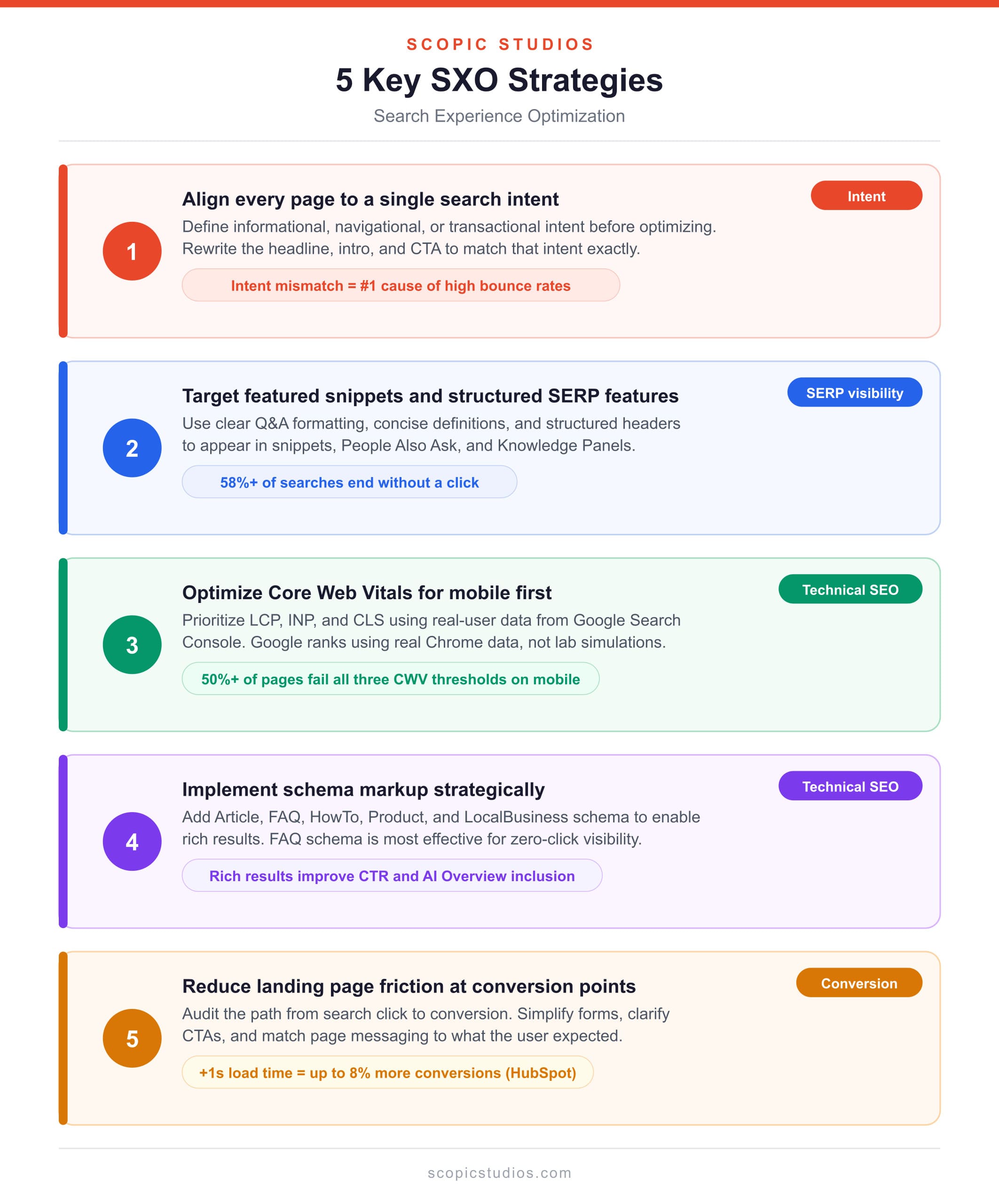
Understanding the pillars of SXO is essential, but applying them requires concrete strategies. Here are five high-impact SXO strategies that move the needle:
- Align every page to a single search intent: Before optimizing any page, define whether it serves informational, navigational, or transactional intent. Rewrite the headline, intro, and CTA to match that intent exactly. A mismatch between what the user searched and what the page delivers is the most common cause of high bounce rates, regardless of content quality.
- Target featured snippets and structured SERP features: With over 58% of searches ending without a click, appearing in featured snippets, People Also Ask boxes, and Knowledge Panels gives your brand visibility and authority even when users don’t visit your site. Use clear question-and-answer formatting, concise definitions, and structured headers to make your content snippet-eligible.
- Optimize Core Web Vitals for mobile-first: Over half of web pages currently fail all three Core Web Vitals thresholds on mobile. Prioritize LCP, INP, and CLS improvements using real-user data from Google Search Console and PageSpeed Insights, as Google’s rankings use real Chrome user data rather than lab simulations.
- Implement schema markup strategically: Structured data (Article, FAQ, HowTo, Product, and LocalBusiness schema) helps search engines understand your content and enables rich results. Rich results attract more clicks, improve CTR, and increase the likelihood of appearing in AI-generated overviews. FAQ schema in particular is one of the most effective tools for zero-click visibility.
- Reduce landing page friction at conversion points: Audit the path from search click to conversion and remove every unnecessary step. Simplify forms, clarify CTAs, ensure mobile usability, and match the page’s visual design and messaging to what the user expected when they clicked. A one-second improvement in load time can increase conversion rates by up to 8%, according to HubSpot performance research.
How to Implement Search Experience Optimization
Understanding SXO strategy and actually implementing it are two different things. Here is a practical, ordered process to get started:
- Conduct a search intent audit: Review your top 20-30 organic landing pages. For each one, identify the primary search intent (informational, navigational, transactional) and assess whether the page content, headline, and CTA match that intent. Pages with a clear mismatch should be prioritized for rewriting.
- Run a Core Web Vitals assessment: Use Google Search Console’s Core Web Vitals report and PageSpeed Insights to identify pages failing LCP, INP, or CLS thresholds. Focus on mobile performance first, since Google’s rankings are based on mobile-first indexing and real Chrome user data.
- Map your conversion funnel from search to action: For each key landing page, trace the full user journey: the query that brought them, the page they landed on, the action you want them to take, and the friction points between arrival and conversion. Document every unnecessary click, form field, or confusing element.
- Implement structured data markup: Add relevant schema types to key pages: Article schema for blog content, FAQ schema for pages with Q&A sections, HowTo schema for instructional content, and Product or Service schema for conversion pages. Validate all schema using Google’s Rich Results Test before publishing.
- Optimize content for engagement and intent alignment: Rewrite intros and headlines to immediately signal relevance to the user’s query. Use clear subheadings, short paragraphs, and visual breaks to improve scroll depth and time on page. Ensure each page answers its primary keyword question clearly within the first 100 words.
- Place and test CTAs at natural decision points: Move CTAs from generic page positions to contextually relevant moments within the content: after a key stat, following a problem-statement section, or at the end of a how-to sequence. A/B test CTA copy, placement, and design to find what converts best for your audience.
- Measure, iterate, and expand: Track the impact of every change using Google Analytics 4, Google Search Console, and session recording tools like Hotjar. Focus on engagement metrics (bounce rate, scroll depth, session duration) and conversion metrics (goal completions, form submissions, CTR). Use this data to refine further and prioritize the next round of improvements.
Best Tools for Managing and Measuring Your SXO Strategy
An effective SXO strategy relies on a combination of tools covering analytics, SEO, UX, and AI visibility. Here is what each tool does within an SXO workflow:
Analytics and Tracking
- Google Analytics 4: Tracks user behavior across sessions, including page engagement rate, scroll depth, conversions, and traffic sources. Essential for understanding how users interact with your site after arriving from search.
- Google Search Console: Provides real-user performance data for Core Web Vitals, keyword rankings, click-through rates, and indexing status. The Core Web Vitals report is the most direct tool for identifying mobile performance issues that affect both rankings and user experience.
- Hotjar: Records user sessions and generates heatmaps showing where users click, scroll, and drop off. Invaluable for identifying friction points on landing pages and informing CRO improvements.
SEO Suites
- Semrush: Covers keyword research, competitor analysis, site audits, and rank tracking. Within an SXO workflow, its site audit tool identifies technical SEO issues and on-page weaknesses that affect both rankings and user experience.
- Ahrefs: Specializes in backlink analysis, keyword research, and content gap identification. Useful for understanding what intent your competitors are targeting and where your authority gaps are.
AI Visibility and GEO Tools
- Peec AI: Tracks your brand’s presence and citation frequency in AI-generated search results across tools like ChatGPT and Perplexity. Helps measure SXO performance in zero-click and generative search environments.
- Alli AI: Automates on-page SEO changes at scale, useful for large sites that need to implement structured data, meta tag optimizations, and content adjustments across hundreds of pages.
- Raleon: AI-powered entity and content optimization tool, focused on strengthening topical authority and structured data implementation.
Entity Management and Structured Data
- Schema.org Validator / Google Rich Results Test: Validates your structured data markup to ensure it is correctly implemented and eligible for rich results in Google Search.
- Screaming Frog: Website crawler that identifies technical issues at scale: broken links, missing meta tags, redirect chains, duplicate content, and schema implementation gaps.
- OnCrawl: Advanced SEO crawling and log analysis platform, particularly useful for large sites where crawl efficiency and index coverage directly impact SXO performance.
SXO in the Era of Search Generative Experience Optimization
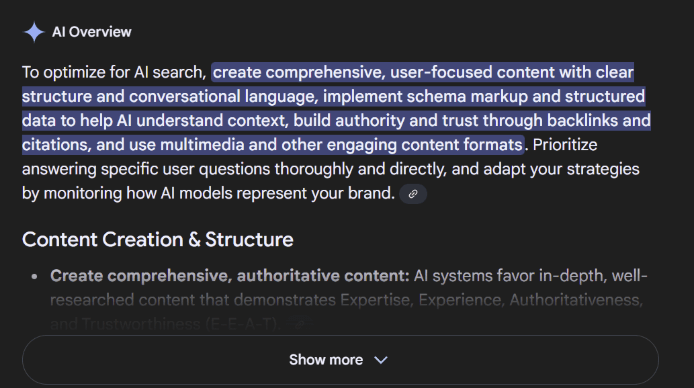
Search generative experience (SGE), now widely referred to as Google AI Overviews, uses generative AI to provide users with synthesized answers directly on the SERP. As our blog on AI-powered search explains, these systems analyze the context of a query, pull relevant details from multiple authoritative pages, and generate summaries that read like natural human explanations.
The practical impact on SXO is significant. With AI Overviews now triggered on nearly 20% of all Google searches as of May 2025 (Semrush), many users get a complete answer without clicking any link. However, brands that are cited within AI Overviews still gain visibility, trust, and authority, even without a direct click. This is the new logic of zero-click optimization: the goal is not just to rank, but to be featured.
To remain visible in a zero-click and AI-first search environment, SXO strategy must actively target SERP features:
- FAQ schema: Pages with FAQ schema have higher eligibility for featured snippet inclusion and People Also Ask boxes, which appear prominently in AI-generated SERP features.
- Featured snippet targeting: Structure content with clear question-and-answer formatting, concise definitions, and step-by-step lists. These formats are most frequently pulled into both traditional featured snippets and AI Overviews.
- Structured data and E-E-A-T signals: AI systems prioritize content from sources that demonstrate clear authorship, expertise, citations, and factual accuracy. Implementing Article schema with author, datePublished, and publisher fields directly supports this.
To implement these tactics at scale and build visibility across both traditional and generative search, explore Scopic’s GEO services.
Future-Proofing with SXO
A good SXO strategy prepares companies for the future. One thing is clear: AI is changing the future of digital marketing, and companies must be prepared to keep up with innovations like search generative experience and conversational AI.
Voice Search and Conversational AI
Voice search and conversational AI are moving users away from short keyword queries toward natural, question-based language. Addressing this shift means focusing on long-tail conversational keywords, implementing structured data, and providing clear, direct answers to common questions, ensuring content is accessible to voice assistants and AI-driven search results.
Personalization and Predictive Intent
AI assistants and large language models are transforming search into a more personalized experience, anticipating what users want based on behavior, preferences, and context rather than serving generic results. SXO prepares businesses for this landscape by building content that is relevant, intent-driven, and structured for machine comprehension.
At Scopic Studios, our team stays ahead of trends so you don’t have to. As technologies and expectations evolve, we help you optimize for AI-driven search, adapt your digital strategy, and create experiences that keep your brand visible.
Success Story: How We Enhanced Conversions with SXO
One of Scopic Studios’ most illustrative SXO projects is our partnership with Shapiro, an organic waste management company. Scopic Studios applied a multi-pillar SXO approach that directly addressed the technical, content, and conversion layers of their website.
Here is how each result connects to a specific SXO pillar:
- Site speed and Core Web Vitals (Pillar 4): Scopic improved Shapiro’s page load performance and mobile experience, reducing bounce rates caused by slow-loading pages and building a stronger technical foundation for rankings.
- Technical SEO and structured data (Pillar 5): The team addressed crawlability issues, implemented structured data markup, and optimized the site architecture, making it easier for Google to index and rank Shapiro’s key pages.
- Navigation and UX design (Pillar 4 / CRO): The user journey was restructured to reduce friction between landing and converting, with clear navigation paths and improved page layouts that guided visitors toward the intended action.
- Content quality and search intent alignment (Pillar 2): On-page content was rewritten to align with the search intent behind Shapiro’s target keywords, improving relevance and reducing pogo-sticking.
- SEO visibility and backlinking (Pillar 1): Keyword targeting and on-page optimization drove organic traffic growth by connecting Shapiro’s pages to the queries their audience was actively searching.
The results of this combined approach:
- 46.9% increase in conversions
- 345% growth in organic traffic
- 211% increase in organic conversions
These outcomes demonstrate that SXO is not just a ranking strategy: it is a conversion strategy. Each pillar contributed to a measurable business outcome, not just a higher position on the SERP.
Final Thoughts
Search experience optimization sits at the intersection of SEO, UX, and CRO, and it is that combination that makes it one of the most complete strategies available for sustainable digital growth. Ranking is no longer the finish line: the full journey from search query to conversion is what determines whether visibility translates into revenue.
If your company has strong visibility but low conversions, steady traffic with little engagement, or high rankings paired with short sessions, SXO is the framework that addresses the gap.
At Scopic Studios, we specialize in search experience optimization that combines technical SEO, UX improvement, and conversion strategy into a single coherent approach. Contact us today to build a tailored SXO strategy that achieves your business goals.
FAQs
What is the difference between SEO and SXO?
SEO is the practice of improving a website’s content, structure, and technical elements to increase visibility in search engines and attract organic traffic. SXO builds on SEO by adding UX and CRO to the equation: it optimizes not just for rankings and clicks, but for what happens after the click. The goal of SXO is to turn search traffic into conversions, not just impressions.
How to optimize for search generative experience?
To optimize for Google’s AI Overviews and generative search: use long-tail, conversational keywords; implement structured data (FAQ schema, Article schema, HowTo schema); structure content with clear question-and-answer formatting; and build E-E-A-T signals through author bylines, citations, and factual depth. For a comprehensive approach to generative visibility, explore GEO services.
What tools are used for SXO?
SXO relies on a combination of analytics, SEO, UX, and AI visibility tools across four categories:
- Analytics and tracking: Google Analytics 4, Google Search Console, Hotjar
- SEO suites: Semrush, Ahrefs
- AI visibility and GEO tools: Peec AI, Alli AI, Raleon
- Entity management and structured data: Schema.org Validator, Google Rich Results Test, Screaming Frog, OnCrawl
See the full tools section above for a detailed explanation of what each tool does within an SXO workflow.
What is the role of AI in SXO?
AI plays a key role in SXO by analyzing user intent, personalizing search experiences, and reshaping how content is discovered and consumed. Generative AI tools like Google AI Overviews, ChatGPT, and Perplexity are changing the search journey: more users get answers directly on the SERP without clicking. SXO adapts to this by targeting SERP features, building structured data, and optimizing content for AI citation alongside traditional rankings.
How is SXO different from CRO?
CRO (conversion rate optimization) focuses specifically on improving the percentage of visitors who complete a desired action on your website, typically through A/B testing, landing page optimization, and funnel analysis. SXO is broader: it includes CRO as one of its three pillars, alongside SEO and UX. CRO starts once someone is already on your site; SXO begins at the search query and optimizes the entire journey from that query through to conversion.
How do I know if my website needs SXO?
Your website is likely a strong candidate for SXO if you are experiencing any of the following: strong organic rankings but disappointing conversion rates; high traffic volumes with short average session durations; a significant gap between impressions and clicks in Google Search Console; or a high bounce rate across key landing pages. These symptoms all point to the same underlying issue: visibility without experience. SXO directly addresses each one.
How long does it take to see SXO results?
SXO results occur at different speeds depending on which pillar you are working on. Technical improvements (Core Web Vitals, structured data, site speed) can show measurable impact within days to a few weeks, as Google recrawls and re-evaluates affected pages. Content and intent alignment improvements typically show ranking and engagement improvements over 4 to 12 weeks. Conversion rate improvements from CRO changes are often visible faster, within 2 to 4 weeks of deploying A/B tests or landing page updates. Full SXO programs typically show compounding results over 3 to 6 months.
What is pogo-sticking and why does it matter for SXO?
Pogo-sticking occurs when a user clicks on a search result, immediately leaves the page, and returns to the SERP to click a different result. It is a behavioral signal that the page failed to meet the user’s expectation, either because the content did not match their intent, the page was too slow to load, or the experience was confusing or frustrating. From an SXO perspective, pogo-sticking is one of the most direct indicators of an intent mismatch or UX failure. Over time, high pogo-sticking rates can damage rankings because they signal to Google that your page is not satisfying the query it ranks for. Fixing pogo-sticking requires identifying whether the cause is content relevance, page speed, navigation clarity, or all three.
About Search Experience Optimization Guide
This guide was authored by Baily Ramsey, and reviewed by Assia Belmokhtar, SEO Project Manager at Scopic.
Scopic Studios delivers exceptional and engaging content rooted in our expertise across marketing and creative services. Our team of talented writers and digital experts excel in transforming intricate concepts into captivating narratives tailored for diverse industries. We’re passionate about crafting content that not only resonates but also drives value across all digital platforms.