
Listen to article
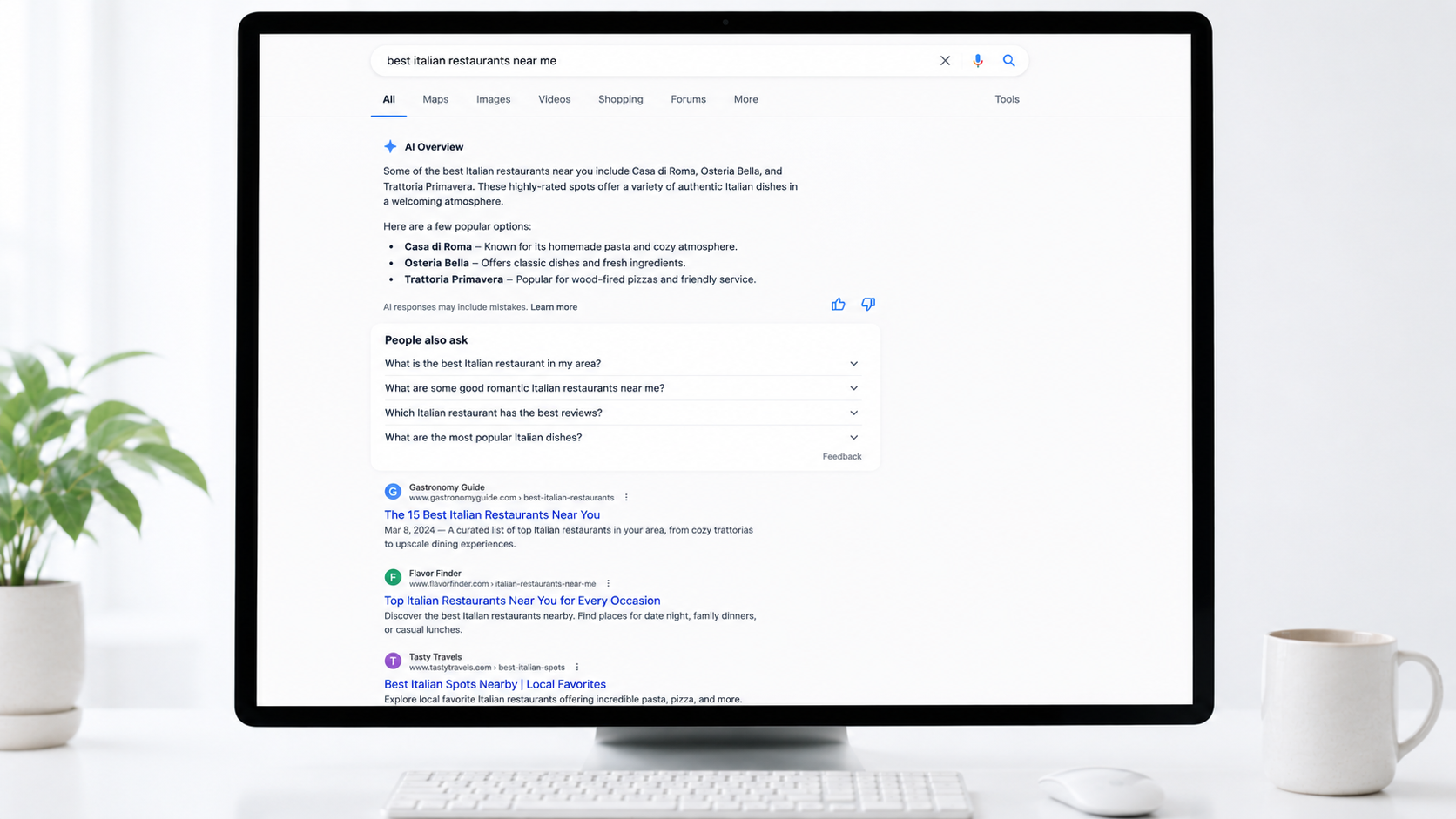
60% of adults report having used artificial intelligence (AI) to search for information. On one hand, this demonstrates how consumer behavior is evolving; on the other, it highlights a valuable opportunity for companies to reach these audiences.
With AI-powered tools and features like Google AI Overview and ChatGPT on the rise, companies must go beyond traditional SEO and adopt LLM optimization (LLMO), an approach that improves your brand visibility in LLM-generated responses.
And since online visibility is a key factor of long-term business growth, LLMO is quickly becoming an integral part of a well-rounded marketing strategy.
Keep reading to learn how to optimize for LLMs, which content formats LLMs prefer, and more.
Key Takeaways
- LLM optimization is the process of refining your content and online presence so that large language models accurately reference, represent, and recommend your brand in their responses.
- To make your content easier for AI systems to understand and reference, structure it clearly with organized headers, bullet points, and summaries, maintain a logical flow that follows user intent, and include an FAQ section to align with conversational queries.
- LLMs understand natural, question-based language, so creating content that mirrors how people actually speak and ask questions increases visibility in AI-generated responses.
- LLMs prioritize clarity and context, so focus on aligning your content with user intent; answer real questions, provide meaningful context, and deliver comprehensive, conversational answers that match what users are truly looking for.
- Keeping your content up to date helps AI models recognize it as credible and relevant, so regularly refresh articles with recent data, current examples, and new insights to maintain authority in AI-generated results.
What Is LLM Optimization?
LLM optimization is the process of refining your content and online presence so that large language models accurately reference, represent, and recommend your brand in their responses. In the world of marketing, LLMO represents a new way of ranking, helping companies increase visibility and authority in an AI-driven environment.
Why LLM Search Optimization Matters in 2025
In today’s technology-driven world, it’s more important than ever to cater to AI-driven search engines.
ChatGPT alone has around 700 million weekly active users , and nearly half of all messages (49%) involve users asking questions. This shows that people increasingly view ChatGPT as an advisor rather than just a task-completion tool.
Pew Research Center also gives us valuable insight into AI summaries in search results. They found that 65% of U.S. adults at least sometimes come across AI summaries in search results, with 45% seeing them extremely often or often.
When it comes to usefulness, one in five respondents (20%) find the information extremely or very useful, while 52% describe it as somewhat useful, as shown below.
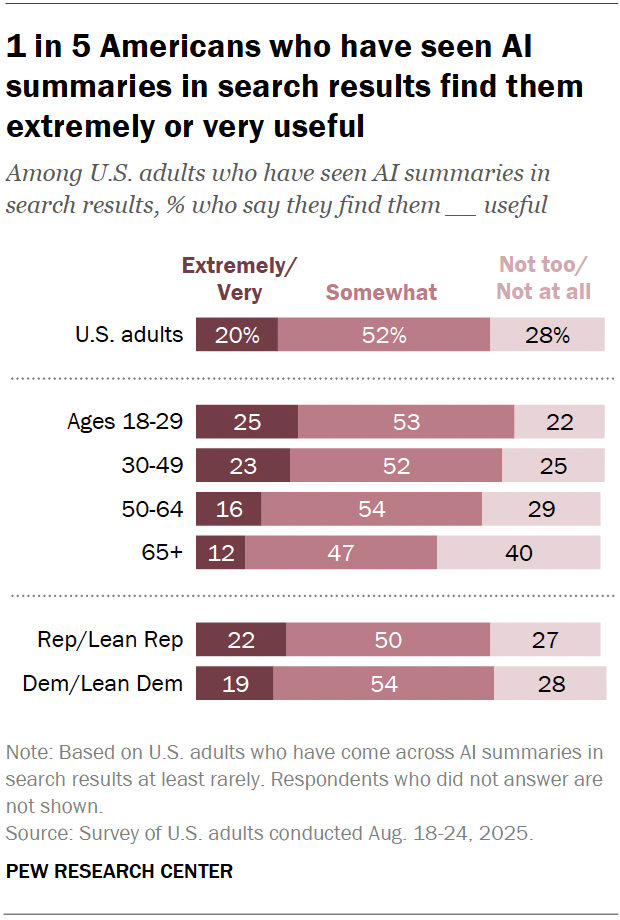
In other words, 72% of U.S. adults find the information in AI summaries at least somewhat useful, demonstrating growing trust in AI-driven search experiences. What does this mean for companies?
That it’s time to start optimizing for LLMs. As AI continues to redefine how users search for and consume information, companies that fail to adapt risk losing visibility and relevance in an increasingly AI-dominated digital landscape.
LLMO vs. SEO: Understanding the Difference
To put it simply, SEO helps you rank on search engines, while LLMO helps you show up in AI conversations.
The table below provides a deeper comparison between the two approaches.
|
Focus Area |
SEO |
LLMO |
|
Primary Goal |
Improve rankings on search engine results pages |
Increase visibility in AI-generated responses and conversation |
|
Optimization Targets |
Keywords, backlinks, metadata, site performance |
Context, accuracy, semantic relevance, and AI-readable structure |
|
Content Approach |
Keyword-driven and structured for ranking factors |
Information-rich, factual, and phrased to align with natural language understanding |
|
Measurement of Success |
Click-through rates, page rankings, organic traffic |
Mentions or citations in AI summaries, brand visibility in AI outputs |
It’s important to note that LLMO is not meant to replace SEO but to build on it to reach a wider audience.
The future of SEO with AI is rapidly evolving. As users increasingly expect instant, authoritative answers—complete with quick summaries and credible citations—companies must focus on becoming sources that AI recognizes and trusts.
At Scopic Studios, our SEO experts have fully adopted LLM search optimization as part of our strategy. By incorporating LLMO best practices, we create tailored strategies designed for both humans and AI algorithms. Contact us for a free quote.
How LLMs Read and Process Your Content
Rather than focusing on elements like backlinks and keyword density as traditional search engine crawlers do, LLMs prioritize semantic clarity and contextual understanding.
They break content down into patterns, entities, and structures, relying on relationships between ideas to interpret meaning.
To enhance accuracy and relevance, many models also use Retrieval-Augmented Generation (RAG), a method that allows them to retrieve updated or domain-specific information from external sources before generating a response.
Here’s how the process works in 5 quick steps:
- Tokenize – Break text into small language units for analysis.
- Understand Context – Interpret meaning, tone, and intent beyond content.
- Recognize Patterns – Identify relationships between ideas using learned data.
- Retrieve Knowledge – Pull relevant information from prior training.
- Generate Responses – Produce coherent, accurate answers based on understanding.
LLMs analyze elements like the order in which information is presented, formatting cues, and redundancy, meaning your content strategy plays a big role in LLM search optimization.
Assia Belmokhtar, SEO Project Manager at Scopic, explains this a little more:
“Large Language Models read and process content through the lens of what we call “entities”: understanding context, tone, and meaning through regular on-page SEO signals (meta tags, HTML text, Schema markups, internal linking, etc), but also through off-site SEO signals (brand mentions across relevant web sources, authoritative backlinks, relevant citations, etc). They interpret relationships between ideas to deliver the most relevant and well-structured information, rather than simply ranking pages. In fact, there’s no such thing as “keywords” or “rankings” in LLMs: it’s all about relational entities, and that’s what SEOs should optimize for.”
Build LLM-Readable, Trustworthy Content in 6 Easy Steps
Want to know how to optimize for LLMs?
Follow these 6 steps:
1. Create Authoritative Content
A poorly written piece is not likely to be chosen by LLMs; a well-cited, comprehensive article, on the other hand, is. That said, one of your top goals should be to create reliable content that LLMs trust.
With science being the top industry where AI Overview has grown, and health taking second place, it’s no wonder why credibility is key.
Let’s take a look at an example. When I search “What medicine should I take for a headache?” in Google, it shows me this:
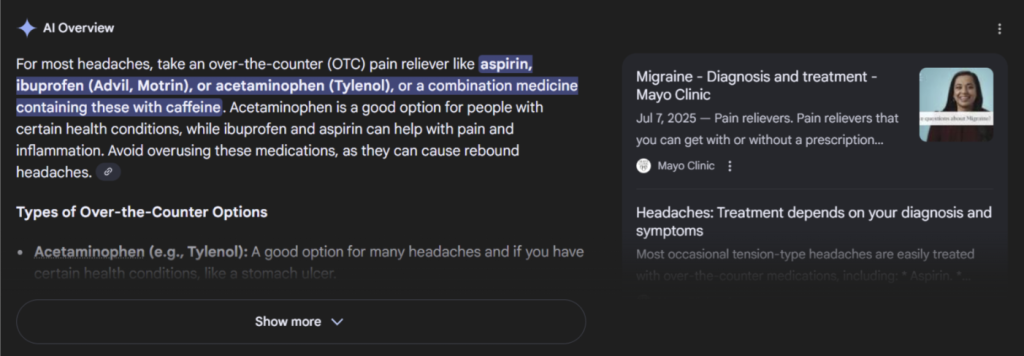
As you can see, it provides a summary while clearly indicating the source of the information. In this case, it links to Mayo Clinic, a well-known medical center recognized for its healthcare and medical research. Backed by years of evidence-based practice, peer-reviewed research, and contributions from licensed medical professionals, Mayo Clinic serves as a trustworthy reference, earning its spot as a reliable source LLMs can draw from.
Experienced digital marketers know that authority isn’t a new concept. Successful SEO strategies are already implementing E-E-A-T, an approach that stands for experience, expertise, authority, and trust, to ensure content is credible.
Now let’s look at an example from the digital marketing world. When we type “digital marketing website development,” here’s what the AI Overview displays.
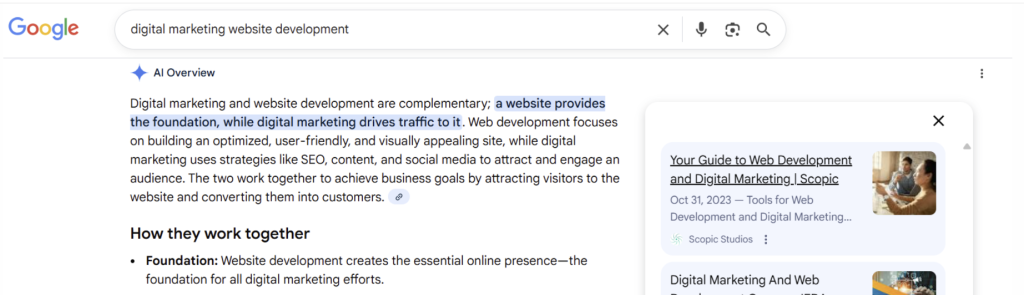
In this case, our strong E-E-A-T signals at Scopic Studios allowed our content to be pulled directly into the AI Overview as an authoritative source.
The difference between this search and the healthcare search above highlights how AI Overviews can vary by niche—sometimes pulling directly from our expertise when the topic aligns, and other times relying on broader industry sources instead.
This distinction helps illustrate how EEAT strength, topic relevance, and content depth all work together to influence when and where our pages are surfaced.
2. Know How to Structure Your Content
Certain content structures are more likely to be referenced by AI systems. To help LLMs extract information from content, you can:
- Use hierarchical headers: Organize your content with clear H1, H2, and H3 headers to make content easier to follow.
- Incorporate bullet points and numbered lists: These formats help AI quickly identify key details, steps, or processes.
- Add concise summaries or key takeaways: Brief, well-written summaries improve clarity.
- Maintain logical flow: Present information in a sequence that mirrors how users naturally ask and learn.
- Include an FAQ section: FAQs naturally mirror conversational queries, helping LLMs recognize your content as a reliable source for common questions.
3. Optimize for Conversational Queries
LLMs are trained to understand natural, question-based language rather than rigid keyword strings, meaning optimizing for conversational queries should be a key part of your strategy. By aligning your content with how people actually speak and ask questions, you increase the likelihood of appearing in AI-generated responses.
This approach is becoming even more important as voice search continues to grow, driving demand for natural, conversational content.
To implement this effectively, focus on creating content that answers specific user questions in a clear, conversational tone, using headings, FAQs, and context-rich phrasing that mirrors real dialogue.
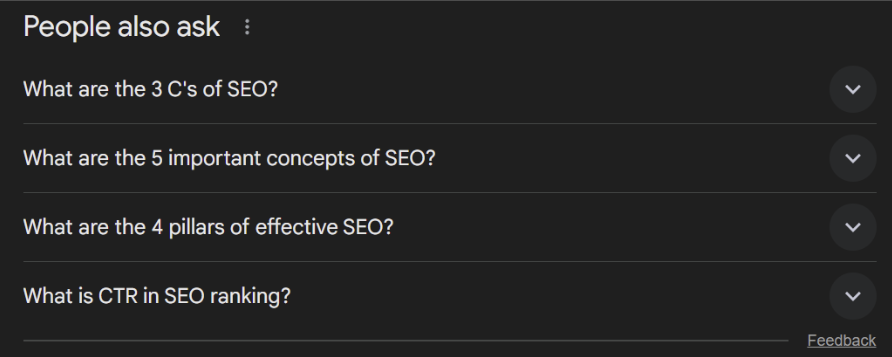
You can also check the “People also ask” section on Google for insight into how users naturally phrase their questions. For example, when I Google “SEO best practices,” it shows me this:
4. Strengthen Relevance Matching
Remember when we said LLMs prioritize semantic clarity and contextual understanding?
Having keywords isn’t enough to be relevant; your content must align with user intent—answering what people actually want to know and providing meaningful context around their questions.
Since LLMs are focused on delivering the most relevant results, your content should do the same. Understand user intent, whether they’re seeking information, comparing options, or ready to act, and craft comprehensive, conversational content that answers their questions clearly.
5. Keep Your Content Up to Date
AI models tend to prefer up-to-date information. This helps build credibility and ensures your content is recognized as a reliable, authoritative source in AI-generated results.
This doesn’t mean you need to delete older articles. Instead, regularly reviewing your content and updating it should be part of your LLM search optimization strategy. Incorporating recent statistics, current examples, and new insights ensures your content remains fresh and aligned with evolving trends.
6. Strengthen Off-Site Signals
Beyond on-page optimization, LLMs also consider off-site signals when assessing authority. These external indicators help AI models understand how your brand is perceived across the web and how trustworthy it appears.
Key off-site elements that influence LLM visibility include:
- Brand mentions on reputable websites
- High-quality, contextually relevant backlinks
- Positive external references, reviews, or citations
- Public expertise signals such as interviews, podcasts, or industry contributions
By enhancing these off-site signals, you reinforce your brand’s authority and improve the likelihood that AI models will surface your content in generated answers.
Which Content Formats LLMs Prefer
LLMs tend to favor content that’s clear, structured, and easy to interpret. Formats like these make it simpler for AI systems to extract accurate, useful information and present it in generated responses:
- FAQs: Provide direct, question-based answers that align perfectly with how users and AI models phrase queries.
- How-to guides: Offer step-by-step clarity, making it easy for LLMs to extract actionable, instructional content.
- Step-by-step tutorials: Present logical sequencing that helps AI understand processes and context.
- Listicles: Organize key points in a scannable format that simplifies summarization.
- Summaries and key takeaways: Deliver concise overviews that LLMs can quickly reference and quote in generated responses.
At Scopic Studios, our SEO copywriting services go beyond traditional optimization; we craft LLM-friendly content that’s clear, structured, and authoritative. Get in touch with our team today.
Technical Optimization Foundations for LLMO
While strong content structure helps AI understand meaning, technical optimization ensures your website is machine-readable and discoverable across AI-driven platforms.
Here’s what you should know:
- Schema Markup: Adds structured data that gives AI systems extra context about your content, such as what it is, who it’s for, and how it relates to other topics. This helps large language models accurately identify your page’s purpose and improve its chances of being included in AI-generated summaries or recommendations.
- Metadata: Defines your page’s focus through titles, descriptions, and headers that clearly reflect your content’s intent. Well-optimized metadata helps AI models categorize information correctly and connect it to relevant user queries, improving both accuracy and visibility.
- Crawlability: Ensures AI crawlers and bots can easily find, index, and interpret your content. Clean URLs, updated XML sitemaps, and consistent site navigation make it easier for both traditional search engines and AI tools to understand your site’s structure and context.
- Internal Linking: Builds logical connections between related pages, helping AI systems follow the flow of information and recognize how different topics support one another. This structure strengthens your site’s credibility and helps AI models surface your content more accurately.
- Topic Clusters: Organize related content around a central “pillar” theme, reinforcing your authority on key subjects. This approach helps AI-driven platforms identify your expertise and surface your content when users search for related or contextual topics.
Don’t worry, we don’t expect you to be an expert in technical LLMO. When you work with a partner who understands how AI is changing search, your content gets the visibility it deserves (without the stress of navigating technical optimization).
LLMO GEO: How to Get Your Brand Cited in AI Answers
If LLMO is about optimizing your content so large language models can read, understand, and trust it, then generative engine optimization (GEO) is about making sure that same content appears in AI-generated answers.
While there may be some overlap, here are some LLMO GEO best practices for different AI search engines:
ChatGPT
To optimize for ChatGPT:
- Create content with clear attributions and cite reputable sources.
- Ensure your content has strong topical authority; cover subjects comprehensively and factually.
- Provide step-by-step guidance and actionable advice.
- Keep your site accessible with no login walls or pop-ups that block crawlers.
- Maintain semantic clarity; avoid vague phrasing so the model can easily extract concise answers.
Perplexity
To optimize for Perplexity:
- Keep data current and verifiable.
- Use structured data and clear headings to make snippets easy to pull.
- Publish expert-driven content with author bios and credentials to reinforce trust.
- Ensure your site loads quickly and uses clean, readable formatting.
Google AI Overviews
To optimize for AI Overviews:
- Strengthen E-E-A-T signals by showcasing credentials, author bios, and real-world experience.
- Implement schema markup (especially Article, FAQ, and Organization schema) to help AI understand your content’s context.
- Build and maintain high-quality backlinks from relevant, authoritative domains.
- Use clear formatting and subheadings that mirror how users phrase questions in search.
- Regularly update content to signal freshness and reliability.
LLMO Tools You Should Know About
While LLM optimization may seem intimidating, there’s a seemingly endless number of tools to choose from to simplify the process. Our favorites include:
- Keyword and Topic Research Tools: Use platforms like Ahrefs, Semrush, AnswerThePublic, or AlsoAsked to uncover user intent, related entities, and semantic topics that guide LLM understanding.
- Content Optimization and Readability Tools: Refine structure, tone, and clarity with MarketMuse, Clearscope, SurferSEO, or Grammarly to make your content easier for both users and AI to interpret.
- AI Testing and Prompt Analysis Tools: Test how models like ChatGPT, Perplexity, or PromptLayer interpret or reference your content in generative responses.
- Structured Data and Technical SEO Tools: Use Schema.org Markup Generator, Rank Math, or Google’s Structured Data Testing Tool to add schema markup and help AI understand entities, context, and relationships.
- Analytics and Performance Tracking Tools: Monitor your content’s performance and visibility using Google Search Console, ContentKing, or Similarweb to see how your pages are being surfaced in AI-driven environments.
Common LLMO Mistakes to Avoid
So now that we know what to do, let’s take a look at what not to do:
- Writing only for humans: While LLMs are designed to understand natural, human language, content that ignores structure, clarity, and factual accuracy can limit its visibility. The best approach is to write for people first, but with the precision and organization that helps AI interpret and surface your content effectively.
- Not using accurate information: LLMs prioritize trustworthy, verifiable sources when generating responses. Inaccurate or outdated data can harm your credibility and reduce the chances of your content being cited in AI-generated results.
- Failing to monitor performance: Not tracking how your content appears in AI-generated results can keep you from refining your strategy. Your digital marketing partner should regularly analyze how LLMs reference, summarize, or cite your content and adjust your strategy as needed.
- Treating it as traditional SEO: While LLMO GEO can be part of a comprehensive SEO strategy, you should never assume a marketing company is already optimizing for it. As a relatively new approach, some companies may not fully understand how LLMs source, interpret, and cite information. Before working with a digital marketing company, make sure they have a clear strategy to help you stay visible.
Quick Action Checklist for LLMO Success
- Create authoritative, credible content
- Structure content with clear headers and bullet points
- Include FAQs and conversational phrasing
- Focus on user intent and semantic relevance
- Keep content updated with current data
- Use LLM-friendly formats (how-to guides, listicles, summaries)
- Leverage optimization and analytics tools
- Ensure strong technical optimization
- Monitor AI-generated visibility and performance
Scopic Studios’ Approach to LLM Optimization
At Scopic Studios, we’re an AI-driven marketing company fueled by creativity and innovation.
Not only do we use AI in digital marketing to enhance our services and give our clients a competitive edge, but we also implement strategies that help you optimize for AI-powered search engines.
In fact, we have a team specifically dedicated to LLMO GEO services. Why is this important?
Because the digital landscape is constantly evolving, and what works today may not work tomorrow. Having a team that specializes in LLMO means that we stay on top of trends and help our clients gain better results.
And we don’t use LLMO to replace existing strategies—instead, we integrate it where it makes sense. Every service we provide contributes to building a stronger, more visible online presence.
When combined, our LLM and SEO strategies create a powerful synergy, helping your website rank well on traditional search engines while remaining visible to large language models.
Final Thoughts
AI is no longer a distant concept; consumers are already using it in their everyday lives to search for companies, find information, and guide their purchasing decisions.
As companies adjust their strategies to keep up, new opportunities are emerging—but those that fail to adapt risk falling behind. With LLM optimization, your company can stay visible in AI-driven searches and connect with audiences in smarter, more meaningful ways.
As a leading AI Digital Marketing Agency, our team at Scopic Studios creates strategies tailored to your unique business goals, ensuring your brand not only keeps pace with innovation but also leverages it to gain a competitive edge.
Ready to start optimizing your website? Contact us today and we’ll get back to you within 1 business day.
FAQs about LLM Optimization
What are large language models (LLMs)?
Large language models (LLMs) are advanced AI systems trained on vast amounts of text data to understand, generate, and respond to human language with accuracy and context.
How to optimize for LLM search?
To optimize for LLMs, create clear, trustworthy, and well-structured content that directly answers user questions, uses natural language, and aligns with how AI models interpret relevance and authority.
Why are LLMs taking over search in 2025?
LLMs provide faster, more conversational, and context-aware answers, allowing users to get precise information without sifting through multiple web pages.
What are common LLMO tools?
Common LLMO tools include Ahrefs, Semrush, SurferSEO, Schema.org Markup Generator, Google Search Console, and more.
What is the difference between LLMO and SEO?
LLMO focuses on optimizing content for AI-driven systems like ChatGPT, while SEO targets traditional search engines to improve website rankings.
How do LLMs actually read and process your content?
LLMs read and process your content by analyzing its language, structure, and semantic relationships to understand meaning and intent. They use this context to determine how your information connects to user queries, allowing them to generate accurate, relevant responses based on your content.
About LLM Optimization Guide
This guide was authored by Baily Ramsey, and reviewed by Assia Belmokhtar, SEO Project Manager at Scopic.
Scopic Studios delivers exceptional and engaging content rooted in our expertise across marketing and creative services. Our team of talented writers and digital experts excel in transforming intricate concepts into captivating narratives tailored for diverse industries. We’re passionate about crafting content that not only resonates but also drives value across all digital platforms.