

Listen to article
If you’ve ever tried to explain to a stakeholder which marketing channel is actually driving revenue, you already know how messy attribution can get. You’re investing in ads, email, social, and search, conversions are coming in, but when the question shifts to where revenue really comes from, the answer is rarely clear.
That’s the problem marketing attribution models are meant to solve, and attribution modeling is how marketers apply those models to assign credit across the customer journey.
There’s no single attribution model that works for everyone. Different marketing attribution models highlight different parts of the customer journey, and the right choice depends on many factors.
This guide breaks down the major types of marketing attribution models, from simple single-touch approaches to advanced algorithmic methods, covering where each model works, where it falls short, and how to choose the right attribution model for your business.
Key Takeaways: Marketing Attribution Models at a Glance
- Marketing attribution assigns credit for conversions across different marketing touchpoints to reveal which channels drive results
- Single-touch attribution gives 100% credit to one interaction, either the first (awareness) or last (conversion)
- Multi-touch attribution distributes credit across multiple touchpoints to reflect complex customer journeys
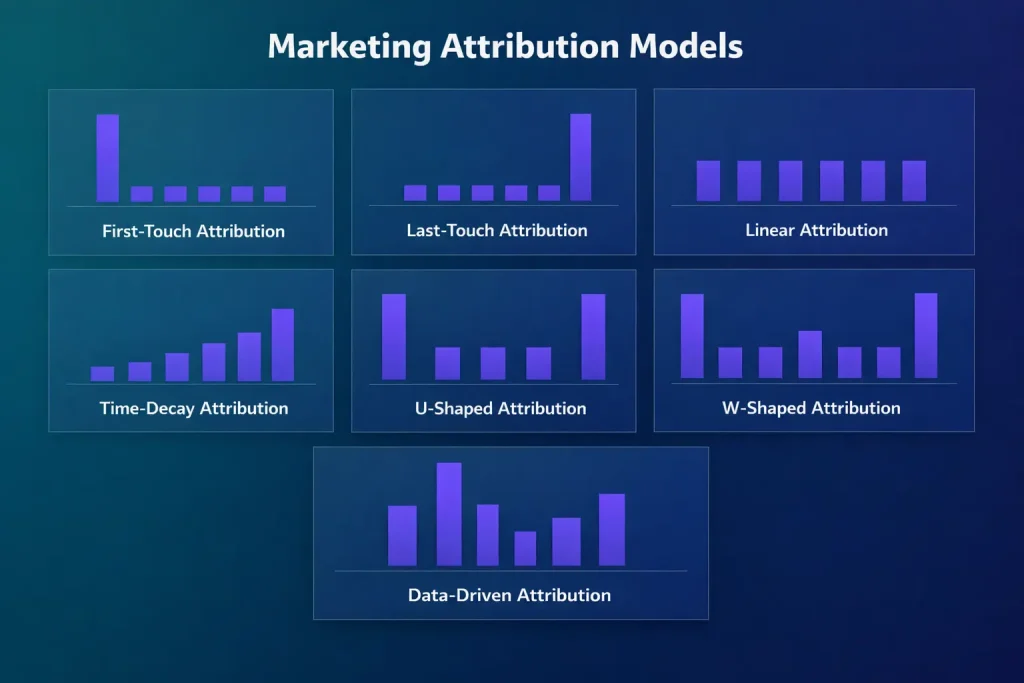
- First-touch: Credits initial discovery; best for awareness marketing campaigns
- Last-touch: Credits final interaction; best for conversion optimization
- Linear: Equal credit to all touchpoints; good baseline when data is limited
- Time-decay: More credit to recent touchpoints; fits longer sales cycles
- Position-based (U-shaped): 40% first, 40% last, 20% middle; balances acquisition and conversion
- W-shaped: 30% each to first touch, lead creation, and opportunity creation; built for B2B pipelines
- Data-driven (algorithmic): Machine learning assigns credit based on actual conversion patterns; requires high volume
What Is Marketing Attribution?
Marketing attribution is a measurement approach that marketers use to assign credit for a conversion or sale across different marketing activities. In digital marketing, attribution modeling usually means looking at the actions someone takes before they convert, such as viewing an ad, reading content, or clicking an email, and deciding how much each of those interactions should count toward the final result.
For example, a customer might first discover a brand through content, return later through a paid campaign, and finally convert after clicking an email. Attribution helps determine which of those steps mattered, and how much, when evaluating performance and allocating budget.
Understanding what marketing attribution is, and isn’t, matters because the attribution modeling approach you choose directly shapes how you evaluate channel performance and allocate budget.
Single-Touch vs. Multi-Touch Attribution Models
Before getting into individual marketing attribution models, it helps to understand the basic split between single-touch and multi-touch attribution. The difference comes down to how many interactions receive credit for a conversion.
What Is Single-Touch Attribution?
Single-touch attribution is a marketing attribution model that assigns all credit for a conversion or sale to one marketing interaction, known as a “touchpoint.”
A touchpoint is any interaction someone has with a brand, such as viewing an ad, reading content, or clicking a campaign message.
In single-touch attribution, only one touchpoint is considered responsible for the outcome. This is usually either the first interaction, which shows how a customer was initially reached, or the last interaction, which shows what happened right before the conversion.
What Is Multi-Touch Attribution?
Multi-touch attribution is a marketing attribution model that assigns credit for a conversion across multiple marketing interactions that happened before the sale.
Instead of choosing a single touchpoint, this approach recognizes that people often engage with several marketing channels over time. Credit is distributed across those interactions to reflect how different activities contribute at different stages of the buying process.
When Each Model Approach Makes Sense
Single-touch attribution makes sense when customer journeys are short, interactions are limited, or when the goal is to answer a very specific question, such as what drives first awareness or what closes conversions.
Multi-touch attribution models are better suited for longer or more complex customer journeys where multiple channels influence decisions over time. These models recognize that conversion paths rarely follow a straight line.
7 Types of Marketing Attribution Models Explained
Once you understand the difference between single-touch and multi-touch attribution models, the next step is looking at the specific models marketers use in practice. Each type of attribution model answers a different business question, from ‘what drives initial awareness?’ to ‘what closes deals?’ Here’s how each model assigns credit across the customer journey.
Single-Touch Marketing Attribution Models
First-Touch Attribution
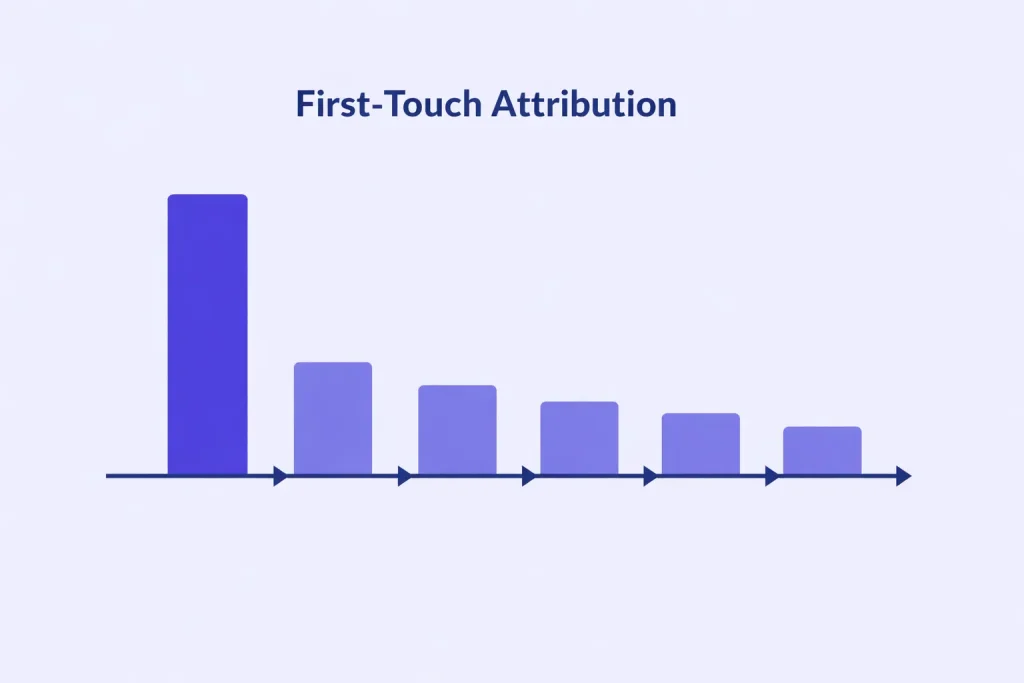
First-touch attribution gives 100% of the credit to the initial interaction that brought someone into your funnel. If a customer first discovered your brand through an organic search result, that channel gets full credit for the eventual conversion, regardless of how many emails, ads, or site visits happened afterward.
Best for:
The first-touch attribution model works best for brand awareness campaigns, top-of-funnel optimization, and businesses with short sales cycles where the first impression genuinely carries most of the weight.
Limitations:
It falls short when nurturing matters. If your customers typically need multiple interactions before converting, first-touch will overvalue discovery channels and undervalue everything that moves prospects toward a decision.
First-Touch Attribution Model Example:
A SaaS company uses first-touch attribution to evaluate which channels bring qualified prospects into their pipeline. They discover that LinkedIn ads generate more first touches than Google search, but at three times the cost per acquisition. This insight shapes their awareness budget allocation.
Last-Touch Attribution
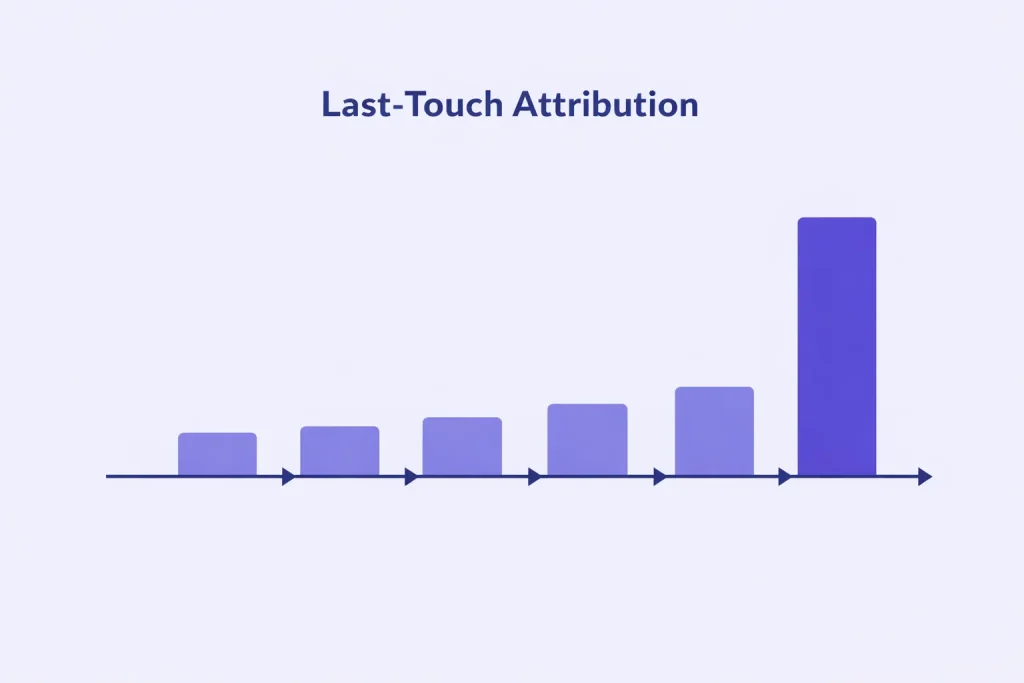
The last-touch attribution model assigns 100% of the credit to the final interaction before conversion. If someone clicked a retargeting ad and then purchased, that ad gets all the credit, even if they’d been reading your content and receiving your emails for months. Last-touch is the default in most analytics platforms, including Google Analytics, which makes it familiar and easy to implement.
This model answers a question: what’s closing deals? It reveals which channels and touchpoints are most effective at pushing prospects over the finish line.
Best for:
It’s useful for conversion optimization, direct response campaigns, and businesses with short buying cycles where the final touchpoint genuinely reflects what drove the action.
Limitations:
Marketing attribution statistics show the limitation of the last-touch model, as it ignores everything that came before. Channels that build awareness and nurture interest get zero credit, which can lead to underinvestment in activities that make your closing channels effective in the first place.
Last-Touch Attribution Model Example:
An ecommerce retailer uses last-touch attribution to optimize their checkout flow. They find that email campaigns have the highest last-touch conversion rate, but when they cut awareness spending to fund more email, overall conversions drop. The emails were closing deals that other channels had warmed up.
Multi-Touch Marketing Attribution Models
Linear Attribution
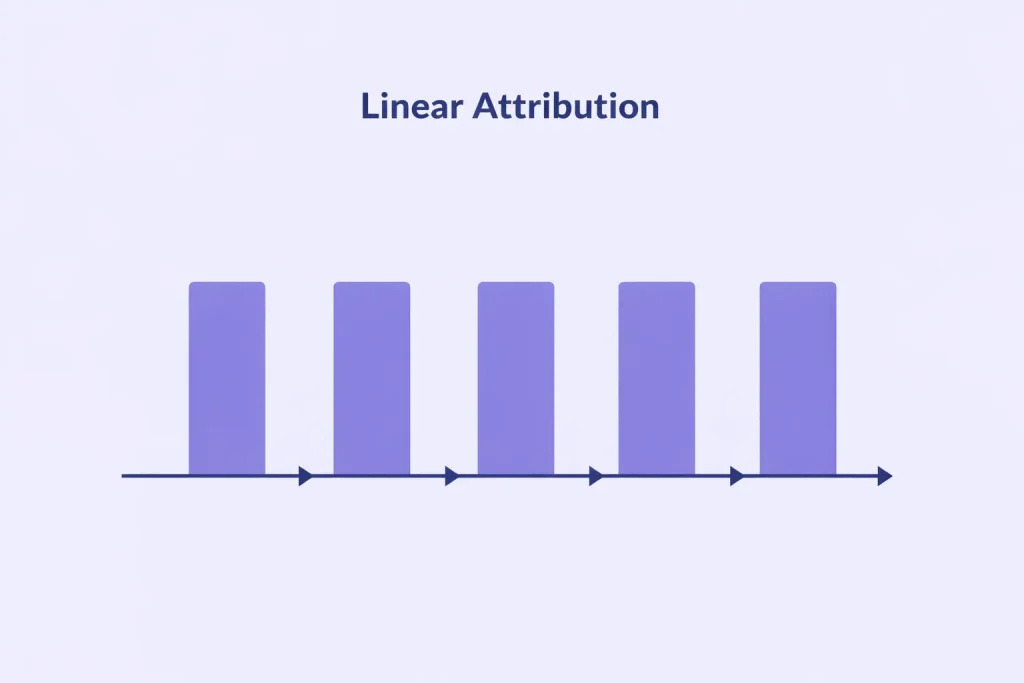
Linear attribution splits credit equally across every touchpoint in the customer journey. If someone interacted with four channels before converting, each one receives 25% of the credit.
This model operates on a simple premise: every interaction contributed, so every interaction deserves recognition. It’s a straightforward way to move beyond single-touch attribution without making assumptions about which touchpoints matter more.
Best for:
The linear attribution model works well as a starting point for multi-touch measurement, especially when you don’t have enough data to justify weighted models. It’s also reasonable for businesses where touchpoints genuinely do contribute similar value, though that’s rarer than it sounds.
Limitations:
The weakness is the equal weighting itself. In most customer journeys, some interactions matter more than others. A casual blog visit probably shouldn’t count the same as a demo request, but linear attribution treats them identically.
Linear Attribution Model Example:
A B2B company implements linear attribution after years of using last-touch. They discover that their content marketing program, which received almost no credit under last-touch, appears in 70% of conversion paths. This doesn’t prove content is their most valuable channel, but it shows the channel was being systematically undervalued.
Time-Decay Attribution
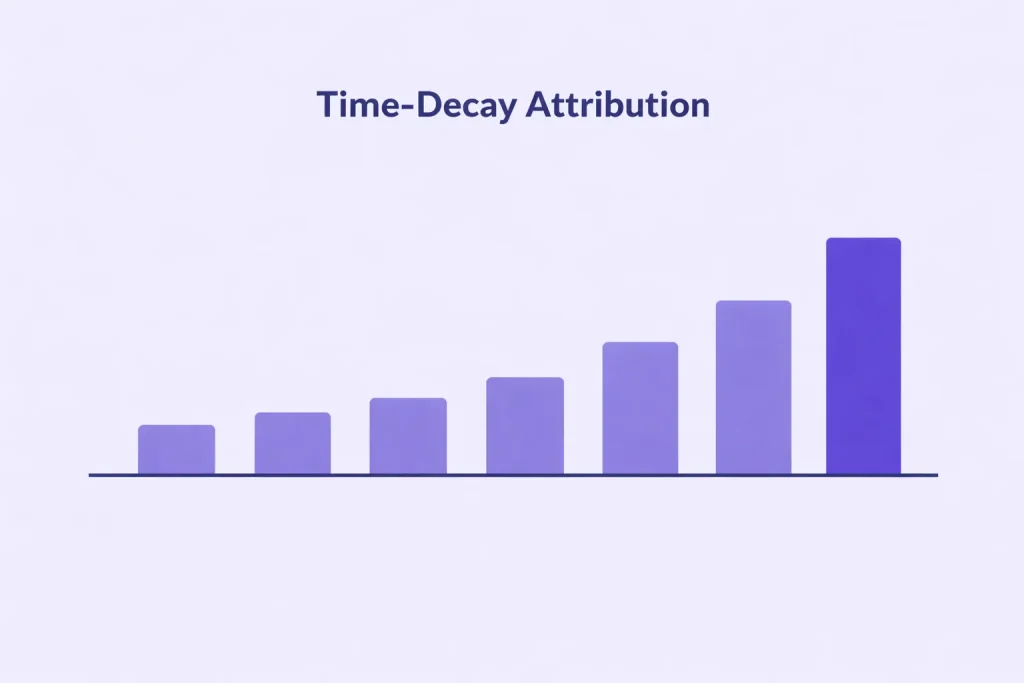
Time-decay attribution gives more credit to touchpoints that occurred closer to the conversion. The first interaction might receive 10% of the credit while the final interaction receives 40%, with a gradient in between.
The logic behind this model is that recent interactions are more relevant to the conversion decision. A prospect who saw your ad six months ago and forgot about you until last week probably wasn’t heavily influenced by that original ad.
Best for:
Time-decay attribution model fits naturally with longer sales cycles, promotional campaigns with deadlines, and businesses where the consideration phase matters more than initial discovery. It acknowledges that awareness activities have value while still weighting toward conversion-stage touchpoints.
Limitations:
The risk is undervaluing top-of-funnel efforts. If your brand awareness campaigns are genuinely responsible for filling your pipeline, time-decay might suggest cutting them, a decision you’d regret once your pipeline dries up.
Time-Decay Attribution Model Example:
An enterprise software company with a 90-day sales cycle uses time-decay attribution to evaluate their marketing mix. They find that webinars receive strong credit because they typically occur mid-to-late in the buying process, while podcast marketing receives minimal credit despite generating initial interest. They adjust by viewing podcast attribution metrics through first-touch while using time-decay for everything else.
Position-Based (U-Shaped) Attribution
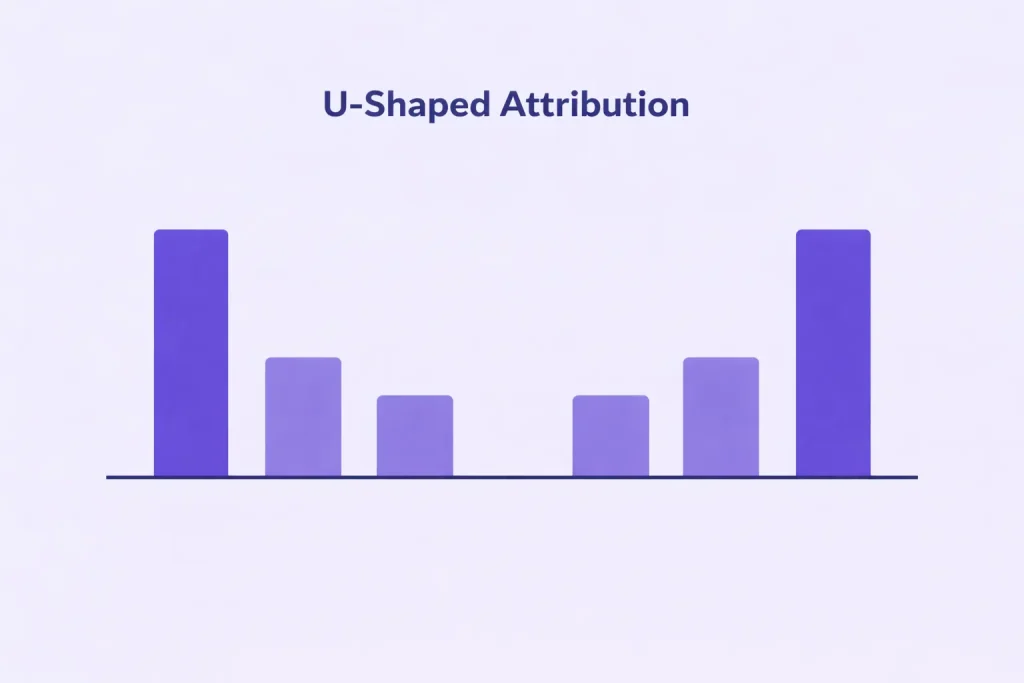
Position-based marketing attribution model assigns 40% of the credit to the first touchpoint, 40% to the last touchpoint, and distributes the remaining 20% across everything in between.
This model reflects a common intuition: the interaction that introduced someone to your brand and the interaction that closed the deal both matter more than the touchpoints in the middle. The shape of the credit distribution, heavy on both ends, light in the middle, gives this model its “U-shaped” nickname.
Best for:
Position-based attribution model works well for businesses that care equally about acquisition and conversion, or for marketing teams that want to balance brand-building and performance metrics.
Limitations:
The downside is that it can undervalue nurturing. Marketing attribution trends show that, for complex B2B sales where middle-funnel activities like case studies, demos, and sales conversations do heavy lifting, giving those touchpoints only a share of 20% may not reflect reality.
U-Shaped Attribution Model Example:
A DTC brand uses position-based attribution to evaluate their channel mix. They find that influencer partnerships dominate first-touch credit while paid search dominates last-touch. The 40/40 split helps them justify influencer spend to leadership while still recognizing that search closes the deal.
W-Shaped Attribution
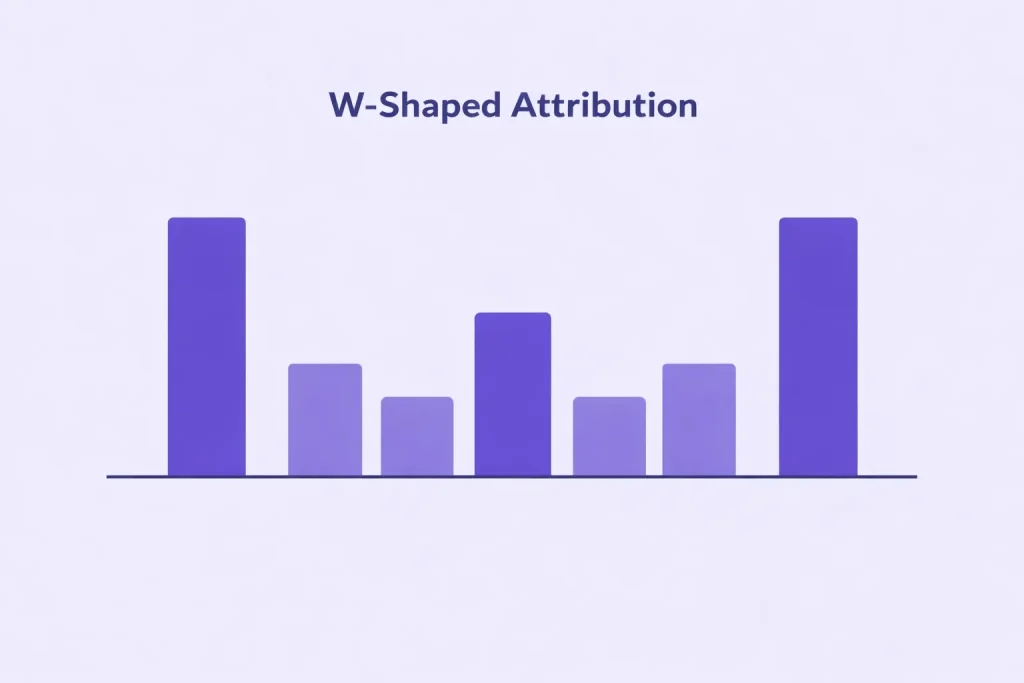
W-shaped attribution model assigns 30% credit each to three key moments: the first touch, the lead creation touch, and the opportunity creation touch. The remaining 10% gets distributed across other interactions.
Best for:
W-shaped marketing attribution model fits B2B companies with defined pipeline stages and clear handoff points between marketing and sales. It’s particularly useful when you need to show marketing’s contribution across the entire funnel, not just at the top or bottom.
Limitations:
The limitation is that the W-shaped model requires clear stage definitions and the tracking infrastructure to capture those transitions. It’s also less relevant for B2C or businesses with simpler buying processes, where “lead creation” and “opportunity creation” aren’t meaningful milestones.
W-Shaped Attribution Model Example:
A B2B SaaS company implements W-shaped attribution to settle an internal debate about marketing’s pipeline contribution. They discover that content downloads trigger most lead creation touches, while sales enablement materials trigger opportunity creation. This insight shapes collaboration between content marketing and sales teams.
Data-Driven (Algorithmic) Attribution
Data-driven attribution, sometimes called algorithmic attribution, uses machine learning to analyze actual conversion paths and assign credit based on statistical patterns. Rather than applying predetermined rules, it calculates which touchpoints genuinely correlate with conversions in your specific data.
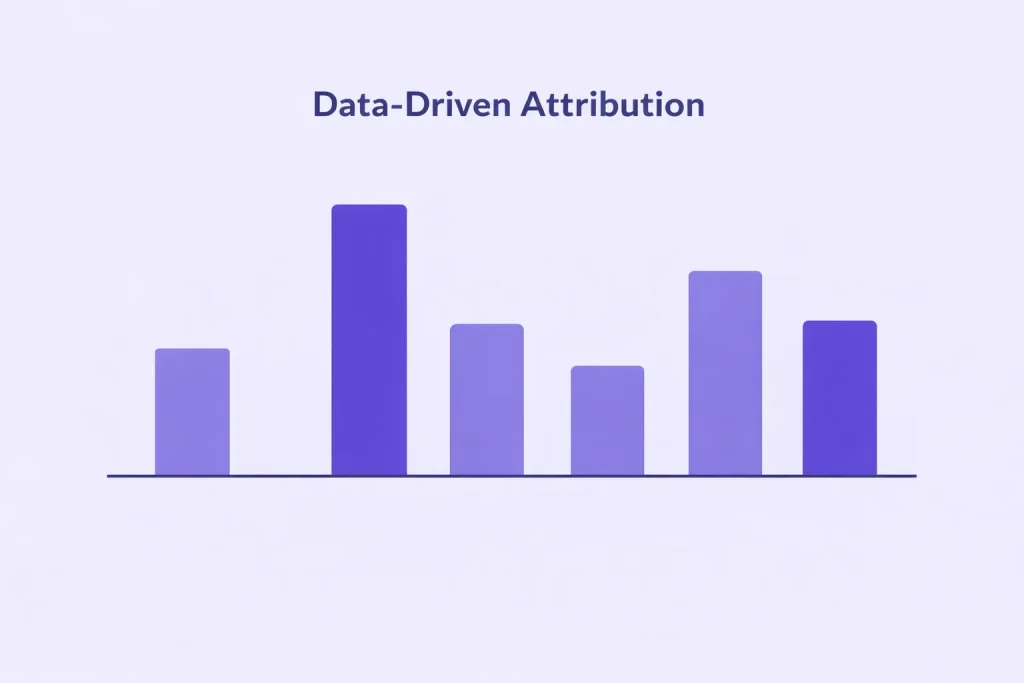
This digital marketing attribution model looks at what actually happened across thousands or millions of customer journeys and derives weights from that evidence.
Data-driven attribution model represents the most sophisticated approach available in standard marketing platforms. Google Ads and GA4 both offer data-driven models, and dedicated marketing attribution tools build their products around algorithmic approaches.
Requirements:
You need substantial conversion volume; Google recommends at least 300 conversions and 3,000 ad interactions within 30 days for reliable results. You also need to accept some black-box opacity, since the algorithm’s weightings aren’t always transparent or intuitive.
Data-Driven (Algorithmic) Attribution Model Example:
A high-volume ecommerce company switches from position-based to data-driven attribution and discovers unexpected patterns. Their algorithm assigns significant credit to YouTube ads, which had received minimal credit under position-based because they rarely appeared as first or last touches. Further analysis reveals that YouTube views strongly correlate with conversion even when they occur mid-journey, an insight that would have remained hidden under rules-based models.
Marketing Attribution Models Compared
Each attribution model answers a different question and fits different business contexts. Here’s how they compare:
| Model | Credit Distribution | Best For | Limitations |
| First-Touch | 100% to first | Awareness | Ignores nurturing |
| Last Touch | 100% to last | Conversion | Ignores awareness |
| Linear | Equal split | Baseline measurement | Oversimplifies |
| Time-Decay | Weighted toward recent | Long cycles | Undervalues top-funnel |
| Position-Based | 40/20/40 | Balanced view | Undervalues middle |
| W-Shaped | 30/30/30/10 | B2B pipelines | Requires stage definitions |
| Data-Driven | Algorithmic | High-volume digital | Black box, data requirements |
MTA vs MMM: What’s the Difference?
The multi-touch marketing attribution models covered above all share one thing in common: they track individual users across digital touchpoints. This user-level approach is often called MTA (Multi-Touch Attribution) when compared against a fundamentally different measurement framework called Marketing Mix Modeling (MMM).
What Is Marketing Mix Modeling (MMM)?
Marketing mix modeling takes the opposite approach from MTA, and instead of tracking individuals, MMM uses statistical analysis of aggregate data to estimate how different marketing inputs affect overall business outcomes.
A typical MMM study pulls together months or years of historical data: marketing spend by channel, sales figures, pricing changes, seasonality patterns, economic indicators, and competitive activity. Regression analysis then isolates the contribution of each variable to revenue or conversions.
MMM doesn’t need to track anyone. It works with totals and averages, which means it can measure channels that user-level attribution can’t touch, such as television, billboards, podcast marketing, and print ads. It also sidesteps privacy concerns entirely since no individual-level data is required.
The tradeoffs go the other way. MMM operates on longer time horizons, typically requiring 2-3 years of data for reliable results. It updates slowly, quarterly or annually rather than daily. And it can’t tell you which specific ad or audience segment performed best, only that a channel category contributed a certain amount to overall results.
Key Differences at a Glance
The multi-touch marketing attribution models covered above all share one thing in common: they track individual users across digital touchpoints. This user-level approach is often called MTA (Multi-Touch Attribution) when compared against a fundamentally different measurement framework called Marketing Mix Modeling (MMM).
| Dimension | MTA (Multi-Touch Attribution) | MMM (Marketing Mix Modeling) |
| Data level | Individual users | Aggregate totals |
| Channel coverage | Digital only | Digital and offline |
| Time horizon | Real-time to weekly | Quarterly to annual |
| Data requirements | User tracking, cookies, pixels | Historical spend and sales data |
| Output | Touchpoint-level credit | Channel-level contribution |
| Privacy exposure | High (relies on tracking) | Low (no individual data) |
| Best for | Tactical optimization | Strategic budget allocation |
Both approaches have value, and many sophisticated marketing teams use MTA and MMM together, using MTA for tactical campaign optimization and MMM for annual budget planning.
When to Use Each Approach
MTA makes sense when your marketing is primarily digital, your sales cycle is short enough to track within cookie windows, and you need tactical insights to optimize campaigns in-flight. It answers questions like “which ad creative is converting best?” or “should we scale this audience segment?”
MMM fits better when you invest significantly in offline channels, your sales cycle extends beyond typical tracking windows, or you need to justify marketing budgets to finance teams who want statistical rigor. It answers bigger questions: “how much revenue can we attribute to marketing overall?” or “what’s the optimal split between brand and performance spend?”
How to Choose the Right Marketing Attribution Model
There’s no universally correct marketing attribution modeling. The right choice depends on your business context, not on what’s theoretically most sophisticated.
Key Factors to Consider
Sales cycle length: Short cycles with few touchpoints work fine with single-touch attribution models. Longer cycles with multiple interactions need multi-touch approaches to capture what’s actually happening.
Channel mix: If you’re running digital-only campaigns, MTA-based digital marketing attribution models can cover most of your activity. If offline channels like TV, events, or print play a significant role, you’ll need MMM or a hybrid approach.
Data maturity: Data-driven digital marketing attribution requires high conversion volumes and solid tracking infrastructure. If you’re not there yet, rules-based models like linear or position-based are more practical starting points.
Business goals: First-touch answers “what drives awareness?” Last-touch answers “what closes deals?” Position-based marketing attribution model tries to answer both. Match the model to the question you’re actually trying to answer.
Model Recommendations by Business Type
Here’s how different types of attribution models align with common business scenarios:
- Ecommerce with short buying cycles: Last-touch or time-decay. Customers typically convert quickly, so recent touchpoints carry real weight.
- B2B with long sales cycles: W-shaped or position-based. You need visibility into pipeline stages, not just first and last interactions.
- Brand-focused campaigns: First-touch. If awareness is the goal, measure what’s generating awareness.
- High-volume digital businesses: Data-driven. You have the conversion volume to make algorithmic models reliable.
- Early-stage or limited data: Linear. It’s imperfect but gives you a balanced baseline without requiring assumptions you can’t validate.
Building Your Attribution Strategy
Perfect attribution doesn’t exist. Every marketing attribution model involves tradeoffs that reflect different assumptions about how customers make decisions. The goal isn’t to find the theoretically correct answer but to get directionally accurate insights that improve your marketing decisions over time.
Start with the simplest model that answers your most pressing questions, then revisit your approach as your data matures and your channel mix evolves. Attribution modeling is a means to an end: better budget allocation, clearer ROI conversations, and smarter campaign optimization.
Need help connecting your marketing data to decisions that actually move the needle? Scopic Studios is a full-service digital marketing agency that helps teams build attribution strategies, tracking infrastructure, and reporting frameworks tailored to how your business actually operates.
Frequently Asked Questions
What is the best marketing attribution model?
There’s no single best marketing attribution model. The right choice depends on your sales cycle, channel mix, and what question you’re trying to answer. The last-touch model works for short buying cycles. Position-based or W-shaped fits B2B with longer journeys. A data-driven or algorithmic model is ideal if you have high conversion volume and solid tracking infrastructure.
What are the four types of attribution?
The “four types” typically refers to first-touch, last-touch, linear, and time-decay. These are the most common models and cover the basics of single-touch and multi-touch attribution. More advanced options include position-based, W-shaped, and data-driven models.
What's the difference between MTA and MMM?
MTA (Multi-Touch Attribution) tracks individual users across digital touchpoints and assigns credit based on their specific journey. MMM (Marketing Mix Modeling) uses aggregate historical data to estimate channel-level contribution, including offline channels. MTA is better for tactical optimization. MMM is better for strategic budget planning.
Which attribution model does Google Analytics use?
Google Analytics 4 defaults to data-driven attribution for accounts with enough conversion volume. For accounts without sufficient data, it falls back to last-click. You can also manually select other models like first-click, linear, time-decay, or position-based in your attribution settings.
How do I know if my attribution model is working?
Compare outputs across multiple models. If switching models dramatically changes which channels look effective, that’s a sign your current model may be over or undervaluing certain touchpoints. Also, check whether your attribution insights lead to decisions that improve actual business results over time.
Which marketing attribution model should you use?
The right model depends on your sales cycle and business type:
- First-touch: Brand awareness campaigns
- Last-touch: Short buying cycles, conversion optimization
- Linear: Limited data or balanced baseline measurement
- Time-decay: Longer sales cycles where recency matters
- Position-based (U-shaped): Balanced acquisition + conversion focus
- W-shaped: B2B with defined pipeline stages
- Data-driven: High-volume digital businesses with 300+ monthly conversions
Match the model to what you’re measuring: awareness, conversion, or both.
About The 7 Types of Marketing Attribution Models
This guide was written by Mikheil Kandaurishvili and reviewed by Assia Belmokhtar, SEO Project Manager at Scopic Studios.
Scopic Studios delivers exceptional and engaging content rooted in our expertise across marketing and creative services. Our team of talented writers and digital experts excel in transforming intricate concepts into captivating narratives tailored for diverse industries. We’re passionate about crafting content that not only resonates but also drives value across all digital platforms.
Note: This blog’s feature image is sourced from Freepik.