
Listen to article
Social media isn’t just memes and family pictures—it’s a powerful marketing tool for B2B companies (and it’s where real business conversations are already happening).
By distributing high-quality content across channels like LinkedIn, X, and YouTube, your business can make real connections, enhance brand awareness, gain market insights, and most importantly, reach decision-makers.
However, a strong B2B social media marketing strategy starts with knowing your audience, choosing the right platforms, and creating a focused content strategy.
So before you start publishing without a plan, we’re here to help you get the best results from your B2B social media marketing efforts, covering everything from the types of posts that work best to how AI can strengthen your strategy.
Key Takeaways
- Every company should understand key details about its target audience, such as demographics, interests, pain points, and online behavior, to avoid sharing content that fails to resonate with the right people.
- Choose the best social media platform for B2B marketing by evaluating platform demographics, engagement data, and audience behavior.
- Focus on creating industry-specific, value-driven content that addresses pain points, supports longer sales cycles, builds trust over time, and includes formats such as thought leadership posts, case studies, and short-form videos.
- Creating a 60–90 day content calendar helps teams plan ahead, stay organized, and consistently deliver high-quality, on-brand content that builds value over time.
What is B2B social media marketing?
B2B social media marketing uses targeted content and strategic engagement on platforms like LinkedIn, X, and YouTube to attract decision-makers, nurture relationships, and drive high-quality leads for business growth. B2B marketing strategies on social media differ from B2C, as they have different target audiences, feature more specific, industry-focused content, and appeal to longer sales cycles.
Follow These 6 Steps to Build Your B2B Social Media Marketing Strategy
Ready to build your strategy?
Our social media marketing experts outlined 6 key steps to follow:
1. Set Clear, Business-Aligned Goals
The first step to any successful strategy is to clearly define your goals. Do you want to generate qualified leads? Grow website traffic? Enhance brand awareness?
With your unique goals in mind, you should create a framework to measure progress by setting specific metrics for each goal and reviewing results regularly.
For example, one company may want to increase engagement on Instagram by 20%, while another may aim to generate 15 qualified leads through targeted posts on LinkedIn.
2. Understand Your Target Audience
Every company should know key information about their target audience, such as demographics, interests, pain points, and online behavior. If not, you risk posting content that does not appeal to the right people.
By using analytics tools, such as Google Analytics, along with surveys and focus groups, you can better understand your target audience and avoid wasted effort.
While you’re researching, don’t be afraid to explore what your competitors are publishing. This gives you valuable insight into what type of content resonates with industry professionals and what gaps you can fill with your own content.
And since this is a key part of your strategy, there are B2B social media marketing services that handle this entire process for you. At Scopic Studios, we craft strategies backed by data, ensuring you reach the right people at the right time. Get in touch with our team for a tailored strategy.
3. Choose the Right Platforms
Where does your content make the biggest impact?
Since every platform has unique content formats, functionalities, and demographics, you must consider the right platform for your specific target audience. This means analyzing platform demographics, engagement data, and audience behavior to determine where they’re most active.
We won’t go into too much detail about the best social media platforms for B2B marketing, as we’ll discuss this in more detail below.
4. Plan Your Content Strategy
The next step is to create a content strategy considering the type of posts that resonate with your target audience and the content format allowed on your chosen social media platform.
Focus on creating industry-specific, value-driven content that addresses pain points, supports longer sales cycles, and builds trust over time. This may include thought leadership content, case studies, short-form videos, and more.
As part of your strategy, you should define how often to post each week, the best times for engagement, and how to handle comments, messages, and interactions.
5. Create a 60–90 Day Content Calendar
Having a detailed social media content calendar helps you consistently produce high-quality, on-brand content. This doesn’t mean you need three months of posts fully created in advance; instead, outlining post types, topics, and required visuals allows your team to plan ahead and stay organized.
A structured calendar also helps ensure your content builds on itself over time, delivering ongoing value to your audience without becoming repetitive.
6. Set Up Measurement & Reporting
There’s only one way to know if your B2B social media marketing strategy is successful: by tracking performance.
As mentioned, different goals require different metrics, so this process may vary depending on your company’s needs.
In an increasingly tech-savvy world, third-party analytics tools can help track performance, uncover trends, and identify opportunities to optimize your strategy.

What Types of Social Media Posts Work Best for B2B Marketing?
An important part of understanding how to use social media in B2B marketing is knowing what to post.
We’ve narrowed down 5 different types of posts your company can consider incorporating:
Thought Leadership Posts
Since B2B organizations target businesses and decision-makers, publishing content with unique perspectives and innovative ideas is key to catching their attention. Why?
Because these audiences are already professionals in their industry, and surface-level information simply won’t impress them. Posts that provide forward-thinking insights and expertise, on the other hand, demonstrate authority and build stronger relationships.
For instance, Scopic is a leading software development company that specializes in AI-driven solutions. Rather than simply telling their followers about existing tools and solutions, they provide expert insight and test new techniques. Recently, they published a case study about AI-powered development, which they can showcase on their social media platforms to demonstrate industry leadership.
Case Studies, Proof & Testimonials
Your clients want real results, and what better way to showcase your expertise than by sharing case studies and testimonials?
Case studies demonstrate real-world value and results from businesses in the same field, making them an effective marketing tool for B2B companies. This shows how your products or services help solve real problems, making it easier for potential clients to visualize outcomes.
Short Videos
Videos are a powerful storytelling tool for B2B companies. In fact, B2B video marketing statistics tell us that by 2025, 80% of B2B traffic is expected to come from video content.
This is partly due to video’s ability to deliver high-impact messaging in a short format, enabling your company to capture your target audience’s attention.
Infographics & Data Visualizations
Infographics are a great way to attract potential clients, simplify data, and encourage viewers to share your content.
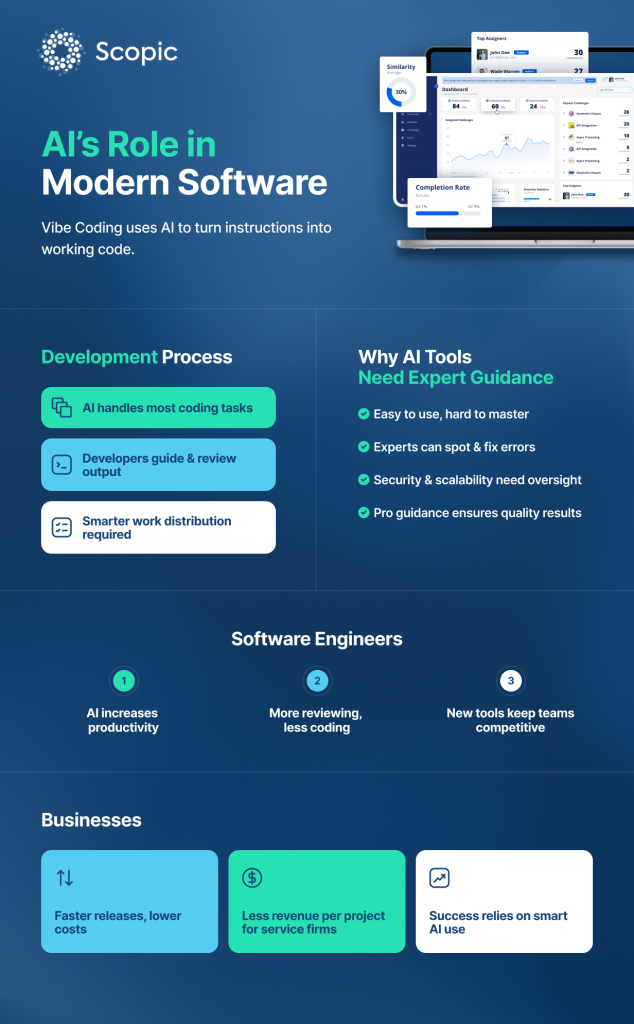
Let’s take a look at an example. Remember how we said Scopic created an ebook exploring AI-powered development?
Our team created an infographic to share on social media to provide viewers with a quick summary of AI’s role in software development:
Behind-the-Scenes & Culture Posts
Don’t forget to humanize your content. This can include sharing images of the people who drive your company, team-building moments, community involvement, and the story behind your products or services.
As more businesses and buyers value transparency and authenticity, these posts help communicate your mission and build stronger connections.
How to Pick the Best Social Media Channels for B2B Marketing
Choosing the right social media channels for your company is a make-or-break for your strategy. As an experienced B2B social media marketing agency, our team at Scopic Studios helps identify which platforms your target audience uses.
Below, we break down the key social media platforms for B2B marketing.
As stated by Statistica, “LinkedIn is the top-of-mind platform when it comes to professional social media.” With over a billion members across 200 countries and regions, it serves as a great platform for reaching business professionals.
This professional audience is reinforced by its demographics. As of October 2025, 33.4% of LinkedIn users worldwide were between the ages of 25 and 34 years old, with 15.9% between 35 and 54 years old.
Because of this strong concentration of working professionals, LinkedIn is a leading platform for B2B marketing, with 89% of B2B marketers using it for lead generation and 62% reporting that it produces leads.
Best for: B2B lead generation, reaching decision-makers and senior professionals, thought leadership and industry insights, employer branding, and promoting case studies, whitepapers, and long-form content.
X (Formerly Twitter)
According to Elon Musk, X has 600 million monthly active users, with about half using the platform daily.
As of February 2025, 37.5% of X’s global audience was between the ages of 25 and 34, while users aged 18 to 24 accounted for 32.1%, making it a strong channel for reaching younger professionals.
With 78% of U.S. users saying they use the platform to stay informed, X is well suited for establishing thought leadership and sharing timely, industry-specific insights. Since X allows companies to share information quickly and join real-time conversations, it creates opportunities to engage directly with industry discussions, respond to trends, and position your brand as a knowledgeable voice.
Best for: Real-time industry updates, trend commentary, thought leadership, engaging in industry conversations and events, sharing short insights and announcements, and driving traffic to longer-form content.
YouTube
Video plays a key role in B2B marketing, so it should come as no surprise that YouTube is among the best social media channels for B2B marketing.
In fact, a survey shows that 59% of senior executives agree that if both text and video are available on the same topic on the same page, they prefer to watch the video.
YouTube also influences discovery across generations, with 56% of Gen Z, 54% of Millennials, 48% of Gen X, and 26% of Boomers saying they most often discover new products on the platform. Additionally, YouTube ads reached 30.9% of the global population in January 2025, underscoring the platform’s massive reach.
Best for: Educational and long-form video content, product demos and tutorials, thought leadership, case studies and customer success stories, and supporting longer B2B buying cycles.
As of July 2025, more than half of Instagram’s global user base was aged 34 or younger, making it a great platform for connecting with the next generation of business professionals and decision-makers.
In 2024, 79% of global marketers used Instagram to advertise their businesses, highlighting its effectiveness as a marketing channel. For B2B companies, Instagram works especially well for visual storytelling, including behind-the-scenes content, brand narratives, and carousel posts that allow for more in-depth content delivery in a visually engaging format.
Best for: Visual brand storytelling, humanizing your brand, showcasing company culture, educational content, brand awareness, and reaching younger professionals and future decision-makers.
How AI Can Strengthen Your B2B Social Media Marketing
Artificial intelligence (AI) is transforming marketing strategies, and top AI content agencies are ahead of these changes.
Curious how to incorporate AI into your B2B social media marketing strategy?
Here’s how:
- Content ideas: AI content personalization strategies include identifying trending topics, generating post ideas, and tailoring content formats and messaging to specific audience segments.
- Analytics: AI-powered analytics tools can track performance in real time, uncover patterns in engagement and conversions, and provide actionable insights to optimize content, posting schedules, and overall strategy.
- Automation: AI can streamline scheduling, content distribution, and basic engagement tasks, helping teams stay consistent while saving time.
Use cases for AI are seemingly endless. Whether you want to generate content ideas or gain deeper audience insights, advanced tools and technologies can support your goals.
At Scopic Studios, our B2B social media marketing services leverage the latest technologies to ensure your strategy is data-driven, effective, and scalable.
Final Thoughts
5.66 billion, or 68.7% of the world’s population, are social media users.
That said, using social media platforms isn’t just recommended—it’s critical to a well-rounded B2B marketing strategy.
At Scopic Studios, our social media management services help you target the right audience, stay on top of top trends, and craft compelling, industry-specific content that resonates.
Ready to create a tailored strategy?
FAQs about B2B Social Media Marketing
What is B2B social media marketing?
B2B social media marketing uses targeted content and strategic engagement on platforms like LinkedIn, X, and YouTube to attract decision-makers, nurture relationships, and drive high-quality leads for business growth.
What types of social media posts work best for B2B?
The types of social media posts that work best for B2B include thought leadership posts, case studies and testimonials, short videos, infographics, and behind-the-scenes content.
How is B2B social media marketing unique?
B2B social media marketing is unique because it focuses on reaching decision-makers with industry-specific, value-driven content that supports longer sales cycles and relationship building.
About B2B Social Media Marketing Guide
This guide was authored by Baily Ramsey, and reviewed by Assia Belmokhtar, SEO Project Manager at Scopic.
Scopic Studios delivers exceptional and engaging content rooted in our expertise across marketing and creative services. Our team of talented writers and digital experts excel in transforming intricate concepts into captivating narratives tailored for diverse industries. We’re passionate about crafting content that not only resonates but also drives value across all digital platforms.