Listen to article
In early 2026, OpenAI announced it would begin testing ads in ChatGPT. For marketers running Google Ads, the immediate question is whether this represents a valuable new channel or simply more noise in an already crowded landscape.
Although these ads are currently invite-only and not widely available, broader adoption is likely, signaling a shift in how businesses connect with consumers.
So, do they truly compete with Google Ads? And is it time for marketers to start allocating budget to this new wave of advertising?
As they say, meet your audience where they are. With AI platforms rapidly gaining attention, understanding what ChatGPT advertising looks like and how it compares to Google Ads is more important than ever.
What Are ChatGPT Ads and How Do They Work?
For those wondering, does ChatGPT have ads? How do ChatGPT ads work? Here’s what you need to know.
ChatGPT ads are sponsored placements that appear within the ChatGPT interface, designed to align with user queries and surface relevant products or services in context.
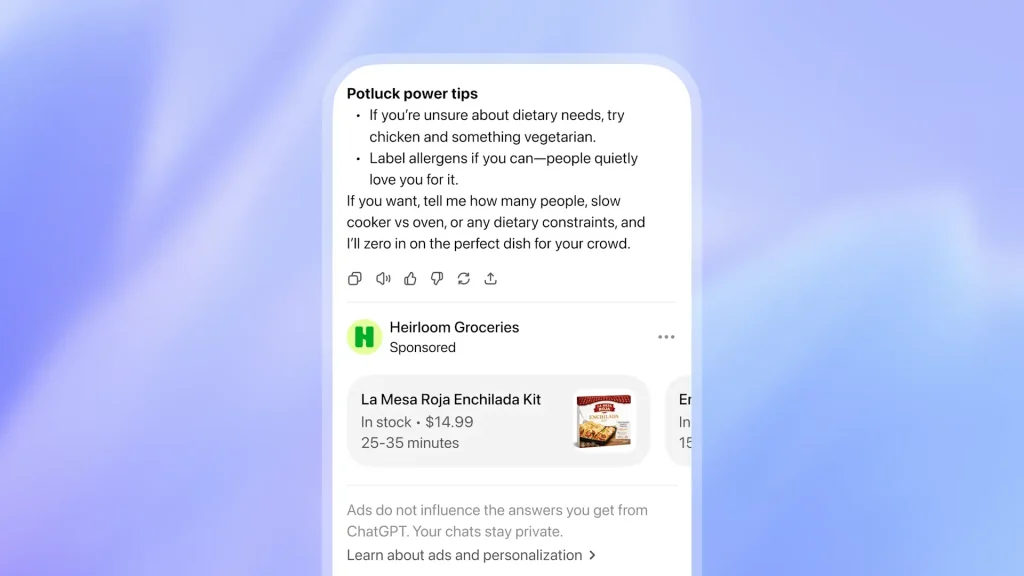
Unlike traditional click-based (CPC) models, OpenAI ads operate on an impression-based (CPM) structure, costing around $60 per 1,000 impressions. These ads do not influence the AI-generated response. Instead, they appear separately below ChatGPT’s answer, clearly labeled as “Sponsored” and distinct from the organic content.
Currently, ads are shown only to Free and Go tier users. Sensitive topics, including health, mental health, and politics, do not display ads.
OpenAI has provided an example to demonstrate how this works. For instance, if a user searches for a recipe, they may see a contextually relevant ad for grocery delivery services. Here’s how it would look:
It’s important to note that ChatGPT advertising is still in a testing and learning phase, meaning formats, targeting, and pricing may evolve based on user feedback.
According to Search Engine Land, “ChatGPT ads could create a high-intent channel for reaching users during active conversations and decision-making moments. Its focus on relevance, AI-driven matching, and agent-style campaign tools could lower barriers for small and midsize advertisers while improving performance for larger brands.”
As ChatGPT ads continue to expand and change, staying up to date is key for marketers and businesses to stay ahead of changes. Updates and program details are available on OpenAI’s official advertiser’s page: https://openai.com/advertisers/
ChatGPT Ads vs. Google Ads: Key Differences
| Feature | ChatGPT Ads | Google Ads |
| Targeting | Contextual (real-time conversation intent) | Keyword + behavioral targeting |
| Pricing Model | CPM ($60 per 1,000 impressions) | CPC, CPM, CPA, Smart Bidding |
| Ad Placement | Below AI responses (labeled “Sponsored”) | Search, YouTube, Maps, Shopping, Display Network |
| Self-Serve Access | Invite-only | Fully self-serve platform |
| Audience Reach | U.S. testing; limited to Free & Go users | Global, multi-platform reach |
| Reporting | Limited (impressions & clicks) | Comprehensive (conversions, attribution, analytics) |
Targeting Method: Contextual Targeting vs. Behavioral Targeting
ChatGPT: ChatGPT ads targeting is primarily contextual. Ads are matched to the content of the user’s current conversation, meaning placement is based on real-time intent rather than past browsing history.
Google Ads: Google Ads relies on a combination of keyword targeting and behavioral targeting. Advertisers bid on specific search terms, and ads are shown when users enter those queries. Google also uses audience signals, such as past website visits, search history, and user interests, to refine targeting.
Pricing Model
ChatGPT: ChatGPT charges 60 dollars per 1,000 ad impressions. In the impression vs. click debate, this means advertisers pay for visibility rather than direct engagement. At this stage, reporting is limited to high-level metrics such as total impressions and clicks, with no insight into downstream actions like conversions or purchases.
Google Ads: Google Ads primarily operates on a cost-per-click model, where advertisers pay when a user clicks on their ad. However, it also supports other bidding strategies, including cost-per-thousand impressions, cost-per-acquisition (CPA), and automated Smart Bidding based on conversion goals.
Ad Placement
ChatGPT: ChatGPT ads appear below the AI-generated response when a relevant product or service aligns with the user’s query. They are clearly labeled as “Sponsored” and visually separated from the organic answer to ensure transparency.
Google Ads: According to Google Ads Help, ads may show above or below search results on Google Search, alongside results on Google Play, within the Shopping tab, and across Google Maps. Ads can also appear across the Google Display Network on partner websites and YouTube.
Self-Serve Access
ChatGPT: At this time, ChatGPT advertising does not offer a public self-serve platform and is primarily available through an invite-only program. As the platform moves beyond the testing phase, this structure may evolve.
Google Ads: Google Ads operates as a fully self-serve platform. Businesses of all sizes can create an account, set budgets, choose targeting options, launch campaigns, and monitor performance independently.
Audience Reach
ChatGPT: ChatGPT ads are currently being tested in the U.S. market. With 34% of U.S. adults reporting that they have used ChatGPT, the platform represents a rapidly growing audience. However, ad reach is presently limited to Free and Go tier users, meaning advertisers cannot yet access the platform’s full user base.
Google Ads: Google Ads provides extensive global reach across Search, YouTube, Maps, Shopping, and the Display Network, allowing advertisers to connect with users at virtually every stage of the purchase funnel.
Are ChatGPT Ads Worth the $60 CPM?
Are ChatGPT ads worth the investment, and how does ChatGPT ads pricing compare to other digital advertising platforms?
Currently, ChatGPT ads cost approximately $60 per 1,000 impressions. This means a brand would spend $6,000 to generate 100,000 impressions regardless of how many users actually click or convert.
For Google Ads, it’s not as straightforward, as the price varies significantly depending on the region and industry. At Scopic Studios, we’ve personally seen one client pay $6 for 1,000 impressions for one project, while another paid $500 for 1,000 impressions in a more competitive market. While these ranges vary widely, factors such as the price of the service or product, industry competition, and the conversion potential can help determine whether the cost of the ads is justified by the results they generate.
When evaluating ChatGPT ads CPM against other platforms, this figure stands out. In a ChatGPT ads vs. meta ads comparison, for example, Meta’s average CPM is typically lower, making ChatGPT roughly three times more expensive from a pure impression standpoint.
The bigger distinction comes down to CPM vs. CPC. While ChatGPT operates on an impression-based model, Google Ads primarily uses cost-per-click, allowing advertisers to pay only when users engage.
Another limitation is reporting. At this stage, ChatGPT advertising provides high-level metrics like impressions and clicks but lacks granular conversion tracking.
So, are ChatGPT ads worth it?
For brands seeking early visibility in AI-driven spaces, possibly. For performance-focused advertisers who prioritize measurable ROI, it may make sense to wait.
We’ve covered in detail whether Google Ads are worth it for your business, and the same principle applies here: align your ad spend with your goals and measurement expectations.
Why Brands with AI Visibility Get More from ChatGPT Ads
Half of consumers use AI-powered search today, and it’s projected to influence $750 billion in revenue by 2028. In other words, AI advertising is no longer experimental; it’s becoming a foundational part of digital strategy.
As AI-powered ads and AI search advertising continue to expand, the brands that benefit most aren’t starting from zero. They’re already visible inside AI-generated answers.
This is where generative engine optimization (GEO) becomes a practical advantage. GEO is the process of optimizing content so AI systems like ChatGPT, Google’s AI Overviews, and Perplexity can find, understand, and reference your brand in their responses.
Here’s why that matters: when users already see your brand cited or referenced organically in AI results, your ChatGPT ads feel more credible. Visibility builds familiarity. Familiarity builds trust. And trust increases performance.
For that reason, organic visibility strategies like SEO and GEO strengthen your presence in AI-generated answers, while paid AI advertising amplifies that visibility. Together, they create compounding returns.
So if you’re wondering, should I advertise on ChatGPT? The better question may be: are you already visible in AI search results?
Brands with established AI visibility, often supported by strategic GEO services, are positioned to extract more value from ChatGPT ads pricing, even at a $60 CPM. Those without organic presence may want to build that foundation first before investing heavily in paid placements.
ChatGPT Ads for B2B vs. B2C: Where the Real Opportunity Is
While ChatGPT ads offer great opportunities for companies, audience access plays a major role in campaign performance.
As mentioned, ChatGPT ads are currently only shown to Free and Go tier users. This creates a stronger immediate opportunity for B2C brands, particularly retail and direct-to-consumer companies.
For example, ChatGPT ads for e-commerce brands can position relevant products in front of users actively researching options or asking for recommendations. That real-time intent makes it appealing to advertise on ChatGPT when targeting consumers.
B2B companies face a different reality, as Plus, Pro, Business, and Enterprise accounts are ad-free. Because many professionals and decision-makers use paid tiers, a significant portion of the B2B audience may never see sponsored placements. While opportunities still exist, reach can be more limited compared to consumer-focused campaigns.
So how should businesses decide?
For B2C brands with moderate budgets and strong product demand, ChatGPT ads can complement paid social and search strategies by capturing high-intent AI search traffic.
For B2B organizations, Google Ads may remain the stronger primary channel. If you’re wondering, do Google Ads work? They often deliver reliable results for B2B lead generation due to keyword precision, remarketing capabilities, and detailed conversion tracking.
For brands with larger budgets, a hybrid strategy may provide the most value:
- Google Ads for scalable acquisition and measurable ROI
- ChatGPT ads for emerging AI visibility and contextual reach
The right approach depends on your audience, goals, and budget. If you’re evaluating where AI advertising fits into your broader strategy, working with our PPC management team can help you determine the most effective channel mix.
What This Means for Your 2026 Ad Strategy
The rollout of ChatGPT ads in 2026 is prompting many companies to rethink how they approach paid media in an AI-first landscape.
As conversational platforms evolve and formats like AI overview ads gain traction, brands have a new opportunity to appear directly within AI-generated responses and reach users in more contextual, intent-driven moments.
Still, before shifting budgets, businesses should weigh factors like cost, which subscription tiers their audience uses, and how ChatGPT ads vs. Google Ads compare in terms of reach, targeting, and ROI.
If you’re evaluating where ChatGPT ads fit into your paid media mix, Scopic Studios’ GEO and PPC experts can help you develop a clear, data-driven plan to maximize performance across platforms.
Contact us today to get started.
Frequently Asked Questions About ChatGPT Ads
What are ChatGPT ads and how do they work?
ChatGPT ads are sponsored placements that appear within the ChatGPT interface, designed to align with user queries and surface relevant products or services in context. These ads don’t influence AI-generated responses and appear separately below them, clearly labeled as “Sponsored.”
How much do ChatGPT ads cost?
ChatGPT ads pricing is currently based on a CPM model, with rates starting at approximately $60 per 1,000 impressions. Advertisers should also expect a minimum spend requirement, making it a better fit for brands prepared to test and scale within an emerging AI advertising channel.
Are ChatGPT ads worth it for small businesses?
ChatGPT ads can be valuable for reaching high-intent users within conversational, AI-driven search experiences. However, due to relatively high entry costs and evolving pricing structures, they may currently be a better fit for mid-sized and enterprise brands with flexible paid media budgets rather than most small businesses.
What is the difference between ChatGPT ads and Google Ads?
The main difference between ChatGPT ads vs. Google Ads lies in intent and placement. Google Ads appear across search results and partner networks based on keyword bidding, while ChatGPT ads are embedded directly within AI-generated responses, aligning with conversational queries in real time.
Can I target specific keywords with ChatGPT ads?
No, ChatGPT ads do not rely on traditional keyword bidding like search engines do. Instead of targeting specific keywords, they use AI-driven context matching to analyze a user’s prompt in real time and deliver sponsored content that aligns with the overall intent of the conversation.
Do ChatGPT ads work for B2B companies?
ChatGPT ads can work for B2B companies, especially when targeting research-driven, high-intent queries within conversational search. However, it’s important to note that Plus, Pro, and Enterprise tiers are ad-free, which may limit reach if your ideal B2B audience primarily uses paid plans rather than Free or Go tiers.
How do ChatGPT ads compare to Meta ads?
ChatGPT ads and Meta ads differ in both format and cost structure. Meta ads typically offer lower average CPMs and broad audience targeting across social platforms, while ChatGPT ads tend to have higher CPMs but focus on reaching users during high-intent, conversational search moments within AI responses.
Should I advertise on ChatGPT in 2026?
You should consider advertising on ChatGPT in 2026 if your audience actively uses AI-driven search and you have the budget to test an emerging, premium channel. It’s best suited for brands that already have strong performance across search and social and are looking to expand into high-intent, conversational environments.
About ChatGPT Ads vs. Google Ads Guide
This guide was authored by Baily Ramsey, and reviewed by Kristina Poghosyan, Marketing Lead at Scopic Studios.
Scopic Studios delivers exceptional and engaging content rooted in our expertise across marketing and creative services. Our team of talented writers and digital experts excel in transforming intricate concepts into captivating narratives tailored for diverse industries. We’re passionate about crafting content that not only resonates but also drives value across all digital platforms.