Understanding the Core Difference
When evaluating digital marketing partners, you’re essentially choosing between two distinct approaches: full-service agencies that handle your entire marketing ecosystem, and budget-conscious or specialty agencies that focus on specific channels or services. A full-service digital marketing agency acts as your single strategic partner, managing all digital channels—SEO, PPC, content, social media, email, and web design—under one integrated strategy. This unified approach ensures your tactics reinforce each other, creating consistent messaging and fewer handoff errors. Budget agencies, by contrast, typically specialize in one or two areas, allowing you to pay only for what you need without the overhead of comprehensive services.
The Full-Service Advantage for Growing Businesses
Full-service agencies shine when you’re juggling multiple marketing channels simultaneously. They’re particularly valuable for startups and small businesses needing comprehensive solutions from branding through implementation, as well as growing companies that have outgrown patchwork vendor arrangements. Full-service agencies save time and money while strengthening your marketing position through professional teams with diverse skills across marketing, web, and graphic design.
The integrated approach delivers measurable results: businesses report organic traffic increases of 331% in six months, 211% conversion improvements, and even 5,066% conversion rate gains in nine months. This isn’t coincidental—integrated campaigns consistently outperform fragmented ones because each channel compounds the others’ effectiveness.
Cost Considerations: More Than Just Price Tags
Full-service agency pricing typically ranges from $1,000 to $10,000+ monthly, $5,000 to $50,000+ project-based, or $40 to $300 per hour, depending on agency size, location, and scope. While this might seem expensive, consider the alternative: building an equivalent in-house team costs an estimated $340,000 to $380,000 annually in US median salaries alone—before accounting for tools, benefits, or management overhead. Full-service agencies become a fraction of that investment.
However, beware of unusually low pricing. When comparing agencies, treat suspiciously low rates as a red flag, as they often indicate weak strategy or outsourced work that creates communication breakdowns. Higher-priced agencies typically reflect greater experience, expertise, and technology.
When to Choose Budget or Specialty Alternatives
Budget agencies and specialty providers excel when you have a single primary marketing lever requiring deep expertise, or when you’re managing specific one-off projects with tight budgets. They develop competitive mastery in particular domains and stay current with cutting-edge techniques in their niche. However, managing multiple specialty agencies adds workflow complexity, increases coordination challenges, and risks brand message inconsistency across channels.
Key Takeaway:
Full-service agencies offer superior value for growing businesses managing multiple channels, delivering integrated results that outperform fragmented approaches while costing significantly less than building an equivalent in-house team. Reserve budget or specialty agencies for focused, single-channel needs where deep expertise justifies the coordination overhead.
Feature Comparison
When evaluating digital marketing agencies, understanding the core differences between full-service and specialty providers is essential for making an informed decision. Here’s a comprehensive breakdown of how these two agency models stack up across critical dimensions.
Service Offerings & Specialization
| Feature | Full-Service Agencies | Specialty Agencies |
|---|---|---|
| Service Range | Comprehensive (SEO, SEM, SMM, Web Design, Email Marketing, Content, Paid Ads, Influencer Marketing, Brand Identity, Marketing Automation) | Focused on 1-3 specific services or niches |
| Expertise Depth | Broad knowledge across multiple channels | Deep, competitive mastery in specific domain |
| Industry Focus | General or multiple industries | Highly specialized (e.g., B2B SaaS, eCommerce, Local Services) |
| Technology Stack | Proprietary platforms (e.g., MarketingCloudFX) | Specialized tools for their niche (e.g., Klaviyo for email, OM3 Platform) |
| Strategic Approach | Consistent messaging across all platforms | Targeted strategy within their specialty |
| Scalability | Handles diverse needs for growing businesses | Excels with single-focus or large-scale campaigns |
| Communication Complexity | Single point of contact for all services | Multiple agencies may be needed; increased coordination |
| Best For | Startups, SMBs, businesses in establishment stages | Enterprise brands, large companies with specific needs |
| Pricing Model | Retainer-based ($1,000-$10,000+/month) | Retainer, performance-based, or project-based ($2,000-$50,000+) |
| Brand Consistency | Unified messaging across channels | Risk of inconsistent branding with multiple agencies |
Key Advantages & Trade-offs
Full-service agencies are beneficial for startups and small businesses due to their comprehensive offerings and ability to provide consistent marketing strategies across all platforms. They eliminate the complexity of managing multiple vendors and ensure cohesive brand messaging.
However, full-service providers may lack deep specialization in every service area. They’re not ideal for businesses with highly specific, niche requirements that demand expert-level focus.
Specialty agencies shine with up-to-date expertise, specialized tools, and strategic relationships within their domain. They’re cost-effective for single tasks and deliver competitive advantages in their area of focus. The trade-off? Managing multiple agencies increases workflow complexity, communication overhead, and potential brand inconsistency—particularly challenging for large companies with diverse marketing needs.
Choosing Your Agency Partner
The decision hinges on three factors: business size, specific requirements, and internal work capacity. Full-service agencies work best during establishment stages when you need coordinated, multi-channel strategies. Specialty agencies suit large brands that can manage multiple vendor relationships and benefit from niche expertise.
When evaluating any agency, prioritize industry expertise, transparent pricing, client testimonials, and clear communication methods. Red flags include unusually low pricing, hidden fees, guaranteed rankings, and lack of monthly reporting. The right partner should help you earn money, not lose it.
Service Scope: What Each Agency Offers
Full-Service Agencies: The All-in-One Solution
Full-service digital marketing agencies operate as comprehensive marketing powerhouses, handling all your digital channels under one integrated strategy. These agencies manage everything from SEO and PPC to content marketing, social media, email campaigns, and web design—essentially covering your entire marketing ecosystem in a single partnership.
The core services typically include technical SEO optimization and link building, paid search and display advertising campaigns, blog content and marketing assets, social media brand presence and engagement, email marketing for lead nurturing, targeted lead generation campaigns, and website optimization with conversion tracking. Many established full-service agencies go even further, offering specialized services like software development and Generative Engine Optimization (GEO).
What makes full-service agencies particularly valuable is their holistic approach. They don’t just execute individual tactics—they plan, design, create, implement, and measure different marketing strategies as part of your entire growth plan. This means you get both digital and offline marketing expertise, covering everything from brand identity and graphic design to scaling and performance measurement.
Specialty Agencies: Deep Expertise in Focused Areas
In contrast, specialty agencies concentrate their efforts on one or a few specific marketing services, such as social media management, market research, or competitor analysis. While their scope is narrower, their depth is exceptional. These agencies develop broad, competitive skills and mastery within their particular niche, staying highly skilled and up-to-date in their specialized domain.
Specialty agencies shine when you need deep expertise in a specific channel that’s your primary growth lever. However, if you’re juggling multiple marketing channels or lack internal marketing staff, coordinating between several specialty vendors can become cumbersome and fragmented.
Choosing Based on Your Needs
Full-service agencies work best when you need multiple channels managed cohesively, have ambitious projects targeting different audiences, or are expanding into global markets. They’re ideal if you’ve outgrown a patchwork of vendors and want unified strategy and execution. Niche agencies, meanwhile, are your best bet when one channel is your primary focus and you need specialist expertise that goes deep.
Key Takeaway:
Full-service agencies provide integrated, comprehensive marketing coverage across all digital channels, while specialty agencies deliver deep expertise in specific areas. Your choice depends on whether you need coordinated multi-channel strategy or focused excellence in one domain.
Pricing Models and Real Pricing Ranges
Understanding Agency Pricing Structure
Digital marketing agency costs vary dramatically depending on multiple factors, ranging from as low as $500 to over $100,000 monthly. Agency pricing depends heavily on agency size, location, service type, and whether they incorporate AI-enhanced services—which now command 20-50% premium rates compared to manual alternatives.
The pricing landscape breaks down significantly by agency tier. Freelancers and solo operators typically charge $500-$2,000 monthly or $40-$100 hourly. Small agencies (2-10 employees) fall in the $1,500-$5,000 monthly range at $75-$150/hour, while mid-sized firms (11-50 employees) charge $5,000-$15,000 monthly. Large agencies with 50+ employees command $15,000-$50,000+ monthly with hourly rates of $150-$300+. For context, the national median hourly rate in the U.S. sits at $84.40, though Delaware leads at $132.04/hour.
Service-Specific Pricing Breakdown
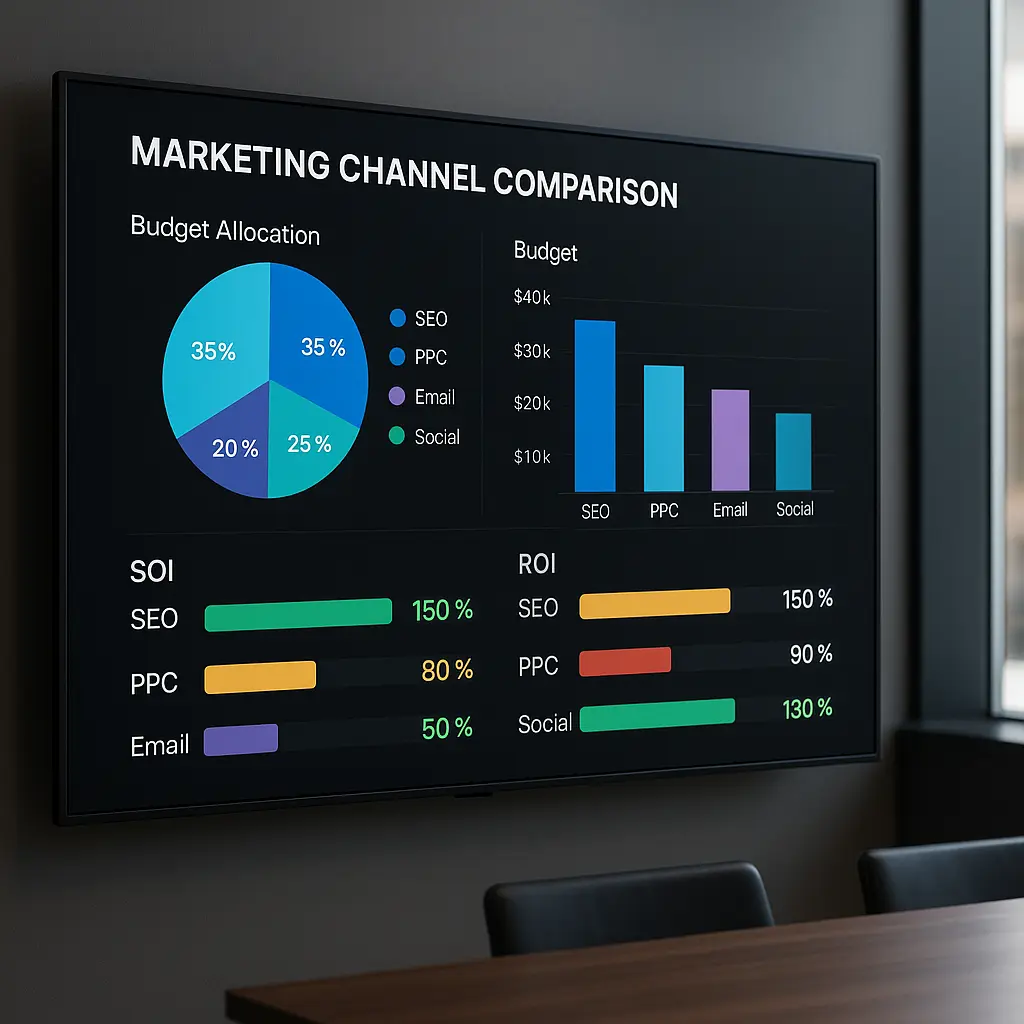
Different services carry distinct pricing models. SEO services range from $500-$3,000 monthly for small businesses to $7,500-$20,000+ for enterprises, with technical audits running $500-$30,000. PPC management typically follows an 80/20 model where you pay 80% for ad spend and 20% for agency fees, with rates decreasing as spending increases: 20-30% for under $5K/month, down to 10-15% for $50K+ monthly spend.
Social media management spans from $500-$1,500 monthly for basic packages to $10,000-$20,000+ for enterprise-level strategies. Content creation ranges from $150-$300 for 500-word blog posts to $1,200-$2,500+ for comprehensive guides. Web design varies from $3,000-$15,000 for simple sites to $50,000-$150,000+ for enterprise solutions, with maintenance retainers between $50-$5,000 monthly.
Common Pricing Models Used by Agencies
Agencies employ six primary pricing approaches. Project-based pricing (used by 50% of agencies) charges a flat fee per project—ideal for clients who want cost certainty. Retainer models (44% adoption) provide ongoing monthly services, typically $1,000-$5,000 for small businesses and $15,000-$50,000+ for enterprises. Hourly billing ($50-$500/hour) works well for consulting but limits scalability. Performance-based models tie fees to results, while value-based pricing aligns costs with client outcomes. Most sophisticated agencies use hybrid approaches combining retainers with performance bonuses.
Key Takeaway:
Digital marketing pricing ranges from $500 to $100,000+ monthly based on agency size and service complexity. Understanding service-specific rates and choosing the right pricing model—whether project-based, retainer, or performance-driven—is crucial for aligning costs with your growth objectives and budget constraints.
Team Structure: Small vs. Integrated Teams
Understanding Different Team Structures
When choosing between a full-service agency and a budget-focused partner, team structure plays a critical role in determining how effectively they’ll execute your marketing strategy. Digital marketing teams operate through different structural models, each with distinct advantages and limitations.
The two primary approaches are centralized and decentralized structures. A centralized structure consolidates all marketing efforts under a core team, delivering consistency, efficiency, and strong resource control—ideal for maintaining unified messaging across channels. However, this approach can struggle with scalability and responsiveness to rapid market changes. Conversely, a decentralized structure distributes marketing responsibilities across different teams or departments, enabling flexibility and specialized expertise. The trade-off is potential inconsistency and coordination challenges.
How Agency Size Shapes Team Composition
The size of an agency directly impacts how they organize their teams. Smaller agencies often operate with lean, multifunctional teams where individual professionals juggle multiple roles. While this keeps costs down, it can create bottlenecks when team members become overwhelmed. The ideal structure involves having a manager for each digital channel with specialized sub-teams working underneath them, allowing professionals to master their focus area—whether that’s SEO, content creation, social media, or paid advertising.
Medium-sized agencies typically benefit from more specialized structures with dedicated roles for each major channel. Larger enterprises require complex, hierarchical structures with specialized teams organized by region, product, or service. This hierarchical approach ensures accountability and expertise depth but requires significant resources.
Building Your Team: In-House, Outsourced, or Hybrid
Agencies employ three primary approaches to team building: hiring internal staff, outsourcing to specialists, or using a hybrid model. A hybrid approach is often preferable for companies without resources to build entire teams internally, allowing you to maintain critical roles in-house while outsourcing specialized functions. This balance provides flexibility and cost-efficiency without sacrificing quality.
When evaluating an agency’s team structure, consider whether they’ve distributed tasks evenly to avoid burnout and ensure quality output. The best team composition depends on your business size, location, industry nature, and specific marketing goals.
Key Takeaway:
The most effective agencies match their team structure to your business needs—whether through specialized hierarchies, centralized coordination, or hybrid models that blend in-house expertise with outsourced specialization. Ensure your chosen partner has clear role definition and adequate resource allocation to deliver consistent results.
Scalability: Growing with Your Agency
Why Scalability Matters for Your Business
Scalability is more than just handling more work—it’s about growing efficiently while maintaining quality and adapting to market changes. Digital marketing agencies help businesses achieve scalability by optimizing marketing efforts, leveraging advanced technology, and ensuring sustained growth without the burden of building an in-house team from scratch. For small and medium-sized enterprises especially, this approach eliminates the need to invest heavily in infrastructure while gaining access to specialized expertise across SEO, content marketing, PPC, and more.
When you partner with an agency, you’re not just getting a service provider—you’re gaining a scalable infrastructure. Agencies invest in advanced tools and technology like SEO software, analytics platforms, and marketing automation systems that streamline processes and reduce manual work. This means you can scale your marketing efforts cost-effectively, often through flexible retainer or project-based models, rather than hiring and training an entire in-house team.
Building Your Scaling Strategy
Successful scaling requires a comprehensive approach that goes beyond simply adding more resources. Key strategies include developing a clear digital marketing strategy, leveraging data and analytics to inform decisions, implementing marketing automation, scaling content creation efficiently, and expanding into new markets strategically.
The right agency partner will help you streamline processes and workflows, invest in technology that automates repetitive tasks, and build strategic partnerships that extend your reach. They’ll also help you develop scalable pricing models and focus on client retention—factors that directly impact long-term growth. As you expand, agencies stay updated on trends and algorithm changes, ensuring your marketing efforts remain competitive and effective in evolving digital landscapes.
Measuring Success and Avoiding Common Pitfalls
Not scaling properly can lead to missed opportunities, output limitations due to manual tasks, and team burnout. That’s why tracking key metrics and adapting to market dynamicss crucial for successful scaling. Monitor ROI, performance benchmarks, and other KPIs to make data-driven decisions about your growth strategy.
Challenges like maintaining service quality, effective project management, and building the right team are real—but they’re manageable with the right partner. Whether you’re looking to expand existing services or diversify into new offerings, a scalable business model combined with operational efficiency ensures sustainable growth.
Key Takeaway:
Partnering with a digital marketing agency accelerates your growth by providing scalable infrastructure, specialized expertise, and advanced technology—without the overhead of building an in-house team. Focus on measuring performance metrics and adapting your strategy as you scale to ensure sustainable, quality-driven expansion.
ROI Expectations: Measuring Your Growth
Understanding Digital Marketing ROI
Digital marketing ROI represents the profit or loss generated from your marketing investment. A positive ROI indicates your campaigns are delivering results, while a negative ROI signals you’re spending more than you’re earning. However, ROI isn’t one-size-fits-all—it depends heavily on your industry, business goals, target customers, and chosen marketing strategies.
The key to maximizing growth is understanding that realistic ROI expectations are crucial for evaluating agency performance. Different industries have different benchmarks: professional services typically see 2:1 to 5:1 ROI (200-500%), while SaaS and technology companies often achieve 5:1 to 10:1 ROI (500-1,000%). E-commerce and local services fall in between, with 3:1 to 8:1 and 4:1 to 7:1 respectively. Understanding where your industry stands helps you set achievable targets and measure success accurately.
Measuring What Matters: KPIs and Analytics Tools
To track your growth effectively, focus on measurable Key Performance Indicators (KPIs) like website traffic, conversion rates, social media engagement, email open rates, search engine rankings, and bounce rates. Digital marketers use real-time tracking tools to monitor performance and adjust strategies on the fly—ensuring your investment continuously improves.
Google Analytics, social media insights, and email marketing platforms provide deep insights into audience behavior and campaign effectiveness. For more advanced tracking, tools like CallRail, HubSpot Marketing Hub, and WhatConverts enable multi-touch attribution—helping you understand which channels drive conversions. Call tracking software alone can improve lead-to-sale conversion rates by 37%.
The ROI formula is straightforward: ((Total Revenue Generated – Total Investment) / Total Investment) × 100%. For example, a $5,000 campaign generating $25,000 in revenue with $10,000 service costs yields 200% ROI. Companies using advanced attribution models see a 15-35% increase in marketing efficiency, making precise measurement essential.
The Timeline for Results and Continuous Optimization
Growth doesn’t happen overnight. Expect a three-phase timeline: months 1-3 focus on foundation and strategy setup, months 4-6 bring initial results and optimization, and months 7-12 deliver consistent growth and higher ROI. This is why most agencies perform best with 12-18 month partnerships—strategies need time to mature.
Different channels have different longevity profiles. SEO requires 3-6 months for significant results but can drive traffic for 2-3 years. Google Ads deliver immediate visibility but stop when budgets pause. Content marketing compounds over time, with older blog posts generating 38% of total blog traffic. SEO traffic is 5.66 times more cost-effective than paid search long-term, though PPC provides instant visibility.
Continuous optimization is non-negotiable. Constantly evaluate and adjust campaigns to maximize ROI over time. If ROI exceeds 5:1, consider increasing investment in that marketing method. Businesses that track ROI are 1.6 times more likely to receive higher budgets for future marketing activities.
Key Takeaway:
Successful growth requires setting realistic ROI expectations based on industry benchmarks, tracking the right KPIs with proper analytics tools, and committing to a 12-18 month partnership timeline. Continuous optimization and multi-channel attribution ensure you’re maximizing every marketing dollar invested.
Conclusion: Making the Right Choice for Your Business
Align Your Decision with Business Needs
The choice between a full-service and budget digital marketing agency ultimately hinges on your unique business situation. Your decision should be guided by three critical factors: your company size, specific marketing requirements, and internal work capacity. Startups and small businesses typically thrive with full-service agencies that provide comprehensive brand building and integrated marketing strategy implementation. However, if you already have an in-house marketing team with strong capabilities, a specialized agency might be the perfect fit to fill specific gaps without redundancy. Larger enterprises have more flexibility—they can leverage specialty agencies effectively, though they’ll need to manage coordination carefully across multiple partners. Some businesses find success with a “general contractor model,” where a full-service agency orchestrates a network of specialized partners to deliver both breadth and depth.
Evaluate Beyond Price Alone
Before comparing agencies, establish clear goals, success metrics, budget parameters, and non-negotiable services. When assessing potential partners, look beyond pricing to evaluate their service offerings, industry expertise, client testimonials, case studies, certifications, technology stack, and communication approach. Here’s a critical insight: unusually low pricing can signal weak strategy or excessive outsourcing, while premium pricing often reflects greater experience and advanced tools. During your selection process, ask specific questions about how they measure success, who your dedicated point of contact will be, expected client involvement, realistic timelines, and whether they handle work in-house. Prioritizing agencies that maintain internal teams helps prevent communication breakdowns and quality issues.
Make Your Final Decision
The partnership with a digital marketing agency should be grounded in your need for specialized expertise, scalability, fresh perspectives, and cost efficiency compared to building an in-house team. Ensure your contract covers scope of work, intellectual property rights, termination clauses, payment terms, and confidentiality. With clear objectives, aligned budgeting, and defined KPIs for measuring success, you’ll be positioned to achieve meaningful growth. Ready to find your ideal marketing partner? Contact us to discuss which approach—full-service or specialized—best fits your business goals.
Note: This blog’s images are sourced from Freepik.