
The AI Search Visibility Challenge: Why Traditional Metrics Fail
The Attribution Gap
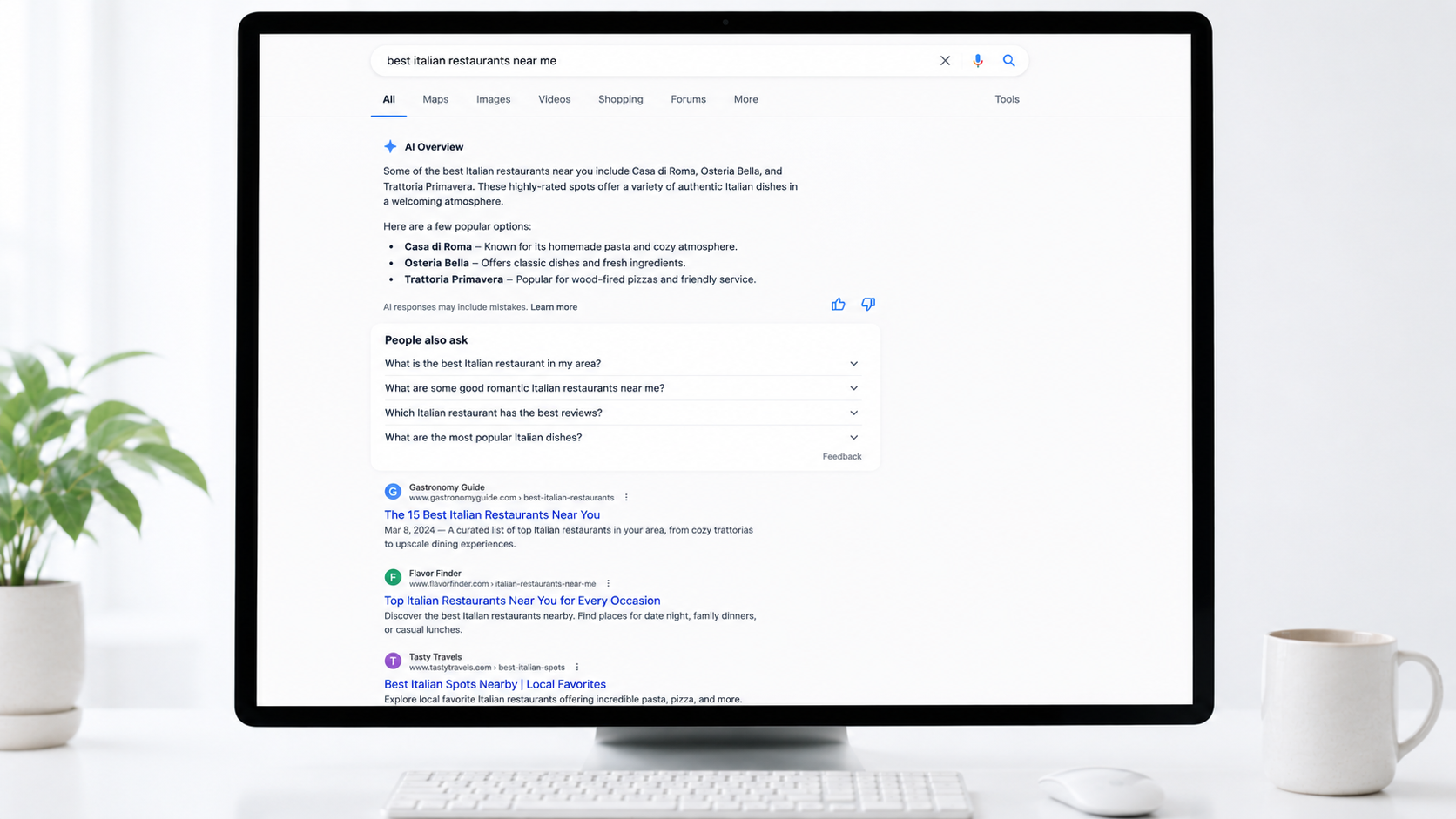
Traditional traffic metrics were built for a world where discovery and conversion happened on the same channel. AI search breaks that model. When a prospect discovers your brand through ChatGPT, Perplexity, or a Google AI Overview, there’s no click to track. They may type your URL directly or search your brand name later—both appear as direct or branded organic traffic in your analytics. The discovery layer has moved upstream to AI interfaces, but your attribution model still only sees the final touchpoint.
Research shows that discovery patterns have shifted significantly toward AI platforms, yet many users still cross-reference with traditional search before converting. Your analytics capture the second step, not the first. This isn’t a tracking bug—it’s a structural mismatch. AI platforms summarize answers directly, leading to what practitioners call “zero-click influence”: users go straight to your site after AI discovery, with no referrer to tie the journey together.
Why Legacy SEO Metrics Miss the Mark
Classic KPIs like average position, organic sessions, and click-through rate measure success in winning clicks. AI search KPIs measure success in winning influence, even without clicks. AI Overviews and answer engines resolve “what” and “how” questions without a site visit, often sitting higher in the funnel than traditional search results. A zero-click AI Overview citing your guide can still shape vendor shortlists and RFP criteria—but it won’t show up in your organic traffic report.
The deeper issue: AI systems generate probabilistic, synthesized outputs, not fixed ranked lists. There is no “#1 position” in an AI-generated paragraph. LLM outputs vary by prompt phrasing, user context, model version, and time. Traditional SEO metrics assume a consistent, URL-based result set. AI visibility depends on how models associate your brand with relevant topics across thousands of prompt variations—not just whether you rank for a keyword.
The mental model must shift from “What position do we rank?” to “How do AI systems talk about this problem, and who do they credit?”
Core AI Search Visibility Metrics
Citation Rate and Share of Voice
Citation rate measures how often your brand appears in AI-generated responses across a defined set of queries. This metric functions as the AI equivalent of search rankings—higher citation frequency signals that AI models recognize your content as authoritative.
Share of voice extends this by comparing your citations relative to competitors, revealing your competitive position in the AI-driven discovery layer. AI citation frequency behaves more like share of voice than traditional SEO rankings. The goal is becoming a trusted source that AI systems consistently reference, not just capturing clicks.
In AI search, visibility is relative. Share of voice measures your brand’s proportion of the total category conversation in AI-generated answers—how often you appear compared to competitors when models respond to relevant prompts. This matters because AI platforms typically cite only a few brands per answer, making your competitive position a critical decision signal for leadership.
Track both primary entity appearances (where your brand is the focus) and secondary mentions, as primary placements carry significantly higher visibility impact. Calculate share of voice per prompt cluster (e.g., “SOC 2 automation”) and per platform (ChatGPT vs Perplexity vs Gemini) to understand where you’re winning and where competitors are gaining ground.
Entity Coverage and Brand Mention Rate
Entity-based measurement tracks three dimensions: whether AI knowledge systems recognize your brand (entity coverage), how often it appears in relevant queries (entity presence), and how prominent it is relative to other entities (entity salience).
Brand mention rate is equally critical—many AI models reference companies without providing direct citations or links, making non-linked mentions a vital visibility signal. Query coverage quantifies how many relevant prompts trigger your brand’s appearance, mapping your total topic footprint across AI platforms.
Cross-platform tracking across ChatGPT Search, Perplexity, Google Gemini, Microsoft Copilot, and Claude is essential, as each system has distinct retrieval mechanisms and citation behaviors.
Answer Accuracy and Sentiment
Answer accuracy rate measures the percentage of AI responses that correctly represent your brand against a documented “brand canon”—your source of truth for key facts. Citation sentiment (positive, negative, neutral) adds qualitative depth; negative mentions can be more damaging than no mention at all. Monitor for hallucinated claims, outdated messaging, or negative framing that requires immediate correction.
Citations as Trust Signals
Citations—clickable links to source content within AI responses—represent which domains the model uses to ground its answers, support claims, or justify recommendations. They function as trust signals, showing that your content is directly referenced by models rather than simply mentioned in passing.
Consistent citations over time align with stronger perceived authority and more stable visibility in AI search. Track both your own domain citations and when competitors’ URLs are cited. Higher citation frequency suggests topical depth and content quality that models rely on. However, recommendations without citations still shape perception and influence consideration sets—both grounded and ungrounded mentions matter for brand positioning.
Measurement Framework: From Concepts to Operations
Define Your Measurement Pillars
Structure your framework around three pillars: Exposure, Quality, and Impact.
- Exposure tracks presence metrics like inclusion rate (percentage of prompts where your domain appears), citation share among competitors, and query coverage.
- Quality measures accuracy against your brand canon—your documented source of truth for brand facts and product details—plus citation sentiment and the URLs being cited.
- Impact connects visibility to business outcomes: branded search lifts, AI referral traffic, and conversions on cited pages.
Align Metrics to Maturity Stage
Organizations typically move through three distinct phases, each with specific capabilities and KPI focus:
Foundation (0–6 months): Focus on AI referral traffic and platform identification using GA4 segments and basic citation tracking. Establish which AI platforms send traffic and baseline citation presence.
Structured (6–12 months): Shift to citation rate, share of voice, and citation sentiment with monthly testing across ChatGPT, Perplexity, Gemini, and other major platforms. Build a stable prompt library and track competitive positioning.
Advanced (12+ months): Layer in revenue attribution, customer acquisition cost, and predictive visibility using API-based monitoring and attribution platforms. Connect AI visibility directly to pipeline and deal velocity.
For B2B organizations, track metrics at three levels: awareness (inclusion rate, share of voice), consideration (citation share on comparison queries), and revenue impact (pipeline influence, deal velocity).
Build Your Testing Cadence
Create a prompt library of 50–100 queries segmented by persona, funnel stage, and intent. Run weekly or monthly panels across key engines, repeating each prompt 2–3 times to account for non-deterministic outputs. Log citations, positions, accuracy, and sentiment. Track competitors’ citation share and cited URLs to benchmark your performance and spot campaign shifts.
Set SMART targets based on your market position and industry benchmarks. Configure dashboards for different stakeholders: executives need pipeline influence and share of voice; marketing teams need citation rates and content performance; operations teams need crawl health and schema validation.
Connecting AI Visibility to Revenue
AI visibility operates differently than traditional search. Where conventional SEO tracks clicks and conversions in a linear path, AI mentions often function like analyst influence—consistent positive mentions lift brand search, improve shortlist inclusion, and increase conversion rates later in the journey. The challenge is that AI-assisted pipeline often appears as direct traffic, branded search, or unexplained high-intent inbound in your analytics.
To measure actual business impact, align your prompts to intent stages: problem-aware, solution-aware, and vendor-aware. Tag each mention with “commercial proximity” to understand which AI appearances sit closest to purchase decisions.
Commercial impact metrics should include:
- AI referral sessions (traffic from AI platform referrers)
- Assisted conversions where AI referral is an early touch
- Brand search lift after high-visibility weeks
- Pipeline influenced by accounts that engaged with AI-referred content
Integrate GA4 for sessions and events, your CRM (HubSpot or Salesforce) for contact and opportunity attribution, and a BI layer (Looker, Tableau) for trend correlation. Track pipeline influenced by measuring dollar value of opportunities with AI touchpoints, pulling data quarterly from your CRM.
Run your AI search reporting system like a revenue program: predictable inputs, a weekly operating rhythm, and a monthly executive readout. Build a dashboard with three panels matching your framework pillars—exposure, quality, and impact.
Competitive Analysis and Citation Gap Analysis
Citation gap analysis helps identify where competitors consistently appear and you don’t. Map those prompts to missing entities, content formats, or topical coverage in your content strategy. Define a clear competitor list for your category, then track share of voice across critical commercial prompts to spot opportunities and defensive priorities. This competitive framing transforms raw citation counts into actionable insight about market position in AI-mediated discovery.
Tools for Tracking AI Search Visibility
Free Tools for Getting Started
If you need a quick baseline without budget approval, both Ahrefs and Semrush offer free AI visibility checkers that require no sign-up. Ahrefs’ free tool shows total AI mentions, breakdown by platform (ChatGPT, Gemini, Perplexity, Copilot, Google AI Overviews), and your top cited pages. Semrush’s free checker provides an overall AI visibility score, platform coverage, competitor comparison, and prompt-level detail.
These free tools work by running industry-relevant prompts across multiple AI platforms and tracking both direct links and unlinked brand mentions. For teams just starting to measure AI search presence, they provide enough signal to identify whether you have a visibility problem and which platforms matter most.
Paid Tools by Business Size
For ongoing monitoring, paid tools scale with your needs. Small businesses can start with Otterly AI for basic brand visibility tracking in AI-generated responses.
Mid-market teams and agencies typically need more volume and competitive context. Peec.ai and Ahrefs Brand Radar offer real-time monitoring and competitive benchmarking across major platforms, with custom prompt tracking and multi-brand support.
Enterprise teams managing multiple brands or markets should evaluate Profound, which offers multi-country and multi-language support, advanced competitive benchmarking, and a Conversation Explorer feature.
Manual Tracking as a Fallback
If budget is zero, you can track AI visibility manually using a spreadsheet. Log the date, platform tested, prompt used, whether your brand was mentioned, its position, competing brands mentioned, and accuracy of the information. This approach costs nothing but requires discipline and weekly consistency to spot trends.
Summary: Building a Sustainable AI Visibility Strategy
Key Takeaways
- Traffic is becoming a weaker signal of influence. The real measure of success is whether your brand becomes the source of the answer, not just the link someone clicks. When AI systems consistently pull insights from your research, guides, or data, your brand embeds itself into the model’s knowledge layer—creating downstream demand even without a click.
- AI visibility is measurable and repeatable. A practical KPI framework uses three pillars: exposure (presence), quality (accuracy and sentiment), and impact (revenue outcomes). AI platforms behave differently enough that a single metric can mislead—platform-specific measurement is crucial.
- Your reporting system should run like a revenue program. Predictable inputs, a weekly operating rhythm, and a monthly executive readout connect AI visibility to business outcomes. Track visibility (share of answer, mention rate, citation rate), influence (recommendation rate, positioning accuracy, sentiment), and outcomes (branded search lift, demo-intent signals, pipeline assists).
- AI systems reward sources that are clear, well-structured, consistent, entity-strong, trusted, and specific. To improve visibility, fix technical basics, build entity strength, publish answer-shaped content, win citations with comparisons and first-party data, and reduce hallucination risk with a single source of truth.
- The brands that win in this landscape treat AI visibility as a measurable system, not a side experiment. Build a stable prompt universe, track across platforms, connect to revenue, and evolve your KPI model as AI platforms mature.
Scopic Studios delivers exceptional and engaging content rooted in our expertise across marketing and creative services. Our team of talented writers and digital experts excel in transforming intricate concepts into captivating narratives tailored for diverse industries. We’re passionate about crafting content that not only resonates but also drives value across all digital platforms.