Listen to article
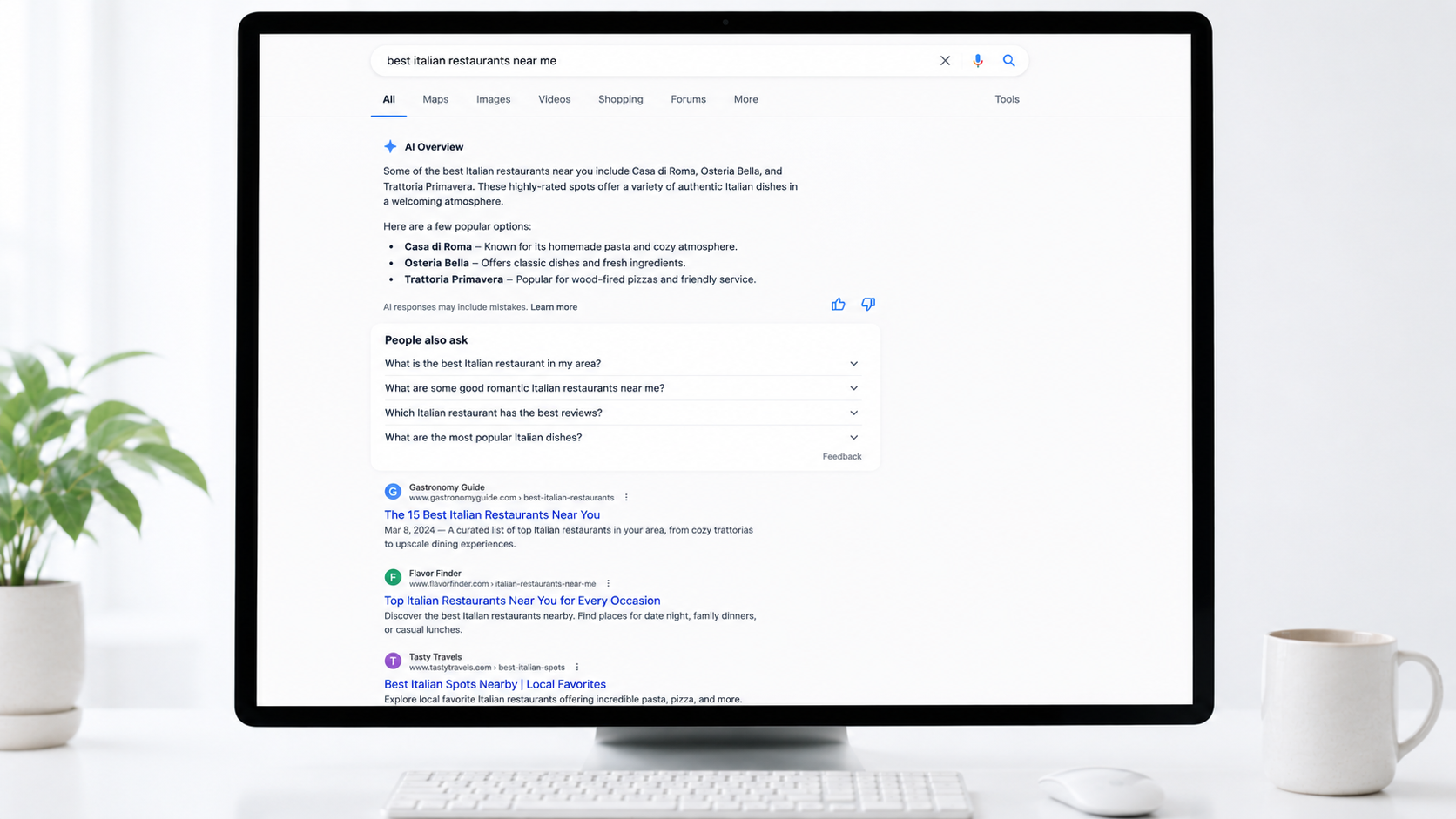
Right now, patients in your area are opening Google and typing “dentist near me,” “urgent care open now,” or “cardiologist accepting new patients.” They’ll click one of the first three results. They’ll book an appointment. And if your practice isn’t in those results, they’re booking with someone else.
The numbers back this up: 77% of patients use search engines before booking a healthcare appointment (mdconnectinc.com, 2024), and 88% of local mobile searches result in a call or visit within 24 hours (seoprofy.com, 2026). That’s not a slow funnel; that’s a same-day decision cycle.
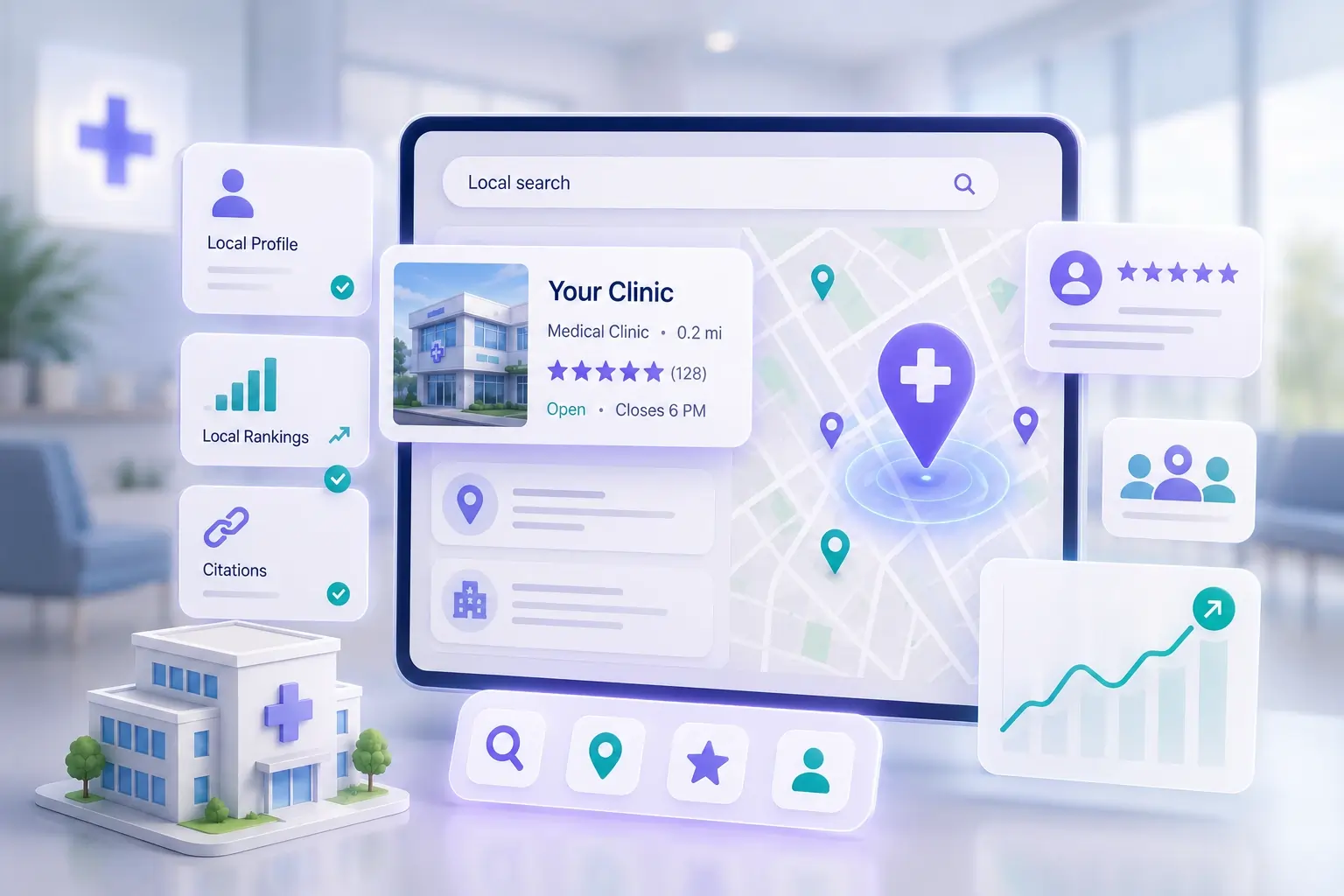
Local SEO for healthcare is the specialized discipline that determines whether your practice shows up at that exact moment or gets buried behind competitors who have invested in it. This guide covers everything: how it works, why it matters, the seven strategies that move the needle, HIPAA compliance considerations, and how to measure whether it’s working.
What Is Local SEO for Healthcare?
Local SEO is the practice of optimizing your online presence so that your business appears prominently when people search for services in a specific geographic area. In healthcare, that means: when a patient types “dermatologist near me” or “urgent care open Sunday,” local SEO determines whether your practice appears at the top of those results; or gets buried on page two where almost no one looks.
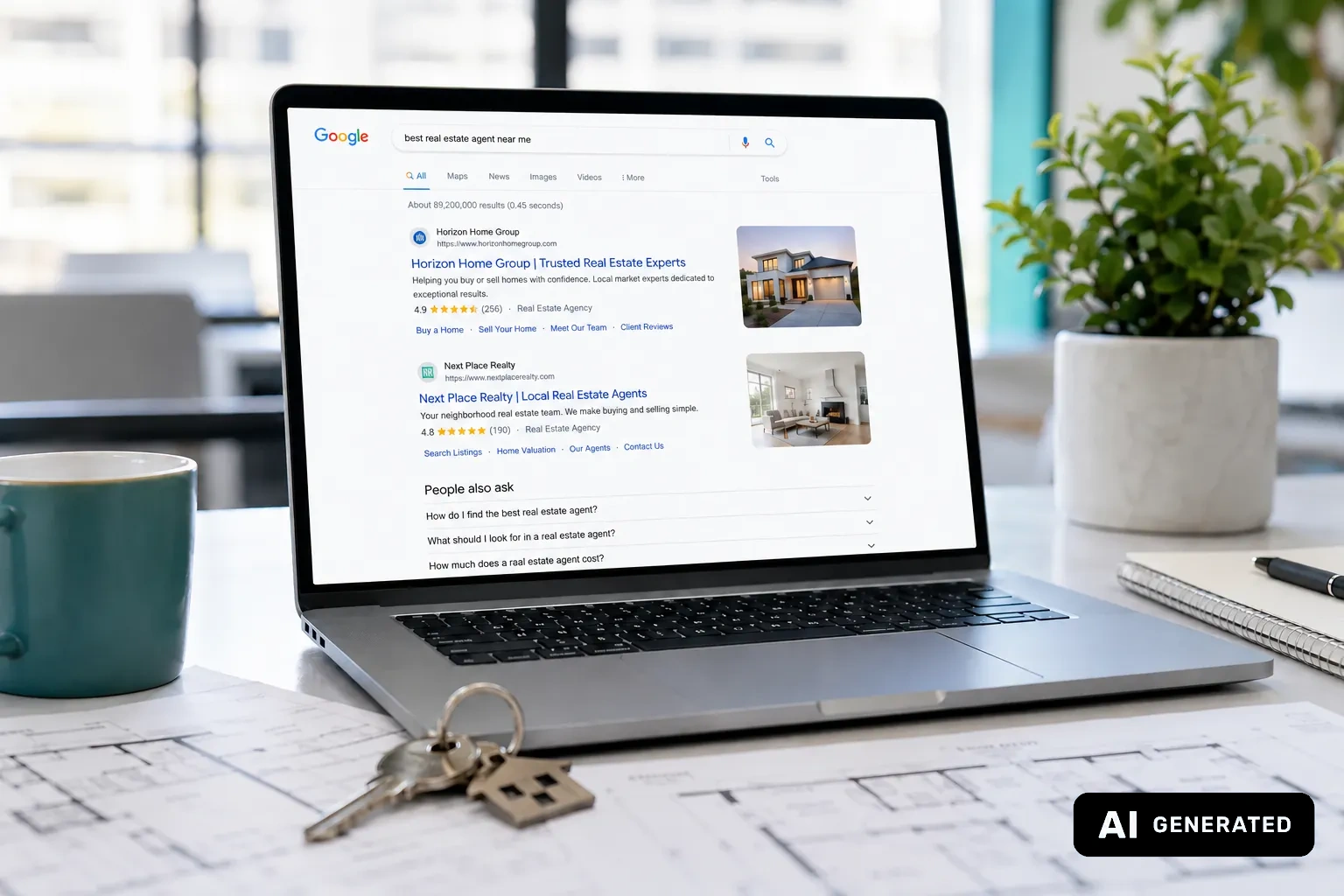
The result that local SEO targets is the Local Pack; the map-based block of three results that appears at or near the top of Google for location-based searches. Research shows local pack results receive the majority of clicks on location-intent searches, far ahead of organic results below them.
Local SEO is not the same as traditional (organic) SEO. Organic SEO focuses on building authority for broad keyword rankings across the web. Local SEO is specifically about geographic relevance; Google’s algorithm for local results weighs three things: proximity (how close your practice is to the searcher), relevance (how well your listing matches the search query), and prominence (how well-known and trusted Google considers your practice to be).
Healthcare local SEO has several characteristics that make it distinct from other industries:
- HIPAA constraints shape how you collect reviews, configure analytics, and interact with patients online; in ways that don’t apply to restaurants or retailers
- Trust stakes are higher; patients are making decisions about their health, not their lunch. E-E-A-T (Experience, Expertise, Authoritativeness, Trustworthiness) signals matter enormously
- Patients search by both provider name and clinic name; a patient might search “Dr. Sarah Chen orthopedic surgeon” or “Riverside Orthopedics” for the same appointment
- Healthcare-specific directories (Healthgrades, Zocdoc, Vitals, WebMD) are citation sources that don’t exist in other industries and carry significant ranking weight
- Geo-targeting can be broader than in other industries; patients travel further for specialists than they do for a coffee shop
Why Local SEO Matters for Medical Professionals
Before diving into tactics, it’s worth pausing on why local SEO for medical professionals deserves budget and attention; not as a marketing nice-to-have, but as a core patient acquisition system.
- 77% of patients read reviews before choosing a doctor (tebra.com, 2025). That means your online reputation is part of the clinical first impression. Patients are evaluating you before they’ve ever spoken to a receptionist.
- 53% of patients won’t consider a provider with a rating below 4 stars (tebra.com, 2025). It doesn’t matter how qualified you are; if your Google Business Profile shows 3.2 stars, a significant portion of prospective patients have already moved on.
- According to a Software Advice survey, 90% of patients use online reviews when evaluating physicians (softwareadvice.com, 2020). This means Google Business Profile is not just an SEO asset; it is your primary reputation platform, and optimizing it has a direct, measurable impact on patient acquisition.
- 32% of patients have used voice search to find a healthcare provider (synup.com, 2026), with voice searches for “doctor’s office near me” growing 50% year-over-year. The way patients find healthcare is evolving, and local SEO is the foundation that voice and AI-powered search build on.
Every new review, every consistent citation, every well-optimized location page makes them harder to displace. The ones that don’t invest are invisible at the exact moment patients are ready to book.
The 7 Key Local SEO Strategies for Healthcare Providers
These strategies work as a system. Each one builds on the others, and the most effective approach is to implement them in the order they’re listed; starting with Google Business Profile as the foundation everything else rests on. A perfect website with a neglected GBP will underperform a modest website with an excellent GBP every time.
1. Google Business Profile Optimization for Healthcare
Your GBP is the single most influential local SEO asset your practice has. It’s often the first thing a patient sees; before they visit your website, before they check your reviews elsewhere, before they call. An incomplete or unoptimized GBP is the most common and most costly local SEO mistake in healthcare.
Claim, Verify, and Secure Your Listing
If you haven’t claimed your GBP, do this first. Unclaimed listings lose ranking power, can display inaccurate information, and; critically, can be claimed by unauthorized parties. Once claimed, verify via Google’s available methods (postcard, phone, or email), and assign owner-level access permissions to protect the listing from being modified without authorization.
Choose the Right Primary Category
Your primary category is one of the most impactful decisions in your entire GBP setup. Select the most specific category available: “Pediatrician,” “Urgent Care Center,” “Cardiologist,” “Dermatologist,” not the vague “Medical Center” or “Doctor.” The more specific your category, the more precisely Google can match your listing to high-intent searches. Secondary categories expand your visibility for additional services (a family medicine practice might add “Women’s Health Clinic” as secondary).
Complete Every Field
Every incomplete field is a missed signal to Google. Your NAP (Name, Address, Phone number) must be exact and consistent with your website. Your business description should use patient-friendly language and include your primary keyword and location naturally. Hours must be accurate and updated for holidays. Appointment links should go directly to your booking page.
Add Photos, Services, and a Booking Link
Practices with photos on their GBP receive significantly more direction requests and website clicks than those without. Upload professional images of the clinic interior and exterior, staff (with consent), and equipment. Your services menu should use the language patients actually use; “knee pain treatment,” not “arthroscopic meniscectomy.” A direct booking link reduces friction and removes a step between discovery and appointment.
Use Google Posts Regularly
GBP Posts are an underused relevance signal. Best-performing post types for local SEO for medical practices: seasonal health tips tied to a service page, new provider announcements, appointment availability updates, and patient education content. Posts that promote a service and link to a corresponding landing page on the website see the strongest correlation with local ranking improvements. Those same service-specific landing pages also make strong destinations for paid search traffic; see our healthcare PPC guide for how to structure them for both organic and paid conversion.
Use GBP Attributes
Healthcare-specific GBP attributes signal trust and help Google surface your listing for filtered searches. Relevant attributes include: telehealth available, wheelchair accessible, on-site parking, LGBTQ+-friendly, language assistance available. These niche attributes can be a tiebreaker when a patient is choosing between two practices with similar ratings and proximity.
Separate Profiles for Doctors vs. Clinics
Patients frequently search by doctor name, not just clinic name; “Dr. James Park dermatologist” and “Riverside Dermatology” are different searches that may land the same appointment. Create a separate GBP for each provider at the practice for maximum surface area. For hospital systems: create separate profiles for truly distinct departments (Emergency, Imaging, Urgent Care); but not every service line, which dilutes rather than expands visibility.
2. NAP Consistency and Local Citations
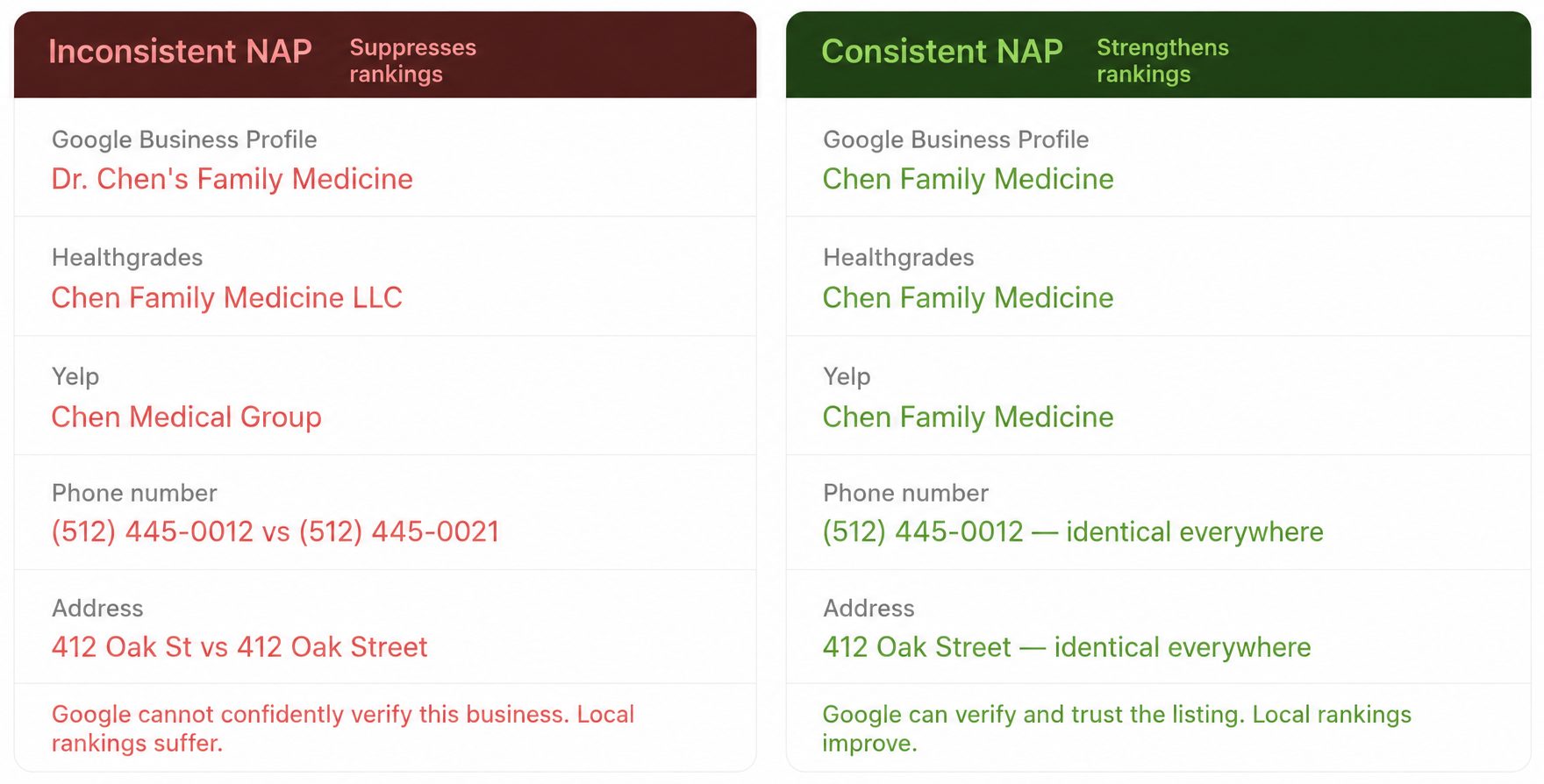
Citations are any online mention of your practice’s Name, Address, and Phone number (NAP). They appear on directories, review platforms, insurance databases, and data aggregators; and they are a core local ranking signal. Google cross-references your NAP across the web to verify that your business is legitimate and that its information is accurate.
Inconsistent NAP data; your practice listed as “Dr. Chen’s Family Medicine” on your website, “Chen Family Medicine LLC” on Healthgrades, and “Chen Medical Group” on Yelp; sends mixed signals that suppress local rankings. 67.58% of patients check whether a healthcare provider’s address and phone number match across platforms when reading reviews, and inconsistencies cause them to move on (repugen.com, 2024).
Start with a citation audit. Before building new citations, identify what already exists and what’s wrong. Tools like BrightLocal or Semrush’s Listing Management can surface duplicate, inconsistent, or outdated listings.
Build citations in two tiers:
- Tier 1: Healthcare-specific directories (highest priority): Healthgrades, Zocdoc, Vitals, WebMD, US News Health, RateMDs, Doximity, Psychology Today (for mental health), Yelp for Healthcare. These directories carry disproportionate authority in healthcare searches and are the first place patients look after Google.
- Tier 2: General business directories: Google Business Profile (already covered), Apple Maps, Bing Places, Facebook, Yelp (general), Foursquare, Yellow Pages, Better Business Bureau.
Don’t overlook insurance accuracy. If your practice is listed as accepting Blue Cross on your website but not on the insurer’s own provider directory, patients who filter by insurance won’t find you; and those who do may arrive with incorrect expectations. Verify your insurance listings directly with each payer.
Data aggregators (Factual, Acxiom, Neustar/Localeze, Infogroup) feed data to hundreds of smaller directories automatically. Correcting your NAP at the aggregator level creates a cascading fix across the web.
3. Patient Reviews and Reputation Management
Reviews are the bridge between local SEO rankings and actual patient conversion. They influence both; Google uses review quantity, recency, and rating as local ranking signals, while patients use them to make the final decision on whether to book.
94% of all healthcare reviews are written on Google (medicaleconomics.com, 2025), which makes your GBP your primary reputation platform. 70% of patients view practices more favorably when providers respond to reviews (tebra.com, 2025); including negative ones.
Collecting Reviews: The HIPAA-Compliant Way
This is where most local SEO guides for healthcare either get it wrong or skip it entirely. You cannot include any PHI in review request communications. That means:
- Compliant review request: “Thank you for visiting us today. We’d appreciate it if you’d share your experience on Google.” Sent after appointment, no mention of condition, treatment, or reason for visit.
- Non-compliant review request: “Hi Sarah, thank you for coming in for your diabetes consultation last Tuesday. We hope your A1C results were reassuring; ≥we’d love a review!”
The safe approach: automate review requests triggered by appointment completion (not appointment type), send via text or email without any clinical context, and use a HIPAA-compliant platform that has signed a BAA with your practice.
Responding to Reviews: HIPAA Rules Apply Here Too
When responding to negative reviews, you cannot confirm, deny, or reference any details about a patient’s visit; even to defend yourself. The correct approach is to acknowledge the concern, express a willingness to resolve it offline, and provide a direct contact number. Example: “We’re sorry to hear about your experience. We’d like to address your concerns directly; please contact our patient experience team at [phone number].”
For positive reviews, a warm, general thank-you response that doesn’t reference any clinical details is appropriate and encouraged.
4. On-Page SEO and Website Optimization for Medical Practices
Your website is the destination your GBP, citations, and reviews all point toward. Local SEO for medical websites requires a different on-page approach than most general websites; patient-language keyword targeting, location-specific pages, schema markup, and mobile performance all play an outsized role.
Use Patient Language, Not Clinical Terminology
Patients don’t search using the same vocabulary their doctors use. Your keyword strategy should reflect how patients describe their needs:
| Specialty | High-Intent Local Keyword Examples |
| Primary Care | “family doctor [city],” “GP accepting new patients [city]” |
| Pediatrics | “pediatrician near me,” “children’s doctor [neighborhood]” |
| Cardiology | “cardiologist [city],” “heart doctor near me” |
| Orthopedics | “knee pain specialist [city],” “orthopedic surgeon near me” |
| Mental Health | “therapist near me,” “anxiety treatment [city],” “psychologist accepting new patients” |
| Dentistry | “dentist accepting new patients [city],” “emergency dentist near me” |
| Dermatology | “skin doctor near me,” “dermatologist [city]” |
Location Pages
If your practice serves more than one geographic area or has multiple locations, each location needs its own dedicated page; not a single “Locations” page with addresses listed. Each location page should have: unique content describing that location, embedded Google Map, local phone number, location-specific hours, location-specific provider bios, and local schema markup. Duplicate content across location pages is a common mistake that suppresses rankings for all of them.
Title Tags and Meta Descriptions
Structure: [Specialty] in [City] | [Practice Name]; for example, “Cardiologist in Austin, TX | Heart Health Associates.” The location keyword should appear in the title tag, H1, first paragraph, and meta description of every location-specific and specialty-specific page.
Schema Markup
For healthcare websites, implement: MedicalBusiness or Physician schema (depending on whether you’re a practice or individual provider), LocalBusiness schema with NAP data matching your GBP exactly, and FAQPage schema on pages with patient FAQs. Schema markup helps Google understand your content at a machine level and improves eligibility for rich results.
Mobile Performance
Healthcare searches are predominantly mobile. Google uses mobile-first indexing, meaning your mobile site’s performance directly affects your rankings. Core Web Vitals; particularly Largest Contentful Paint (LCP) and Cumulative Layout Shift (CLS); should be within Google’s “Good” thresholds. A slow mobile page doesn’t just frustrate patients; it actively suppresses your rankings.
5. Local Content Marketing for Healthcare
Content serves two purposes in medical local SEO: it builds trust with patients who are evaluating your practice, and it signals to Google that your website is an authoritative, expert source on the conditions and treatments you provide.
Google classifies healthcare content under YMYL (Your Money or Your Life), a category of content where inaccurate information could cause real harm. YMYL content is held to the highest E-E-A-T standards. This means thin, generic health articles won’t rank; and could actively harm your credibility. Every piece of content should demonstrate clinical expertise, cite credible sources, and be authored or reviewed by a licensed provider. For a full framework on producing compliant medical content at scale, see our guide to healthcare content marketing.
Content types that perform best for local healthcare SEO:
- Condition and treatment pages: “What is atrial fibrillation?” or “ACL reconstruction: what to expect;” these capture awareness-stage searches and feed patients into your appointment funnel
- Symptom-based pages: “Chest pain on the left side: when to see a doctor;” high search volume, strong patient intent
- Local health guides: “Managing seasonal allergies in [City]” or “Best urgent care options in [Neighborhood];” geo-specific content that builds local relevance
- Provider bios: Often overlooked as SEO assets. A detailed bio with credentials, specialties, and patient-friendly language ranks for the provider’s name and builds YMYL trust signals
- FAQ content: Answers to the questions patients actually ask at consultations. Structured with schema markup, these can capture featured snippets
Content clusters are the most effective structural approach. Build a pillar page around a high-level topic (e.g., “knee pain treatment”) and connect it to cluster pages covering related topics (causes of knee pain, meniscus tear treatment, knee replacement surgery, recovery timeline). This signals topical authority to Google and helps your service pages rank for competitive terms. Our SEO copywriting services team builds these content systems for practices across specialties.
6. Voice Search and AI Search Optimization
Voice search has moved from novelty to necessity in healthcare. 32% of patients have used voice search to find a healthcare provider (synup.com, 2026), and voice searches specifically for “doctor’s office near me” have grown 50% year-over-year. When a patient says “Hey Siri, find me a cardiologist near me,” the result they get is determined by local SEO signals; primarily GBP quality, proximity, and NAP consistency.
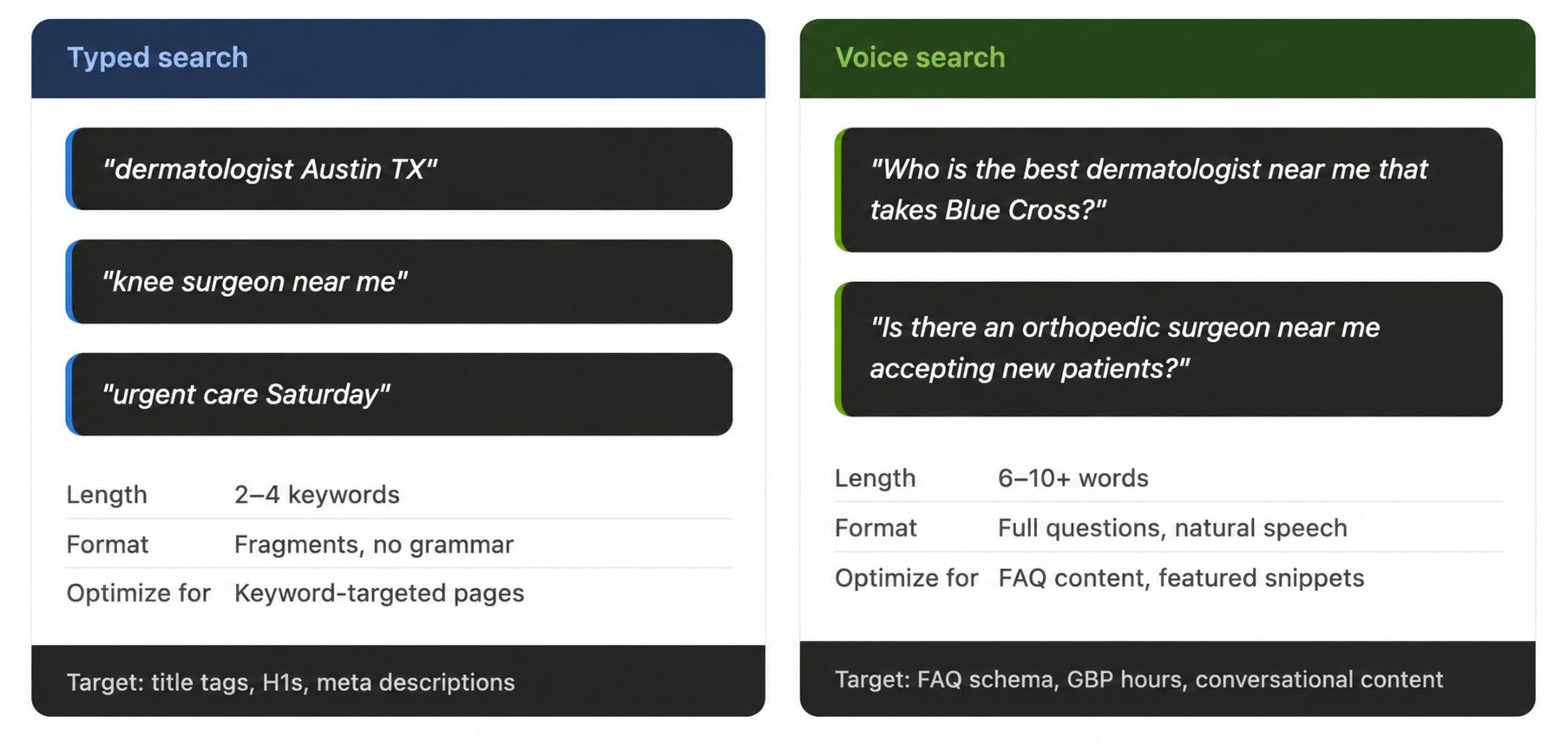
Voice queries are conversational, not keyword-based. A typed search might be “dermatologist Austin TX;” a voice search is more likely “Who is the best dermatologist near me?” or “Is there a dermatologist near me that accepts Blue Cross?” Your content should include natural-language answers to these question-format queries, structured clearly enough that voice assistants can extract and read them aloud.
Practical optimizations for voice search:
- Keep your GBP hours scrupulously accurate; voice assistants pull operating hours directly from GBP for “open now” queries
- Include FAQ sections on service pages that answer “who,” “what,” “where,” and “how” questions in plain language
- Target featured snippet positions; voice assistants frequently read featured snippets as their answer
- Use structured data (FAQ schema, Speakable schema) to signal which content is suitable for voice responses
AI Overviews and Generative Engine Optimization (GEO) represent the next frontier. 84% of medical searches now generate a Google AI Overview (tebra.com, 2025), with many also presenting local pack features. Appearing in AI-generated answers requires structured, authoritative content that AI models can cite with confidence; a discipline known as Generative Engine Optimization. If you want comprehensive support with AI-driven search visibility, our GEO services are built specifically for this.
7. HIPAA Compliance in Healthcare Local SEO
No competitor article covers this as a dedicated section. It’s the most important gap in the existing content on this topic, and the most legally consequential area for healthcare marketers to get wrong.
HIPAA compliance in local SEO is not just about avoiding fines. It shapes how you configure your analytics, how you automate review requests, how you respond to reviews publicly, and which third-party tools you’re permitted to use without a BAA.
A practical compliance test you can apply to any marketing action: “Does this action involve transmitting, displaying, or referencing any information that could identify a patient or their health condition?” If yes, you need either explicit patient consent or a BAA with every vendor involved.
Key intersections of HIPAA and local SEO:
- Analytics: Standard Google Analytics configuration can capture PHI (e.g., a URL like /patient-portal/diabetes-results). Use server-side tagging or a HIPAA-compliant analytics platform that signs a BAA. Configure GA4 to exclude sensitive URL parameters.
- Review request automation: Trigger by appointment completion, never by appointment type. The request should contain zero clinical context.
- Review responses: Never confirm a patient visited, confirm their condition, or reference any details of their care; even positively. Acknowledge and redirect offline.
- Contact forms and booking tools: Any tool that captures patient data (name + reason for visit) must have a BAA. Standard embedded forms on healthcare websites frequently do not qualify.
- Social media: Never share, tag, or reference patient cases; even anonymized ones, without explicit written consent. Reposting patient-shared content also requires consent.
The HHS guidance on the HIPAA Privacy Rule is the primary reference. For marketing-specific HIPAA guidance, our team stays current on enforcement guidance as it applies to digital marketing activities.
Local SEO for Multi-Location Practices and Hospital Search Engine Optimization
Single-practice local SEO and hospital search engine optimization are fundamentally different problems; not just in scale, but in strategy.
A single-location practice needs one optimized GBP, one set of citations, and one location page. A ten-location group practice needs ten GBPs, ten citation profiles, ten location pages, and a system to manage them consistently without each location drifting from brand standards. A hospital system with 50+ departments needs a sophisticated, layered approach that creates separate visibility for truly distinct patient entry points while avoiding internal competition between profiles.
Key multi-location and hospital SEO considerations:
- Unique location pages: Each location must have genuinely unique content; not templated copy with only the city name swapped. Google can identify duplicate location pages and will suppress them. Each page should reflect the actual providers, services, and community served by that specific location.
- Provider turnover management: Healthcare has high provider turnover. Every time a provider joins or leaves, their GBP profile, bio page, and directory listings need to be updated. Outdated provider listings are one of the most common local SEO problems in multi-location healthcare; a departed doctor still ranking for your practice creates a dead-end patient experience.
- Department-level GBPs for hospitals: Create separate GBP profiles for distinct patient-facing departments; Emergency Department, Imaging Center, Cancer Center, Urgent Care; where patients search independently. Don’t create profiles for every internal service line, which dilutes authority. A hospital’s main GBP and its Emergency Department GBP can coexist and rank for different queries.
- Listing management platforms: At scale, manual management of citations and GBPs is not feasible. Platforms like BrightLocal, Yext, or Semrush Listing Management automate NAP consistency across directories and flag discrepancies. For hospital-scale deployments, these tools are a necessity, not a luxury.
For enterprise-scale healthcare organizations, our SEO services for healthcare practices include multi-location strategy, listing management, and the kind of AI digital marketing infrastructure that larger systems need.
How to Measure Medical Local SEO Performance
Knowing what to do is only half the job. If you’re not tracking results, you have no way to tell what’s working, what’s wasting budget, and where to focus next. These are the metrics worth monitoring.
Key metrics to track:
- Google Business Profile Insights (free, within GBP): Search queries that triggered your listing, views by Search vs. Maps, website clicks, direction requests, and phone calls. GBP Insights show how patients are finding and interacting with your listing; but note that GBP does not show your ranking position. You need a separate local rank tracking tool for that.
- Local rank tracking: Tools like BrightLocal, Local Falcon, or Semrush’s Position Tracking show where your practice ranks in the local pack and organic results for your target keywords, broken down by geographic grid (so you can see ranking variations across a city, not just an average).
- Website analytics for location pages: Track organic traffic to each location page, conversion rate (appointment bookings or phone calls), and bounce rate. A location page with high traffic but a high bounce rate indicates a content or UX problem that’s costing you appointments.
- Review velocity: How many new reviews are you receiving per month, and what is your average rating trajectory? A stagnant review profile (no new reviews in months) is a local ranking signal that works against you.
- Share of Local Voice (SoLV): The percentage of local searches in your target area where your practice appears in the top results. This is the most comprehensive local SEO performance metric; tools like Local Falcon calculate it automatically.
Realistic timeline expectations:
- GBP optimization improvements: 2–6 weeks for measurable impact on GBP metrics
- Citation building: 1–3 months for new citations to be indexed and influence rankings
- On-page SEO changes: 3–6 months for meaningful ranking movement on competitive keywords
- Content marketing: 6–12 months for topical authority to compound into consistent ranking improvements
Local SEO is not a one-time project; it is an ongoing system that compounds over time. The practices that treat it as a set-and-forget exercise see diminishing returns; the ones that treat it as continuous infrastructure see compounding returns.
How Much Does Local SEO Cost for Healthcare Practices?
This is one of the most practical questions a practice manager or physician can ask; and it’s conspicuously absent from most guides on this topic. Here’s an honest breakdown.
- DIY local SEO (time cost, not financial): Claiming and optimizing your GBP, building Tier 1 citations manually, and responding to reviews yourself costs primarily time. This is viable for a solo practice with a limited budget but becomes unmanageable for practices with multiple providers or locations.
- Entry-level local SEO services ($300–$800/month): Covers GBP management, basic citation building and monitoring, and review request setup. Suitable for single-location practices in low-competition markets. At this budget, expect limited content creation and no technical SEO work.
- Mid-range local SEO services ($800–$2,000/month): Adds ongoing content creation (2–4 blog posts or service pages per month), comprehensive citation management, local rank tracking, and technical SEO auditing. Appropriate for competitive urban markets or multi-provider practices.
- Enterprise/multi-location ($2,000–$6,000+/month): Covers full listing management across all locations, dedicated content strategy, schema implementation, AI search optimization, and regular performance reporting. Hospital systems and large group practices typically need this tier.
Key factors that affect pricing: market competition (a cardiologist in Manhattan competes very differently from one in a rural town), number of locations, number of providers, current baseline (a brand-new website needs more foundational work than an established practice), and scope of content required.
The ROI calculus is straightforward: if a new patient is worth $2,000–$5,000 in lifetime value to your practice, and effective local SEO brings in even 3–5 additional patients per month, the math justifies the investment at virtually every price tier.
Conclusion
Local SEO for healthcare is not a marketing luxury; it’s the infrastructure that determines whether patients find you or your competitor at the moment they’re ready to book. The seven strategies in this guide work as a compounding system: GBP optimization builds the foundation, citations and NAP consistency build trust signals, reviews build both rankings and conversion, on-page SEO captures intent, content builds authority, voice and AI optimization future-proofs your visibility, and HIPAA compliance protects everything you’ve built.
Start here, in this order:
- Claim and fully optimize your Google Business Profile
- Audit and clean up your NAP consistency across Tier 1 directories
- Set up a HIPAA-compliant review request system
- Optimize your core service and location pages
- Build a content strategy around patient-language keywords
Local SEO compounds. The work you do today builds an advantage that gets harder for competitors to close over time. The practices that start now will be significantly harder to displace by the time others begin.
If you’d like expert support building this system, our SEO services for healthcare practices and broader healthcare marketing services are designed for medical providers; from solo practices to hospital systems.
Frequently Asked Questions
What is local SEO for healthcare and why does it matter for my practice?
Local SEO for healthcare is the process of optimizing your practice’s online presence so it appears prominently when patients search for healthcare services in your area. It matters because 77% of patients use search engines before booking a healthcare appointment (mdconnectinc.com, 2024), and most of those patients choose from the top three results. Without local SEO investment, your practice is effectively invisible to patients who are actively looking for exactly what you offer.
How is local SEO for medical practices different from regular SEO?
Regular SEO targets broad keyword rankings without geographic focus. Local SEO specifically optimizes for location-based searches and the Google Local Pack; the map-based results block that appears for “near me” and city-specific queries. For medical practices, it also involves healthcare-specific directories (Healthgrades, Zocdoc, Vitals), HIPAA-compliant review management, and E-E-A-T signals that Google applies more strictly to health content than most other categories.
How do I collect patient reviews without violating HIPAA?
Send review requests triggered by appointment completion; never by appointment type or condition. The request should contain zero clinical information: no mention of the condition treated, procedure performed, or reason for the visit. Use a HIPAA-compliant platform that has signed a BAA with your practice. When responding to reviews publicly, never confirm or reference any details of a patient’s visit, even in a positive response.
What Google Business Profile category should I use for my medical practice?
Choose the most specific category that accurately describes your primary service: “Pediatrician,” “Cardiologist,” “Urgent Care Center,” “Dermatologist”, not a generic label like “Medical Center” or “Doctor.” Add secondary categories for additional services you provide. Specific categories help Google match your listing to the exact queries your target patients are using.
How long does local SEO take to show results for a healthcare practice?
GBP optimizations can show measurable impact in 2–6 weeks. Citation building influences rankings over 1–3 months. On-page SEO changes typically take 3–6 months for meaningful ranking movement. Content marketing compounds over 6–12 months. Local SEO is not a quick fix; it’s an investment that builds durable, compounding visibility over time.
Do I need a separate Google Business Profile for each doctor in my practice?
Yes, in most cases. Patients frequently search by provider name, not just practice name; “Dr. Sarah Chen pediatrician” and “Riverside Pediatrics” may be the same appointment, but they’re different searches. A separate GBP for each provider maximizes your practice’s surface area in local search. For hospital systems, create separate profiles for distinct patient-facing departments, not every internal service line.
What are the most important local SEO ranking factors for doctors?
The top factors for local pack rankings are: Google Business Profile completeness and activity (posts, reviews, Q&A), NAP consistency across citations and directories, proximity to the searcher, review quantity and quality, on-page SEO signals from your website (particularly location and specialty pages), and behavioral signals (clicks, calls, and direction requests from your GBP). Reviews and GBP completeness are the highest-leverage factors for most practices.
How much should a medical practice budget for local SEO?
Entry-level management runs $300–$800/month for solo practices in low-competition markets. Mid-range services covering content, citations, and rank tracking run $800–$2,000/month. Multi-location or hospital-level programs range from $2,000–$6,000+/month. The right budget depends on your market competitiveness, number of locations, and patient lifetime value. Most practices find the ROI justifies investment at every tier when measured against actual patient acquisition costs.
Can voice search optimization help my practice get more patients?
Yes, and it’s growing in importance, and the trend is accelerating. Voice queries are conversational and question-based (“Is there a cardiologist near me accepting new patients?”), so your content and GBP need to reflect natural language, accurate hours, and FAQ-style answers to the questions patients ask. The foundational local SEO work; GBP optimization, NAP consistency, reviews; directly feeds voice search results.
What is the difference between local SEO and hospital search engine optimization?
Local SEO typically refers to optimization for individual practices or small group practices targeting a defined geographic area. Hospital search engine optimization involves the same principles at a much larger scale; managing GBPs and citations for multiple departments and locations, building location pages for each facility, optimizing for a broader range of specialties, and coordinating brand consistency across a complex organizational structure. Hospitals also have greater authority as established institutions, but managing that authority across dozens of service lines and hundreds of providers requires dedicated systems and processes that go beyond standard local SEO.
About Local SEO for Healthcare: A Complete Guide for Medical Professionals
This guide was written by Meri Tiratsyan and reviewed by Sonja Somborac, SEO Project Manager at Scopic Studios.
Scopic Studios delivers exceptional and engaging content rooted in our expertise across marketing and creative services. Our team of talented writers and digital experts excel in transforming intricate concepts into captivating narratives tailored for diverse industries. We’re passionate about crafting content that not only resonates but also drives value across all digital platforms.