
Listen to article
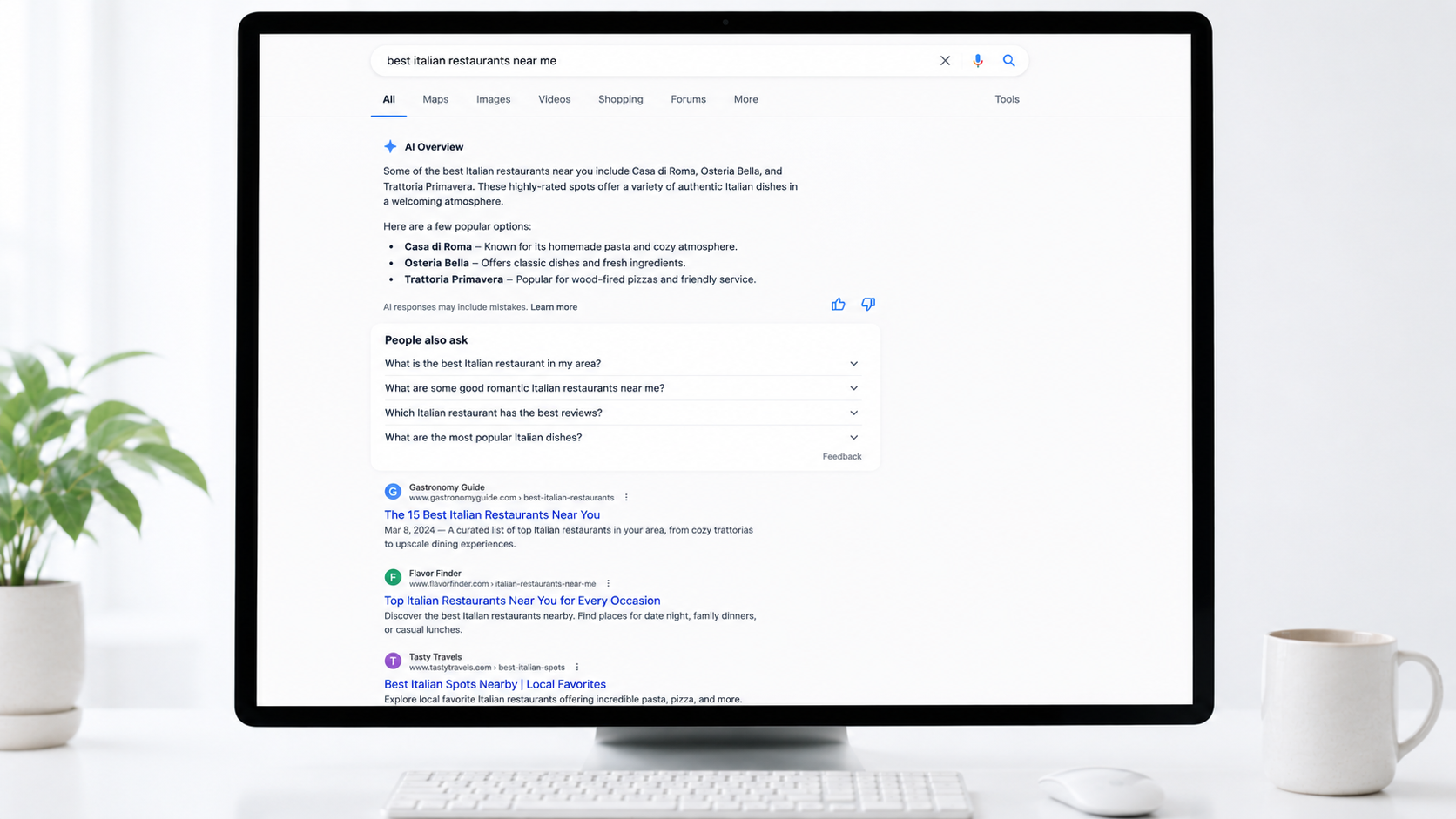
Before a patient ever calls your office, they’ve already searched for you, or someone like you. 77% of patients use search engines before booking a healthcare appointment (MDConnect, 2024). And search drives 3x more visitors to hospital websites than any other digital channel (Sagapixel, 2024). That is not a trend, that is how modern patient acquisition works.
Content marketing in healthcare is uniquely demanding. Unlike most industries, it must simultaneously:
- Educate worried patients with clinically accurate information
- Build institutional trust with a skeptical audience
- Attract and convert prospective patients
- Comply with strict regulatory requirements; including HIPAA
Get any of these wrong, and the consequences range from lost search rankings to federal enforcement actions.
This guide gives you a complete, practical playbook for content marketing healthcare in 2026; from strategy fundamentals to HIPAA compliance to real-world examples; built for marketing teams who need to execute, not just plan.
Quick Summary
- Healthcare content marketing must balance patient education, trust-building, and strict HIPAA compliance simultaneously
- Every piece of healthcare content must pass 3 tests before publishing: accuracy (clinically reviewed), credibility (E-E-A-T signals), and HIPAA compliance (no PHI without written authorization)
- The #1 compliance mistake marketers make: publishing patient stories, testimonials, or review responses that inadvertently reveal someone received care at your facility
- Content formats mapped to the patient journey: blog posts and video for awareness, email and webinars for consideration, testimonials and case studies for decision
- Results take time; expect 2–4 months for ranking movement, 3–6 months for traffic, 6–12 months for full content authority
What Is Healthcare Content Marketing?
Healthcare content marketing is the practice of creating and distributing medically accurate, audience-relevant content; blog posts, videos, emails, and infographics; to attract patients, educate the public, and establish your organization as a trusted authority.
It is not advertising. It never leads to a hard sell. It leads to information that genuinely helps people.
How It Differs From Traditional Content Marketing
| Traditional Content Marketing | Healthcare Content Marketing | |
| Primary goal | Generate leads, drive sales | Educate, build trust, then convert |
| Stakes of inaccuracy | Low, brand reputation risk | High, patient health is directly affected |
| Regulatory environment | Minimal | HIPAA, FTC, FDA, state medical boards |
| Trust threshold | Moderate | Extremely high, YMYL classification |
| Content review process | Marketing team | Requires credentialed medical review |
The product being marketed directly affects people’s health. That means accuracy is not optional; it is a professional and ethical obligation.
What the Data Says
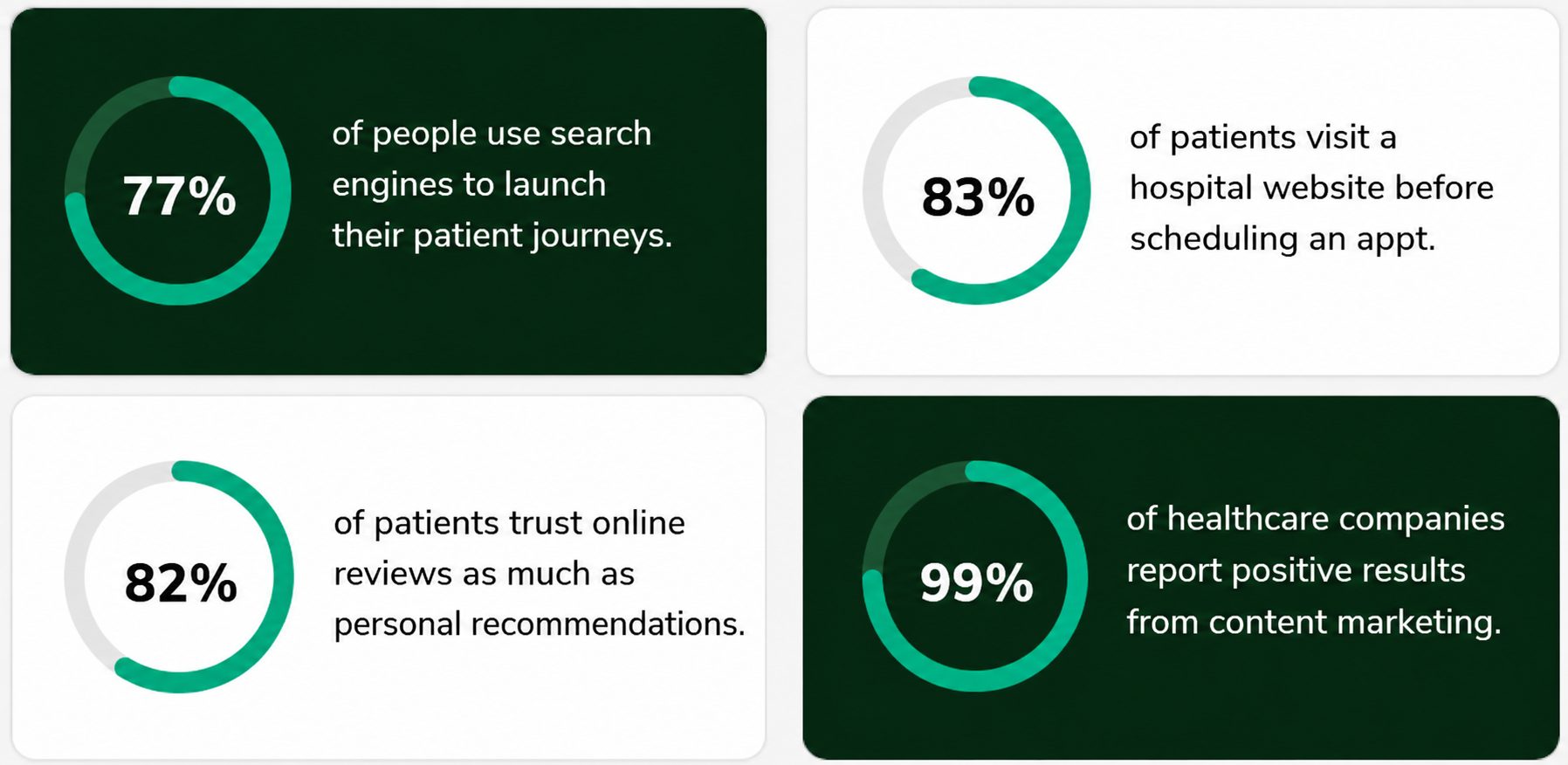
99% of healthcare companies that invest in content marketing report positive outcomes from the channel (Semrush, 2024). The right medical SEO strategy amplifies those results further by ensuring your content reaches patients at the exact moment they need it.
Why Healthcare Organizations Cannot Afford to Ignore Content Marketing
The business case for healthcare content marketing is no longer theoretical. Here is what the numbers show.
Patients Research Before They Book
- 77% of patients start their healthcare journey at a search engine (MDConnect, 2024)
- 83% of patients visit a hospital’s website before scheduling an appointment (WinSavvy, 2024)
- Search drives 3x more hospital website traffic than any non-search channel (Sagapixel, 2024)
If your organization doesn’t rank for the conditions, symptoms, and services your patients search for, a competitor does.
Trust Is the Primary Decision Driver
- 82% of patients trust online reviews as much as personal recommendations (WinSavvy, 2024)
- That trust is built long before an appointment, through the content your organization publishes and the credibility it demonstrates online
The Cost Economics Favor Content
Content marketing generates roughly 3x as many leads as paid advertising while costing significantly less over time (Semrush, 2024). For healthcare organizations managing tight marketing budgets, content is one of the highest-leverage investments available.
The core message: Content marketing is not optional in healthcare. It is how patients find you, evaluate whether they can trust you, and decide to book.
What Are Healthcare Content Marketing Trends in 2026?
The forces shaping how healthcare content is created and consumed are shifting fast. These are the 6 trends that matter most right now.
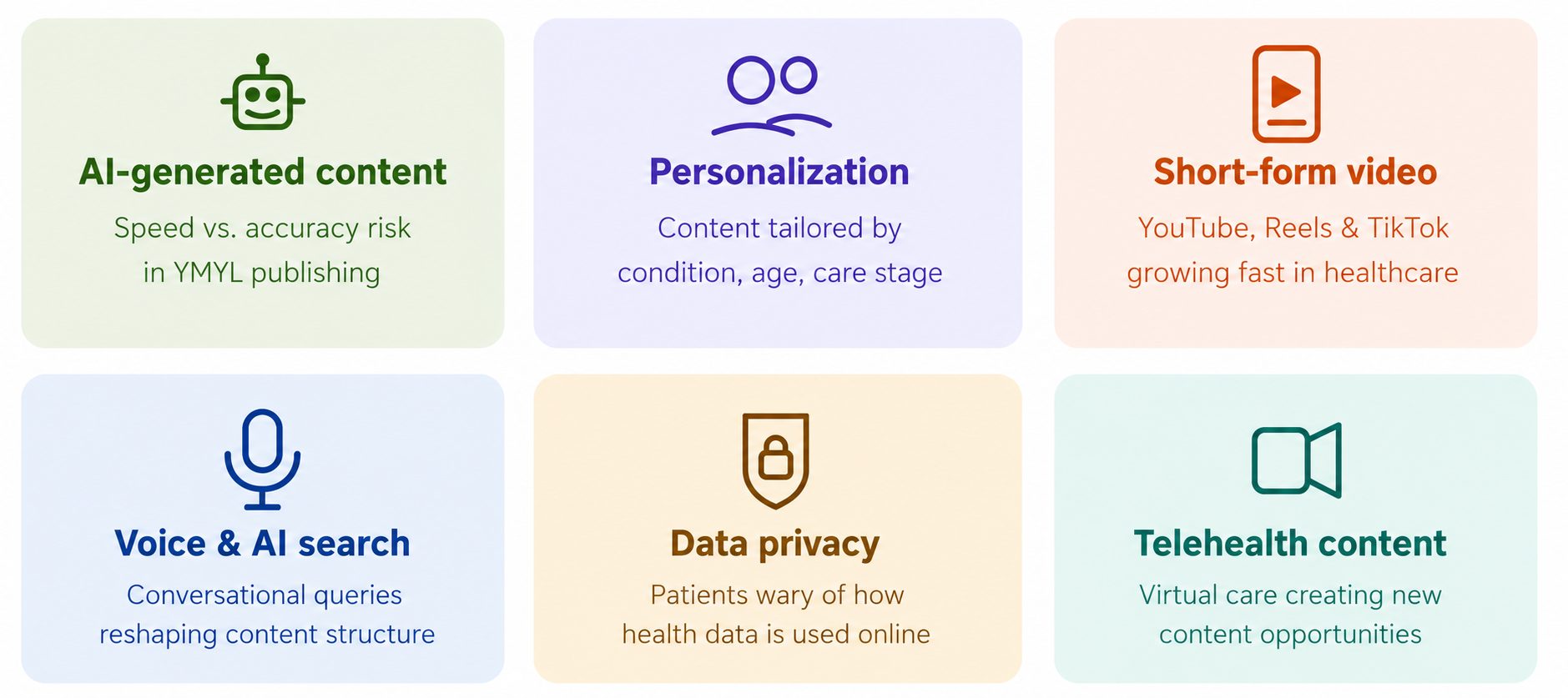
1. AI-Generated Content-Speed vs. Accuracy Risk
AI can produce healthcare content writing at speed, but speed creates risk in a YMYL industry. AI tools don’t hold medical licenses, can confabulate clinical details, and are not accountable for patient harm. Every piece of AI-assisted content in healthcare must be reviewed by a credentialed medical professional before publication.
2. Personalization at Scale
71% of consumers now expect personalized interactions with brands (McKinsey, 2023). In healthcare, this means segmenting healthcare content by patient condition, life stage, and care journey; not publishing one-size-fits-all advice. Organizations that do this see higher engagement and longer time-on-page meaningfully.
3. Short-Form Video
Health content consumption is growing rapidly on YouTube, Instagram Reels, and TikTok. Procedure explainers, provider introductions, and preventive health tips in short-video format consistently outperform static content with younger demographics. Video is no longer optional in a complete medical content marketing strategy.
4. Voice and AI Search
Patients ask health questions conversationally: “What are the symptoms of atrial fibrillation?” or “How long does recovery take after knee replacement?” Content structured around natural-language questions; FAQ formats, clear H2/H3 headers, direct answers; performs significantly better in voice and AI-generated search results. This is the foundation of generative engine optimization as it applies to healthcare.
5. Data Privacy Concerns
Patients are increasingly aware of how their health data moves online. Healthcare organizations that are transparent about data practices, avoid invasive tracking setups, and communicate clearly about privacy build stronger patient trust, and avoid significant regulatory exposure.
6. Telehealth Content
The normalization of virtual care has created entirely new content categories: how to prepare for a telehealth visit, which conditions are appropriate for virtual consultations, and how to share medical records remotely. Organizations that address these questions build useful evergreen assets while positioning their telehealth capabilities to a growing audience.
The 3 Non-Negotiables of Healthcare Content
Before any tactic, format, or editorial calendar, every piece of healthcare content must meet 3 foundational standards.
Non-Negotiable #1: Accuracy
- Every medical claim must be evidence-based and referenced to authoritative sources (peer-reviewed research, clinical guidelines, or recognized medical institutions like the NIH or Mayo Clinic)
- Content must be reviewed by a credentialed healthcare professional before publication
- Google’s YMYL framework actively penalizes inaccurate or thin healthcare content in rankings
- Beyond SEO, inaccurate health information causes real-world patient harm
Non-Negotiable #2: Credibility
- Author credentials must be visible on every piece of clinical content
- Sources must be cited and linked
- Your organization’s expertise must be demonstrated through bylines, medical advisory structures, and a consistent professional tone
- E-E-A-T (Experience, Expertise, Authoritativeness, Trustworthiness) signals carry more weight in healthcare than in almost any other industry
Non-Negotiable #3: HIPAA Compliance
The essential compliance test before publishing any piece of content:
“Does this content confirm or reveal that a specific individual received care at this facility?”
If yes, it requires explicit written patient consent or must not be published.
This test applies to testimonials, case studies, social posts, review responses, and any format referencing individual patient experiences.
HIPAA Compliance in Healthcare Content Marketing
A single non-compliant testimonial, an improperly configured analytics tool, or one review response that mentions a patient’s condition; any of these can trigger a HIPAA violation. This section gives you the practical framework to make sure none of them happen.
What Is PHI and Why It Must Never Appear in Marketing Content
Protected Health Information (PHI) is any information that could identify a specific individual in connection with their health condition, care, or payment. This includes:
- Names, dates of service, and geographic identifiers
- Photos or videos that identify a patient
- Combinations of demographic data that could identify a person
- Any reference to a specific individual’s diagnosis, treatment, or visit
PHI must never appear in marketing content, social posts, email campaigns, or any public-facing material without explicit written authorization.
Written Authorization: The Requirements
Before publishing any patient story, photo, testimonial, or case study, you must obtain a signed written HIPAA authorization that specifies:
- Exactly what information will be used
- Which formats it will appear in (written, video, photo)
- Which platforms it will be published on
- Whether you can use it in perpetuity or for a defined period
- The patient’s right to revoke consent
A verbal agreement or a general intake consent form is not sufficient.
Business Associate Agreements (BAAs)
A BAA is a legal contract that governs how a third-party vendor handles PHI on your behalf. Any marketing tool that has the potential to process or store PHI, email platform, CRM, analytics tool, chatbot, requires a signed BAA before use. Vendors that do not offer BAAs cannot legally handle any patient-identifiable information. (HHS guidance on BAAs, 2023).
HIPAA-Safe Content Types (No PHI Required)
The following content formats are fully compliant and require no patient data:
- Educational blog posts on health conditions and symptoms
- General wellness and preventive health tips
- Provider and staff introduction profiles
- Facility feature content and service explanations
- Seasonal health reminders and awareness campaigns
- Condition and treatment overview pages
These are your safest and most scalable content categories, and they drive the most consistent organic traffic.
Analytics Compliance
Standard GA4 in its default configuration is not HIPAA compliant. PHI can be inadvertently captured through:
- URL parameters (e.g., condition-specific page paths)
- Form field submissions (e.g., appointment request forms)
- Referral strings containing patient-identifiable data
Before going live, GA4 must be configured with PHI exclusions across all event parameters, page path filters, and form submissions. For higher-risk environments, consider HIPAA-compliant analytics alternatives such as Freshpaint or Piwik PRO.
Review Request and Response Compliance
Review requests: Automate by appointment type only. Sensitive categories, mental health, oncology, reproductive health, substance use treatment, and HIV care, should never trigger automated review requests. Soliciting a review that inadvertently reveals a patient’s care category is a compliance violation.
Review responses: When responding to patient reviews publicly, never:
- Confirm the reviewer is a patient
- Reference their visit date, condition, or treatment
- Discuss any detail of their care, even sympathetically
A HIPAA violation in a public review response has resulted in federal enforcement actions against healthcare organizations.
Compliant vs. Non-Compliant: Side-by-Side Examples
| ✅ Compliant | ❌ Non-Compliant |
| “Our cardiology team shares expert insights on heart health.” | “Read how our patient recovered from heart surgery at our clinic.” |
| “Managing diabetes starts with small, consistent lifestyle changes.” | “John, a patient at our clinic, reversed his Type 2 diabetes with our program.” |
| “Our orthopedic surgeons perform over 500 joint replacement procedures annually.” | “See the before-and-after X-rays from last week’s knee replacement.” |
HIPAA Compliance Checklist
Before publishing any piece of content, confirm:
[ ] Does this content confirm or reveal that a specific individual received care here?
[ ] Does any patient appear by name, photo, or identifiable detail without signed written authorization?
[ ] Has the vendor processing this content signed a BAA?
[ ] Are all analytics configurations confirmed to exclude PHI?
[ ] For sensitive appointment types, has automated review triggering been disabled?
How to Build a Healthcare Content Marketing Strategy
A documented healthcare content marketing strategy is the difference between random publishing and consistent patient growth. Without a plan, content efforts produce scattered results. With one, every piece published serves a defined business goal, a defined patient persona, and a defined stage in the patient journey.
Define Your Audience and Patient Personas
Healthcare audiences are not monolithic. A cardiology practice serves fundamentally different patients than a pediatric clinic. Before writing a single word, map your primary patient segments across 3 dimensions:
Demographic factors:
- Age range, gender, and geographic location
- Insurance profile and payer mix
- Language and health literacy level
Condition and care-stage factors:
- Chronic condition management vs. acute care
- Preventive health vs. post-surgical recovery
- Early-stage research vs. ready-to-book
Behavioral factors:
- Where they search for health information (Google, YouTube, patient forums)
- What questions they type vs. ask by voice
- Which devices do they use and at what time of day
Example Persona 1 – “Chronic Condition Carol” Female, 52–65, managing Type 2 diabetes and hypertension. Searches Google for symptom questions and medication interactions. Reads long-form content. Trusts doctors but also reads patient forums. Wants content that validates her experience and gives clear, practical guidance.
Example Persona 2 – “New Parent Nick” Male, 28–38, father of a child under 3. Searches for pediatric symptoms on a smartphone at 11pm. Wants fast, reliable answers. Likely to book online. Trusts pediatrician’s recommendations but checks Google reviews before every appointment.
Personas make every content decision sharper: what topics to cover, what tone to use, which formats to invest in, and which channels to prioritize.
Set Clear Goals and KPIs
Vague goals produce vague results. Use SMART goal-setting tied directly to business outcomes.
| Goal | KPI | What to Avoid |
| Increase organic traffic to condition pages by 40% in 9 months | Organic sessions to target pages | Total site traffic |
| Grow email subscriber list from 2,000 to 5,000 in 12 months | Subscriber count + monthly growth rate | Social follower count |
| Achieve 5% appointment booking rate from organic content | Bookings attributed to organic search | Page impressions |
Track metrics that connect directly to patient acquisition or retention. Everything else is noise.
Build an Editorial Calendar
An editorial calendar maps content to patient journey stages, seasonal relevance, and business priorities. Without one, publishing becomes reactive, and consistency is one of the primary drivers of long-term domain authority.
A balanced editorial calendar should include:
- Evergreen content – condition explainers, treatment guides, provider introductions, that generate traffic year-round
- Seasonal content – flu season preparation, allergy guides, back-to-school physicals, open enrollment reminders; that captures timely search demand
- Strategic content – service line pages, location pages, condition hubs, that directly support new patient acquisition goals
Practical starting cadence for most organizations:
- 2–4 blog posts per month
- 1 email newsletter per month
- Quarterly content audit to update high-traffic pages with current clinical information
Choose Your Content Types
Different formats serve different goals in a healthcare content marketing strategy. The strongest programs use multiple formats strategically, not every format for every objective.
- Blog posts
-
- Best for: Healthcare SEO, patient education, condition and symptom content, provider Q&As
-
- Why they work: Condition pages and symptom explainers drive consistent organic traffic and build subject-matter authority over time. This is the highest-priority investment for most organizations.
- Videos
-
- Best for: Procedure explainers, provider introductions, patient education
-
- Why they work: Video builds trust faster than text. Short provider introductions and walkthrough videos are particularly effective at reducing patient anxiety before unfamiliar procedures.
- Infographics
-
- Best for: Simplifying complex health data, preventive care timelines, and medication guides
-
- Why they work: Complex clinical information; dosage schedules, screening timelines, become easy to share and understand. High-performance as supporting assets within blog content and on social.
- Email newsletters
-
- Best for: Patient retention, appointment reminders, general health tips
-
- Why they work: Email marketing service is the most effective channel for keeping your organization top of mind between appointments. Requires a HIPAA-compliant platform with a signed BAA.the most effective channel for keeping your organization top of mind between appointments. Requires a HIPAA-compliant platform with a signed BAA.
- Webinars and podcasts
-
- Best for: Thought leadership, professional audience engagement, specialist referral networks
-
- Why they work: Particularly valuable for building relationships with referring physicians and positioning clinical leadership as subject-matter experts.
- Patient testimonials and case studies
-
- Best for: Trust-building at the bottom of the patient journey funnel
-
- Why they work: The most persuasive content format in medical content marketing, and the most compliance-sensitive. Use only with a full written HIPAA-compliant patient authorization.
Real-World Healthcare Content Marketing Examples
The most instructive healthcare content marketing examples come from organizations that turned content into their primary patient acquisition engine.
Example 1: Mayo Clinic – Condition and Symptom Library
- What they did: Mayo Clinic built one of the most comprehensive medical content libraries on the internet. Its Diseases and Conditions directory covers thousands of clinical conditions with structured, physician-reviewed pages; consistently ranking for high-intent search terms across every major specialty (Mayo Clinic).
- Why it worked: The content is accurate, consistently formatted, regularly updated, and built on clinical credibility that no SEO shortcut can replicate. Mayo now ranks on page 1 for tens of thousands of health-related queries.
- What you can replicate: Build a scaled-down condition library focused on your specific specialties. A regional cardiology practice that publishes 20 evidence-based pages on common conditions, such as arrhythmias, heart failure, and hypertension management, will outrank most local competitors who don’t invest in this type of content.
Example 2: Cleveland Clinic – Health Essentials Blog
- What they did: Cleveland Clinic’s Health Essentials blog (health.clevelandclinic.org) is one of the most-visited health content properties in the United States. Rather than publishing promotional content about services, Health Essentials leads with patient education; practical guidance on managing conditions, understanding test results, and preparing for procedures.
- Why it worked: Education-first content generates millions of monthly organic visits and positions Cleveland Clinic as the trusted authority patients return to when making care decisions. The brand recognition built through content directly reduces paid acquisition costs.
- What you can replicate: Publish content your patients actually need, not content that promotes your services. The trust built through educational healthcare content writing converts to patient acquisition over time.
Example 3: Specialty Practice – Condition-Focused Authority Building
- What they did: A regional orthopedics practice published 30 evidence-based pages covering its core conditions: ACL injuries, rotator cuff tears, knee replacement candidacy, and sports injury prevention. Each page was physician-reviewed, answered the top patient questions, and included clear calls to action for booking a consultation.
- Why it worked: Within 9 months, organic traffic to condition pages grew by 60% and appointment bookings from organic search doubled. No competitor in their market had invested in comparable condition-specific content.
- What you can replicate: Pick your top 10–15 conditions or services. For each, answer the 5 questions patients ask most. Have a physician review and sign off. Publish and track.
Tools Every Healthcare Content Marketer Needs
These are the core tool categories; not an exhaustive list, but the ones you cannot operate without.
Content Planning
Tools: Trello, Asana, CoSchedule: For editorial calendar management, content briefs, and publishing workflow coordination. Any of these works, pick the one your team will use consistently.
SEO and Keyword Research
Tools: Ahrefs, SEMrush, SE Ranking: For identifying patient search queries, tracking keyword rankings, and auditing competitor content gaps in your specialties. SE Ranking is a cost-effective entry point for smaller practices.
Analytics
Tools: GA4 (with PHI exclusions configured), Freshpaint, Piwik PRO Standard: GA4 out of the box is not HIPAA compliant. For any workflows that touch patient data, use a HIPAA-safe analytics alternative with a signed BAA.
Content Management
Tools: WordPress remains the dominant CMS for healthcare content marketing, with mature plugin ecosystems for SEO (Yoast, Rank Math), accessibility compliance, and schema markup.
Email Marketing
Tools: Mailchimp (Business Associate Agreement available on paid tiers), Klaviyo, Constant Contact: Only platforms that sign BAAs should be used for any patient-facing communication. Verify BAA availability before selecting any email platform.
Social Media Scheduling
Tools: Buffer, Sprout Social: Safe to use for scheduling healthcare social content, provided no PHI is processed or stored in these platforms. Keep all patient-specific information entirely out of these tools.
How to Measure Healthcare Content Marketing Performance
Attribution in healthcare is harder than in most industries. Here’s why, and how to measure accurately despite those constraints.
Why Attribution Is Harder in Healthcare
- Longer patient journeys: A patient may read 3–5 pieces of content over 3–6 months before booking
- Offline conversions: Appointments are often booked by phone, breaking digital tracking chains
- HIPAA constraints: You cannot legally attach patient identity data to digital tracking without strict controls in place
Key Metrics to Track
| Metric | What It Tells You |
| Organic traffic to condition and service pages | Whether SEO-focused content is working |
| Keyword ranking positions for target terms | Competitive visibility; track monthly |
| Time on page and scroll depth | Content quality and reader engagement |
| Email open and click-through rates | Audience engagement with retention content |
| Appointment bookings from organic sources | Direct ROI; requires call tracking or UTM-tagged booking links |
| Patient acquisition cost: content vs. paid | Long-term ROI case for content investment |
HIPAA Analytics Reminder
All analytics configurations must exclude PHI from URL parameters, form field submissions, and referral strings before going live. Revisit this configuration every time new pages, forms, or tracking parameters are added. This is not a one-time setup; it requires ongoing auditing (HHS, 2023).
Timeline Expectations
Pair your SEO services investment with realistic timelines, and set stakeholder expectations accordingly:
- On-page improvements to existing content: 2–4 months for visible ranking movement
- New content on an established domain: 3–6 months for meaningful organic traffic
- Full content authority in a competitive specialty: 6–12 months of consistent publishing
Healthcare content marketing is a long-term asset, not a short-term demand generation tactic. The organizations that treat it as such consistently outperform competitors relying on paid channels alone.
Conclusion
Healthcare content marketing is not a checkbox exercise. When executed well, it is the most durable and cost-effective patient acquisition channel available; one that builds compounding organic visibility, establishes institutional trust, and converts patient research into booked appointments.
The organizations that win in organic search in healthcare share a common approach: they commit to accuracy, credibility, HIPAA compliance, and consistency over time. They publish content that their patients actually need. And they measure what matters.
If you’re ready to build a healthcare content marketing strategy that delivers, from HIPAA-compliant content creation to condition-specific SEO, our healthcare marketing agency can help you get there faster. Let’s talk.
Frequently Asked Questions
Do I need a healthcare content marketing agency, or can I do it in-house?
It depends on your team’s capabilities and bandwidth. In-house teams with a skilled writer, SEO knowledge, and clinical review access can build effective programs. Agencies accelerate results by bringing specialized healthcare content marketing expertise, compliance familiarity, and production capacity that most in-house teams can’t replicate without significant hiring. For most mid-size practices, a hybrid model, agency for strategy and production, in-house for clinical review, performs best.
How is healthcare content marketing regulated beyond HIPAA?
Beyond HIPAA, healthcare content writing is subject to FTC regulations on advertising claims and endorsements, FDA rules governing promotional content for prescription drugs and medical devices, and state medical board guidelines that vary by jurisdiction. Specialties such as addiction treatment and fertility services carry additional advertising restrictions. Any content making clinical outcome claims should be reviewed by both marketing and legal counsel before publishing.
Can healthcare organizations use AI tools to create content?
Yes, but with strict guardrails. AI can accelerate research, drafting, and formatting, but AI-generated medical content marketing must always be reviewed by a credentialed medical professional before publication. AI models are not trained to current clinical guidelines and can produce plausible but dangerously inaccurate medical information. Treat AI output as a first draft that requires expert review, never a finished product.
What is the difference between healthcare content marketing and medical SEO?
Healthcare content marketing is the broader strategy, creating and distributing valuable content to attract and retain patients. Medical SEO is the technical and structural practice of optimizing content to rank in search engines. You can produce excellent healthcare content that no one finds (content without SEO), or rank for terms that don’t convert (SEO without content strategy). Effective programs integrate both disciplines.
How do I get patients to consent to appear in content?
You need a dedicated HIPAA-compliant patient authorization form, separate from general intake consent, that specifies: what information will be used, in which formats, on which platforms, for how long, and whether the patient can revoke consent. The form must be signed before content is created, not after. Store signed authorizations in a secure, retrievable location. Work with healthcare legal counsel to ensure your authorization meets current federal and state requirements (HHS, 2023).
What content topics are off-limits or high-risk in healthcare marketing?
High-risk topics include: content that guarantees specific clinical outcomes, comparative claims against named competitors without evidentiary support, content that could be interpreted as individualized medical advice, and any content related to off-label drug use or unapproved treatments. Sensitive specialties; mental health, substance use, reproductive health, and HIV care, require extra care in both topic selection and distribution channel choices to avoid stigmatizing language or inadvertent PHI exposure.
How do I handle negative patient reviews without violating HIPAA?
Respond briefly, empathetically, and generically. Never confirm the reviewer is a patient. Never reference their visit, condition, or any detail of their care; even in a sympathetic response. A compliant response: “We take all feedback seriously. Please contact our patient experience team at [phone/email] so we can address your concerns directly.” Move the conversation offline before any specifics are discussed.
Should a small private practice invest in content marketing or focus on paid ads first?
For most small practices, a hybrid approach works best. Paid search (Google Ads targeting high-intent appointment keywords) generates immediate patient volume while healthcare content marketing builds long-term organic authority. Content alone takes 6–12 months to generate meaningful traffic. If the practice needs patients immediately, paid search bridges the gap. Once established, redirecting a portion of the paid budget into content builds an asset that generates traffic without ongoing cost; something paid ads never do.
About Healthcare Content Marketing: Complete HIPAA-Compliant Strategy Guide
This guide was written by Meri Tiratsyan and reviewed by Sonja Somborac, SEO Project Manager at Scopic Studios.
Scopic Studios delivers exceptional and engaging content rooted in our expertise across marketing and creative services. Our team of talented writers and digital experts excel in transforming intricate concepts into captivating narratives tailored for diverse industries. We’re passionate about crafting content that not only resonates but also drives value across all digital platforms.