Listen to article
Healthcare and pharma digital ad spending reached $24.77 billion in 2025, up 13.3% year-over-year (statista.com, 2025), and for good reason. When a patient needs a cardiologist, an orthopedic surgeon, or a therapist, they don’t ask a neighbor. They open Google.
That’s the opportunity. Here’s the problem: healthcare PPC is simultaneously one of the highest-spend, most competitive advertising verticals and one of the most restricted. Most healthcare marketers respond to this tension in one of two ways. They either over-restrict themselves out of fear and leave patient acquisition on the table, or they run non-compliant campaigns and face ad disapprovals, account suspensions, or legal exposure.
This guide exists to give you a third option: a complete, practical framework for running effective healthcare PPC campaigns that comply with Google, Meta, and HIPAA requirements, without leaving revenue behind.
Whether you’re a GP, a dental practice, a hospital system, or a telehealth provider, you’ll find exactly what applies to you, what doesn’t, and how to build campaigns that convert.
Key Takeaways
The five things to take from this guide:
- Most general practices don’t need LegitScript; the certification requirement is specific to pharmacies, addiction treatment, and prescription drug advertising (legitscript.com, 2025).
- HIPAA risk in PPC isn’t in the ads themselves; it’s in the tracking. Standard pixels on healthcare websites can capture PHI, and neither Google nor Meta signs a BAA (paubox.com, 2026).
- Patient intent stages should drive your campaign structure. Awareness, consideration, and decision keywords need different messaging, bids, and landing pages.
- Meta’s health condition targeting is gone. Build your Meta strategy around demographics, lookalike audiences, and first-party data instead (transparency.meta.com, 2022).
- Measurement without call tracking is incomplete. In healthcare, most conversions are phone calls; make sure you’re capturing them.
What Is Healthcare PPC?
Healthcare PPC refers to paid digital campaigns across search, display, social, and video used by medical practices, hospitals, telehealth providers, and health brands to acquire patients or reach healthcare professionals.
Unlike generic PPC, PPC in healthcare operates in a complex environment; one shaped by longer patient decision cycles, emotional stakes, regulated messaging, and restricted data targeting. Patients making healthcare decisions aren’t buying a t-shirt; they’re navigating fear, uncertainty, insurance questions, and long decision timelines. That affects everything: which keywords convert, how to write compliant copy, what platforms work best, and how you track results without violating privacy law.
Here’s how healthcare PPC differs from general PPC at a glance:
| Factor | Healthcare PPC | General PPC |
| Average CPC | $2.62–$8.31+ (varies by specialty) | $1–$3 average across industries |
| Conversion rate | ~8.09% (search) | ~4–6% average |
| Compliance requirements | HIPAA, Google health policy, LegitScript (some categories) | Minimal |
| Decision cycle | Days to weeks | Often immediate |
| Targeting restrictions | Significant (no health condition targeting Meta) | Few |
| Trust/credibility needs | High credentials, reviews, certifications | Moderate |
Healthcare CPC and conversion rate figures: (localiq.com, 2025). Cross-industry CPC averages: (webfx.com, 2025).
The stakes are higher. The rules are stricter. But for practices that understand the landscape, the ROI is substantial.
Key Platforms for Medical PPC
- When it comes to Google Ads for healthcare, no other platform comes close; healthcare search queries are overwhelmingly Google-first, with patients using it to find everything from urgent care to specialist consultations. High-intent queries like “plastic surgeon near me” or “urgent care in LA” are overwhelmingly Google searches. Google Ads covers search, display, and YouTube. LegitScript certification is required for specific categories (online pharmacies, addiction treatment, prescription drug advertising), but not for general practices. More on this below.
- Meta Ads (Facebook/Instagram) are effective for awareness campaigns and appointment-booking retargeting. Meta removed detailed health-based targeting in January 2022; you can no longer target by health condition interest (transparency.meta.com, 2022), but demographics, broad interests, lookalike audiences built from patient lists, and first-party data retargeting remain available.
- Microsoft/Bing Ads mirror Google’s policies largely and skew toward an older demographic, making them particularly relevant for specialties treating older patients. CPCs are often lower, making them a useful supplement.
- Google Local Services Ads (LSAs) are underused and underappreciated. Unlike standard Google Ads, LSAs are pay-per-lead (not pay-per-click), carry a Google-verified badge, and have relatively low compliance friction for general practices. For local medical practices, they deserve serious consideration alongside standard search campaigns.
Health Advertising Restrictions: What Actually Applies to You
Here’s something most healthcare advertising guides won’t tell you upfront: the majority of medical practices face far fewer advertising restrictions than they assume. The fear of compliance complexity causes many providers to under-invest in digital advertising, which is itself a competitive disadvantage.
This section cuts through the noise. Rather than a general compliance warning, here’s a practical breakdown of what actually applies to your specific situation.
Google Ads Health & Medical Advertising Policies
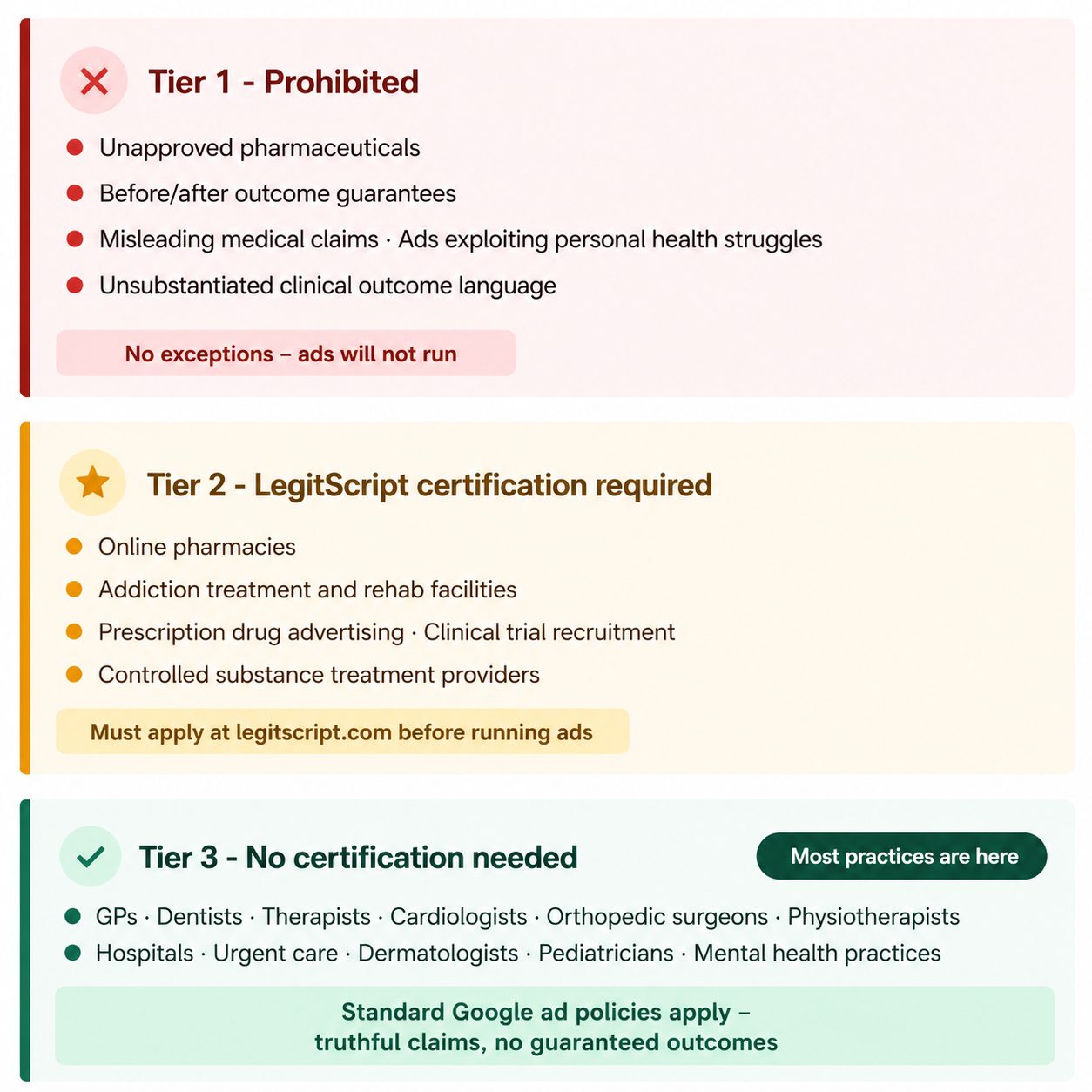
Google’s health advertising policy operates on a three-tier structure. Understanding which tier your practice falls into determines exactly what you need to do, and what you don’t (support.google.com, 2025).
Tier 1: Outright Prohibited (No Exceptions):
- Unapproved pharmaceuticals or supplements with unsubstantiated medical claims
- Before/after imagery that implies guaranteed surgical or treatment results
- Misleading medical claims (“cure your diabetes in 30 days”)
- Ads that exploit personal health struggles for shock value
Tier 2: Restricted Content Requiring LegitScript Certification:
- Online pharmacies
- Addiction treatment and rehabilitation services
- Prescription drug advertising
- Clinical trial recruitment
Tier 3: Additional Requirements, No Certification Needed:
- Healthcare services that must comply with standard Google policies around truthful claims and appropriate messaging
What is your concern: common disapproval triggers that apply across the board.
Common Google Ads disapproval triggers for healthcare:
- Superlatives without substantiation (“best orthopedic surgeon in Dallas” fine if you can prove it; not fine if it’s a claim you can’t back up)
- Vague or exaggerated weight loss claims (“lose 30 pounds in 30 days”)
- Unapproved or experimental treatment language (“stem cell therapy cures arthritis”)
- Implying the viewer has a specific health condition in a targeting or messaging context
If your ads are landing in “Eligible (Limited)” status on Google, this is normal for healthcare; it’s not a penalty. Google automatically classifies health-related services as sensitive, meaning some targeting restrictions apply by default (ehmresults.com, 2025). Your goal isn’t “full eligibility,” it’s avoiding “Not Eligible,” which blocks your ads from running entirely. Review Google’s official healthcare and medicines advertising policies
Meta’s Health Advertising Restrictions
In January 2022, Meta removed detailed health-based targeting options from its advertising platform. This was a significant change that still catches healthcare advertisers off guard. Here’s what changed and how to adapt. No longer available on Meta (transparency.meta.com, 2022):
- Targeting by health condition interest (e.g., “people interested in diabetes management”)
- Disability status targeting
- Medical treatment interest categories
- Specific medication or condition-based audiences
Still fully available:
- Age, gender, and geographic demographics
- Broad interest categories (fitness, wellness, nutrition, healthy living)
- Lookalike audiences built from existing patient lists (with appropriate HIPAA safeguards applied)
- Retargeting website visitors (with a compliant pixel setup
- Custom audiences from first-party CRM data
Additional Meta restrictions for healthcare ads:
- Before/after imagery is prohibited
- Ad copy cannot imply that the viewer has a specific health condition (“Do you struggle with anxiety?” is a violation)
- Landing pages cannot use health condition-based URL parameters that could identify user’s health status
The right response to Meta’s restrictions isn’t to abandon the platform; it’s to shift toward first-party audience strategies and demographic-based targeting, which remain highly effective for local patient acquisition and appointment-booking campaigns. Review Meta’s health and wellness advertising standards.
HIPAA and Paid Advertising: What You Need to Know
The most important clarification upfront: HIPAA doesn’t regulate your PPC ads themselves. It regulates the data that flows around those ads.
The risk area is conversion tracking. Standard Google and Meta tracking pixels fire when a page loads, and they can inadvertently capture Protected Health Information (PHI); for example, a page URL that includes a health condition (/appointments/depression-therapy), a form submission that includes a patient name alongside a diagnosis, or health-condition data inferred from user interactions on your site (gatorworks.net, 2025).
This creates HIPAA exposure because that data flows to Google and Meta, and here’s the key fact: neither Google Ads nor Meta signs a Business Associate Agreement (BAA) (paubox.com, 2026). A BAA is a contract required under HIPAA between a covered entity (your practice) and any vendor that may access PHI. Without a BAA, transmitting PHI to these platforms creates legal liability (hhs.gov, 2024).
This is why standard pixel tracking is problematic for healthcare advertisers, and why the tracking section of this guide matters as much as the campaign strategy section.
Quick Reference: What’s Restricted, What’s Not
| Practice / Ad Type | Restricted? | What Applies |
| General medical practice (GP, dentist, therapist, physio) | Low | Standard Google/Meta ad policies; no LegitScript required |
| Hospital system | Low–Moderate | Standard policies; personalized health targeting limits on Meta |
| Online pharmacy | High | LegitScript certification required on Google |
| Addiction rehab facility | High | LegitScript certification required; additional scrutiny on both platforms |
| Telehealth provider | Moderate | State-by-state targeting considerations; HIPAA tracking requirements |
| Medical device company | Moderate | FDA claim restrictions; no unapproved medical device claims |
| Clinical trial recruitment | High | LegitScript certification required on Google; strict IRB and platform guidelines |
Restriction classifications based on (support.google.com, 2025), (legitscript.com, 2025), and (ehmresults.com, 2025).
Healthcare PPC Strategy: How to Run Campaigns That Actually Convert
Knowing the rules is the foundation. Now here’s how to build ppc for healthcare campaigns that go beyond compliance and drive patient acquisition.
1. Target by Patient Intent, Not Just Search Volume
The biggest mistake in ppc for healthcare is bidding on high-volume keywords without understanding where the searcher is in their decision journey. A patient searching “symptoms of knee pain” is not the same as one searching “orthopedic surgeon near me,” but both searches show up in keyword tools with volume numbers.
Map your keyword strategy to the three stages of the patient journey:
| Journey Stage | Intent | Example Keywords (Orthopedics) | Bidding Priority |
| Awareness | Informational | “symptoms of knee pain,” “what causes hip stiffness,” “how to treat a rotator cuff tear” | Lower bids; educate and capture |
| Consideration | Evaluating options | “orthopedic specialist vs. sports medicine,” “best treatment for torn meniscus,” “minimally invasive knee surgery” | Mid bids; differentiate your practice |
| Decision | Ready to act | “orthopedic surgeon near me accepting new patients,” “book knee replacement consultation,” “orthopedic clinic open Saturday” | Highest bids; direct CTA |
Decision-stage keywords are more expensive per click but convert at dramatically higher rates. Use separate ad groups for each stage; different messaging, different landing pages, different bids.
Long-tail keywords are especially powerful in healthcare. “Back pain doctor near me” gets more volume than “minimally invasive lumbar discectomy specialist Chicago,” but the second query comes from someone who knows exactly what they need and is much closer to booking an appointment. Don’t ignore long-tail because of low volume.
2. Segment Campaigns for Patients vs. Healthcare Professionals
Patients and healthcare professionals (HCPs) search in completely different languages. A hospital promoting a surgical technique needs entirely separate campaigns; one for patients (“minimally invasive hip replacement, faster recovery”), one for referring physicians (“clinical outcomes data, hip arthroplasty, referral pathway”).
Different platforms, different copy tone, different landing pages, different success metrics.
For HCP-focused campaigns, LinkedIn Ads is worth serious consideration alongside Google. Volume is lower, but professional precision is significantly higher; you can target by job title (cardiologist, hospitalist, GP), institution, and specialty. The CPC is higher, but for B2B referral-generation goals, the audience quality justifies it.
For patient campaigns, Google Search and Local Services Ads remain the highest-intent channels. Meta works best for top-of-funnel awareness and retargeting.
3. Geo-Targeting: Make Local Work for You
Most medical practices serve a defined geographic catchment area. Smart geo-targeting is one of the highest-leverage, lowest-complexity optimizations in ppc for doctors.
Practical execution:
- Radius targeting: Set your primary radius around your clinic location, then bid more aggressively within the inner radius (closest patients are most likely to attend)
- Bid adjustments by ZIP code: Review which postcodes generate actual appointments in your patient data, then increase bids for those areas
- Location extensions: Ensure your address, phone number, and hours appear directly in the ad; this drives calls and direction-seeking clicks
- Google Local Services Ads: For local practices, LSAs deserve a dedicated budget. They’re pay-per-lead, carry Google’s verified badge, and show above standard paid search results
Paid local targeting works best when your organic local presence is already solid; if patients see your ad but find an incomplete GBP or inconsistent directory listings when they click through, you’re paying for traffic that doesn’t convert. Our guide to local SEO for healthcare covers how to build that foundation.
A practical budget rule: allocate 80% of your geo-targeted budget to your proven high-converting geographic zones, and 20% to testing adjacent areas where you’d like to grow patient volume.
4. Write Ad Copy That Converts Without Getting Disapproved
This is where many healthcare campaigns fail twice: once by writing copy that gets disapproved, and again by writing overly cautious copy that doesn’t convert.
What to avoid (support.google.com, 2025):
- Guaranteed outcomes: “Cure your back pain for good”
- Unsupported superlatives: “The best orthopedic surgeon in New York”
- Implying diagnosis: “Do you have anxiety?”
- Before/after framing: “See results in 30 days”
What works:
| Non-Compliant Version | Compliant, High-Converting Version |
| “Best knee surgeon in Dallas; guaranteed results” | “Board-certified orthopedic surgeon; same-day appointments available” |
| “Cure your back pain today” | “Minimally invasive back treatment; most patients return to work in days” |
| “Do you have depression? We can help.” | “Compassionate mental health care; accepting new patients, most insurance accepted” |
| “Before & After: see what we’ve done for others” | “4.9 star rating on Google; read our 200+ patient reviews” |
The strongest performing elements in healthcare ad copy, consistently:
- Board certifications and training credentials
- Appointment availability (“Same-day,” “Weekend appointments”)
- Insurance acceptance (“Accepting Blue Cross, Aetna, United”)
- Trust signals (years in practice, patient review count)
- Specific, clear calls-to-action (“Book a free consultation,” “Call now”)
5. Build Landing Pages That Convert Healthcare Visitors
Sending paid healthcare traffic to your homepage is one of the most common and most expensive mistakes in healthcare PPC marketing. Every ad group should have a dedicated landing page matched to the specific keyword and intent.
A high-converting healthcare landing page needs:
- Provider credentials above the fold: Photo, board certification, years of experience; patients need to trust who they’re booking with before they scroll
- Clear, specific service description: What condition do you treat? What does the process look like? What can the patient expect?
- Real patient testimonials: Social proof is essential in healthcare. Just be careful, testimonials cannot include specific medical outcome claims (e.g., “Dr. Smith cured my cancer”)
- HIPAA-compliant contact form: Do not use a standard embedded form that sends data to third-party tools without a BAA in place
- Fast mobile load time: Healthcare searches are heavily mobile; a one-second delay in mobile load time reduces conversions significantly
- Single, prominent CTA: One action per page; “Book an appointment,” “Call our office,” or “Request a callback.”
Resist the urge to include everything about your practice on the landing page. The goal is conversion, not information overload.
6. Bid Strategy and Budget Allocation
Start with Manual CPC when launching new campaigns. Manual bidding gives you visibility and control while you gather conversion data, essential before handing optimization to an algorithm.
Transition to Smart Bidding (Target CPA or Target ROAS) once you’ve accumulated sufficient conversion history. For healthcare, Target CPA is typically the more relevant strategy since the goal is an appointment booking, not a product purchase. Target CPA can function with as few as 15 conversions per month, but performs best at 30+ (netpeak.us, 2025).
Seasonal budget planning matters in healthcare. Key periods to increase budgets:
- January: Elective procedures (new year, new health goals), new insurance plan activation
- Spring: Allergy-related specialties peak
- Fall: Annual checkups, open enrollment season
Don’t overlook ad scheduling. Review your conversion data by hour and day. Many healthcare practices see their highest phone call volumes during business hours on weekdays, which means you may want to concentrate your budget during those windows and reduce spend overnight.
HIPAA-Compliant Conversion Tracking: The Part Most Guides Skip
Most healthcare practices are unknowingly running conversion tracking in a way that creates HIPAA exposure. This is the section most healthcare PPC guides skip entirely; and skipping it is the most legally consequential mistake a covered entity can make in digital advertising.
Why Standard Google and Meta Pixels Are Problematic for Healthcare
Standard tracking pixels from Google and Meta fire when a page loads and can capture PHI embedded in user interactions. Examples of how PHI enters your tracking data (gatorworks.net, 2025):
- A URL like /appointments/depression-therapy reveals a user’s health condition
- A form submission on a condition-specific page associates a patient name with a diagnosis
- Page-level tracking on a /hiv-testing-results confirmation page captures health status data
This data flows directly to Google and Meta. Because neither platform signs a BAA with healthcare advertisers, this transmission creates HIPAA liability, even if you didn’t intend to share patient data. Google Ads is explicitly not covered under Google’s BAA (paubox.com, 2026), making standard pixel implementation a meaningful compliance risk for covered entities.
What Compliant Tracking Looks Like
Server-side tracking is the most robust solution. Rather than firing pixels directly from the browser, events are processed on your server first, where PHI can be stripped before the data is sent to Google or Meta. This gives you conversion measurement without patient data exposure (istudiosmedia.com, 2026).
HIPAA-compliant analytics middleware; tools like Freshpaint or HubSpot Healthcare (with a signed BAA); sit between your website and ad platforms, automatically stripping PHI before it reaches Google or Meta (cardinaldigitalmarketing.com, 2025). These tools are specifically designed for healthcare advertisers.
Careful event configuration is the minimum viable approach if you’re using standard pixels and can’t immediately implement server-side tracking. Only fire conversion events on pages or actions that cannot capture PHI. Tracking a “Thank You page view” after appointment booking (where no patient data appears in the URL or page content) is safer than tracking the form submission itself (ehmresults.com, 2025).
This area of compliance is evolving rapidly. The guidance here reflects current best practices, but this is not legal advice; consult a healthcare attorney for your specific situation.
Measuring Healthcare PPC Performance
Effective measurement starts with knowing what “good” actually looks like in the healthcare context.
Key benchmarks for Google Ads for healthcare (localiq.com, 2025):
- Average CPC for healthcare: $2.62–$8.31 (varies significantly by specialty; dental and surgical specialties trend higher)
- Average conversion rate for healthcare search ads: 8.09%
- Average cost per lead (CPL): $66.02 for healthcare search ads
For additional context, healthcare CPLs from Facebook/Meta Ads average $82–$103 depending on specialty (superads.ai, 2025); making Google Search the more cost-efficient channel for most patient-acquisition goals.
These are averages across the full industry. Competitive specialties in major metros (cosmetic surgery, fertility, bariatric) will see significantly higher CPCs and CPLs (promodo.com, 2025). The more important metric is your Cost Per Acquisition (CPA); the cost to generate an actual booked appointment, rather than a raw lead, since not all leads convert to appointments.
For practices with clear patient lifetime value data, target a minimum 3:1 ROAS. A patient who generates $2,000–$5,000 over their relationship with your practice justifies a significantly higher CPL than a one-time transaction. For more on evaluating digital marketing ROI in this context, see our related benchmarks resource.
Reporting cadence:
- Weekly: Spend, CTR, CPL; catch underperformance before it drains budget
- Monthly: CPA trends, campaign structure review, ad copy performance
- Quarterly: Audience and keyword refresh, competitive landscape review, landing page testing assessment
Remember: in healthcare, “conversions” are almost always phone calls or appointment bookings, not page views. If your tracking is only capturing page views, your optimization decisions are being made on incomplete data. Call tracking software (like CallRail) integrated with your Google Ads account is essential for accurate measurement.
Common Healthcare PPC Mistakes to Avoid
- Sending paid traffic to the homepage. Your homepage is designed for everyone. Your landing page should be designed for one specific patient with one specific need. This mistake alone can cut conversion rates significantly (netpeak.us, 2025).
- Skipping negative keywords. Without a robust negative keyword list, healthcare ads show for job seekers (“nursing jobs near me”), students (“medical school requirements”), and bargain hunters (“free dental clinic”). Add negatives before you launch, not after you’ve wasted budget.
- Ignoring mobile bid adjustments. Healthcare searches are heavily mobile. If you haven’t analyzed your conversion rate and CPA by device and adjusted bids accordingly, you’re likely overpaying for desktop conversions while underinvesting in mobile.
- Running ads without conversion tracking. Making budget decisions based on clicks alone is like treating a patient without diagnostic data. Set up call tracking and form submission tracking before spending a dollar on ads.
- Using the Meta health condition targeting that was removed in 2022. Meta’s elimination of detailed health-based targeting options (emarketer.com, 2022) still catches many advertisers and agencies off guard. If your Meta strategy depends on detailed health condition targeting, it needs to be rebuilt around first-party data and demographic audiences.
- Running a single ad creative indefinitely. Ad fatigue is real, and healthcare audiences are no exception. Rotate creative regularly, test headline variations, and use Google’s responsive search ad format to let the platform identify your best-performing combinations.
Our Expertise in Healthcare PPC
At Scopic Studios, our healthcare PPC services cover the full campaign lifecycle: strategy, ad creation, dedicated landing pages, HIPAA-aware tracking setup, and ongoing performance reporting.
Our Google-certified PPC team has direct experience in healthcare marketing services as a named vertical, alongside fitness, entertainment, and real estate. We understand that healthcare campaigns require a different approach; not just from a compliance standpoint, but in how patients make decisions, what messaging earns trust, and what conversion actions matter.
One example: our work with JobSiteCare, a telemedicine and occupational health provider. Scopic Studios managed their PPC campaigns (including LinkedIn Ads) alongside SEO and web development, driving a revamped digital presence and measurable growth in patient acquisition.
We don’t make compliance guarantees; no honest agency should. But we do bring a deep understanding of the healthcare advertising landscape, built through hands-on campaign work in the vertical. If you’re curious whether Google Ads are worth it for your specific practice type, that resource is a useful starting point alongside this guide.
If you’re looking to grow patient volume through paid advertising, explore our healthcare PPC agency services, or learn more about current healthcare marketing trends to build context for your broader strategy.
Conclusion and Key Takeaways
Healthcare PPC is not as restricted as most providers fear, and not as simple as most generic PPC guides suggest. The practices that win in this space are the ones that understand exactly which rules apply to them, build campaigns around patient intent rather than just keyword volume, take conversion tracking seriously, and invest in dedicated landing pages that earn trust.
The practices that invest in understanding this landscape and building compliant, well-structured campaigns have a clear competitive advantage over the many providers who aren’t advertising at all, or who are running campaigns that don’t convert.
Ready to build healthcare PPC campaigns that actually deliver patients? Talk to our team.
FAQs
What is medical PPC?
Medical PPC is paid digital advertising; on Google, Meta, Microsoft, and YouTube, used by healthcare providers to attract patients and drive appointment bookings. Unlike general PPC, it involves stricter compliance requirements, higher average CPCs, and longer patient decision cycles.
Is PPC advertising HIPAA compliant?
PPC ads themselves aren’t regulated by HIPAA; the risk is in the data that flows around them (hhs.gov, 2024). Standard Google and Meta pixels can capture Protected Health Information (PHI) from URLs and form submissions, and since neither platform signs a Business Associate Agreement (BAA), this creates HIPAA exposure (paubox.com, 2026). Server-side tracking or a HIPAA-compliant middleware tool like Freshpaint is the recommended fix.
How much does healthcare PPC cost?
On Google, the average healthcare CPL is $66.02, the conversion rate is 8.09%, and CPCs range from $2.62 to $8.31 (localiq.com, 2025). On Meta, CPLs average $82–$103 depending on specialty (superads.ai, 2025). Competitive specialties in major metros run significantly higher (promodo.com, 2025). See our PPC advertising statistics for cross-industry context.
Does a general medical practice need LegitScript certification?
No. LegitScript is only required for online pharmacies, addiction treatment facilities, prescription drug advertising, and clinical trial recruitment (legitscript.com, 2025). GPs, dentists, therapists, and most specialist clinics can advertise on Google without it (ehmresults.com, 2025).
What is the best PPC platform for healthcare providers?
Google Search Ads are the highest-priority channel for patient acquisition due to search intent. Google Local Services Ads are ideal for local practices; pay-per-lead with a verified badge. Meta Ads work well for awareness and retargeting using demographic and first-party audiences. LinkedIn Ads suit HCP-focused campaigns targeting referring physicians. Most practices benefit from combining Google Search and Meta, with LSAs as a complement. See our patient lead generation guide for more.
What are the best practices for PPC campaigns in healthcare?
Align keywords to the patient journey (awareness, consideration, decision) with separate ad groups and dedicated landing pages for each. Write copy around credentials and availability; not outcomes claims; within Google’s policies (support.google.com, 2025). Set up HIPAA-compliant conversion tracking before scaling spend. Segment patient and HCP campaigns separately, use geo-targeting for local growth, and review performance weekly against industry benchmarks (localiq.com, 2025).
How do I track PPC conversions without violating HIPAA?
Three approaches:
- Server-side tracking: strip PHI on your server before sending data to ad platforms (istudiosmedia.com, 2026).
- HIPAA-compliant middleware like Freshpaint, which automatically removes PHI and will sign a BAA (com, 2025).
- Careful pixel configuration; only fire events on pages that cannot capture PHI, such as a generic “thank you” confirmation page. Add call tracking (e.g., CallRail) to capture phone conversions accurately. For more, see our digital marketing ROI
About Healthcare PPC Guide
This guide was written by Meri Tiratsyan and reviewed by Sonja Somborac, SEO Project Manager at Scopic Studios.
Scopic Studios delivers exceptional and engaging content rooted in our expertise across marketing and creative services. Our team of talented writers and digital experts excel in transforming intricate concepts into captivating narratives tailored for diverse industries. We’re passionate about crafting content that not only resonates but also drives value across all digital platforms.